Facts
The petitioner was enrolled in the Central Industrial Security Force (CISF) on 4 July 1994 and had received several rewards but was also subjected to twelve prior punishments for misconduct and indiscipline.
Source reference: para. 2, 21On 4 February 2013, while detained for night-shift duty, he quarrelled with Constable B. Shekhar, and the altercation escalated into a physical scuffle in the CISF barracks.
Source reference: para. 3, 25It was alleged that Shekhar picked up a wood-cutter and that the petitioner picked up his service rifle; the incident was recorded in General Diary entries.
Source reference: para. 3, 25A charge-sheet dated 1 July 2013 framed two charges: first, that the petitioner had engaged in an undisciplined quarrel; and second, that despite twelve previous punishments, he had failed to reform his conduct.
Source reference: para. 4Following a departmental enquiry, both charges were held proved.
Source reference: para. 5The Disciplinary Authority imposed the major penalty of compulsory retirement with eligible pensionary benefits under Rule 34 of the CISF Rules, 2001.
Source reference: para. 6The petitioner’s statutory appeal and revision were dismissed on 28 February 2014 and 27 July 2014, respectively.
Source reference: paras. 7–8He thereafter invoked the writ jurisdiction of the High Court, challenging the disciplinary orders and seeking reinstatement with consequential benefits.
Source reference: para. 9Issues
Whether the disciplinary authorities were legally entitled to take the petitioner’s twelve previous punishments into account while determining the penalty, when such past conduct had been expressly incorporated as a separate charge?
Source reference: para. 24Whether the findings of guilt were based on no evidence, hearsay, or otherwise perverse findings warranting interference under Article 226 of the Constitution?
Source reference: paras. 25, 31Whether the petitioner’s quarrel and physical confrontation with a fellow CISF member, including the alleged resort to a service weapon, constituted misconduct notwithstanding the absence of a specific statutory definition of “misconduct” in the CISF Rules?
Source reference: para. 32Whether the punishment of compulsory retirement was legally infirm or disproportionate in the circumstances of the case?
Source reference: paras. 15, 30, 34Law Applied
The Court applied the limited scope of judicial review over departmental enquiries: a writ court does not sit as an appellate authority or reappreciate evidence, and interference is justified where there is breach of natural justice, procedural illegality, or a finding based on no evidence or evidence that no reasonable person could accept.
Source reference: para. 25Relying on Kuldeep Singh v. Commissioner of Police, the Court held that a finding is perverse when based on no evidence, but a finding supported by some evidence cannot be disturbed merely because another view is possible.
Source reference: para. 31Under Article 20(2) of the Constitution, double jeopardy prohibits prosecution and punishment more than once for the same offence; however, considering past disciplinary conduct as a factor in assessing present misconduct and penalty is not a second punishment where that conduct has been separately charged and the employee has been given notice and an opportunity to respond.
Source reference: para. 26Applying Union of India v. Subrata Nath, the Court held that past conduct may be considered at the penalty stage when it has been made part of a specific charge.
Source reference: paras. 17, 27–29The Court further applied Rule 34 of the CISF Rules, 2001 concerning major penalties and Rule 54 concerning revision.
Source reference: paras. 6, 8It held that misconduct need not have a specific statutory definition where the alleged conduct—physical confrontation within an armed and disciplined force and resort to a service weapon—is inherently incompatible with the discipline expected of CISF personnel.
Source reference: para. 32Reasoning
The Court found that the departmental proceedings complied with natural justice and disclosed no procedural irregularity.
Source reference: para. 25Although the prosecution did not establish the alleged fracture through medical or documentary evidence, the evidence sufficiently established that the petitioner had quarrelled and physically confronted Constable Shekhar; the petitioner’s challenge that the case rested solely on hearsay therefore did not demonstrate a finding based on no evidence.
Source reference: paras. 22, 31The Court rejected the Article 20(2) argument because the twelve prior punishments were not resurrected for separate punishment; they had been expressly included as Charge II in the charge-sheet, thereby giving the petitioner notice and an opportunity to contest them.
Source reference: paras. 26–29The petitioner’s conduct was considered particularly serious because it occurred within the CISF and allegedly involved taking up a service rifle, conduct incompatible with the standards of a disciplined armed force.
Source reference: para. 25In light of the proved present misconduct and the petitioner’s repeated prior punishments, the Court found no legal infirmity in the authorities’ decision to impose compulsory retirement.
Source reference: paras. 30, 34Holding
The Court answered the issues against the petitioner.
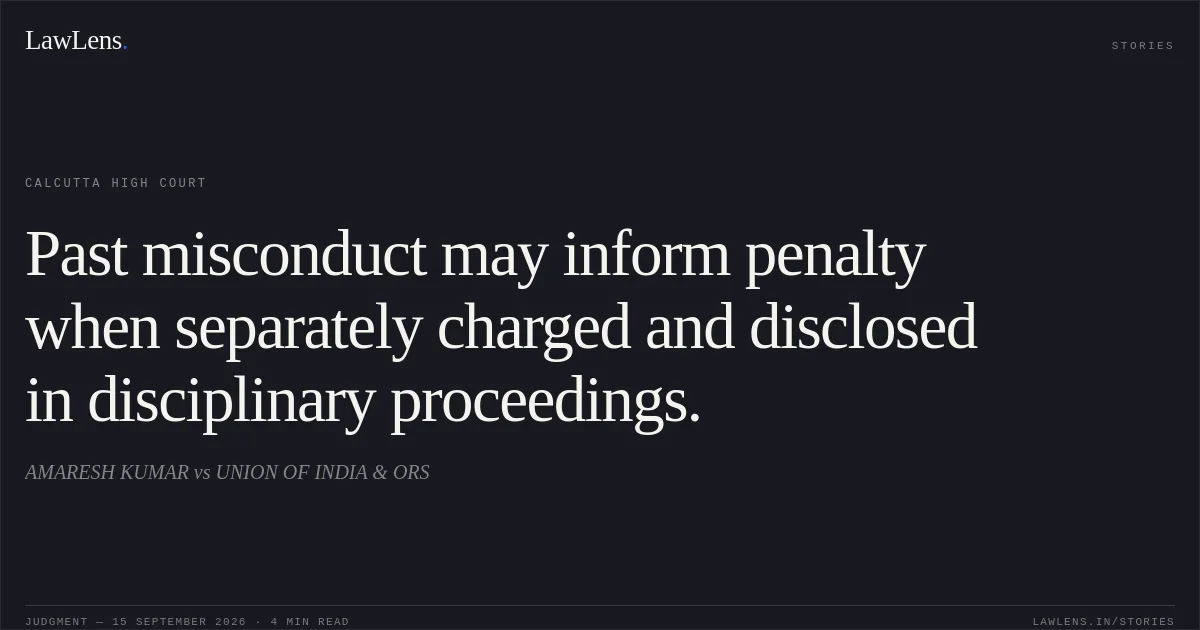
It held that the authorities lawfully considered the petitioner’s previous punishments because they had been separately incorporated into the charge-sheet; the findings of guilt were supported by evidence and were not perverse; and the quarrel and physical confrontation constituted misconduct despite the absence of a statutory definition of that term.
Source reference: paras. 29–32The writ petition was dismissed, and the orders imposing compulsory retirement, dismissing the appeal, and rejecting the revision were upheld.
Source reference: para. 34–35CAN 1 of 2022 and all connected applications were disposed of, and any interim order was vacated.
Source reference: paras. 35–36The petitioner’s subsequent prayer for stay of the judgment for four weeks was also rejected.
Source reference: no citationOriginal Court PDF
AMARESH KUMARvsUNION OF INDIA & ORS
Click to open original judgment
Original judgment, available to read, download and summarize on LawLens.in