Facts
The Respondent allegedly engaged the Appellant as a Peon at its Pitampura Branch, Delhi, on 1 August 2001 and terminated his services on 5 March 2010.
Source reference: no citationAfter issuing a protest and demand notice on 26 July 2010, the Appellant raised an industrial dispute.
Source reference: no citationThe Labour Court, in Award dated 10 January 2022 in I.D. No. 118/2012, held that the Appellant had failed to establish an employer–employee relationship with the Respondent and that his termination was not illegal.
Source reference: no citationThe Appellant’s challenge to the Award in W.P.(C) 14988/2022 was dismissed by the learned Single Judge on 8 August 2025 for want of cogent documentary evidence.
Source reference: no citationIn the intra-court appeal, the Division Bench first condoned delays of 306 days in filing and 17 days in re-filing the appeal.
Source reference: pp. 1–2, paras. 1–3The Appellant contended that he had performed perennial work as a casual worker for nearly nine years, had completed the requisite period of continuous service, and was entitled to statutory and constitutional protection.
Source reference: pp. 2–5, paras. 5–13The Respondent disputed any direct employment and relied on the absence of appointment, wage, identity, PF, ESI, or other contemporaneous records.
Source reference: pp. 2–5, paras. 5–13Issues
Whether the Appellant established a direct employer–employee relationship with the Respondent through cogent evidence.
Source reference: p. 5, para. 15Whether the Appellant proved completion of 240 days of continuous service in the twelve months preceding his alleged termination so as to claim protection under Section 25F of the Industrial Disputes Act, 1947.
Source reference: pp. 5–6, paras. 15–18Whether the concurrent findings of the Labour Court and the learned Single Judge warranted interference in the intra-court appeal.
Source reference: p. 5, para. 15Law Applied
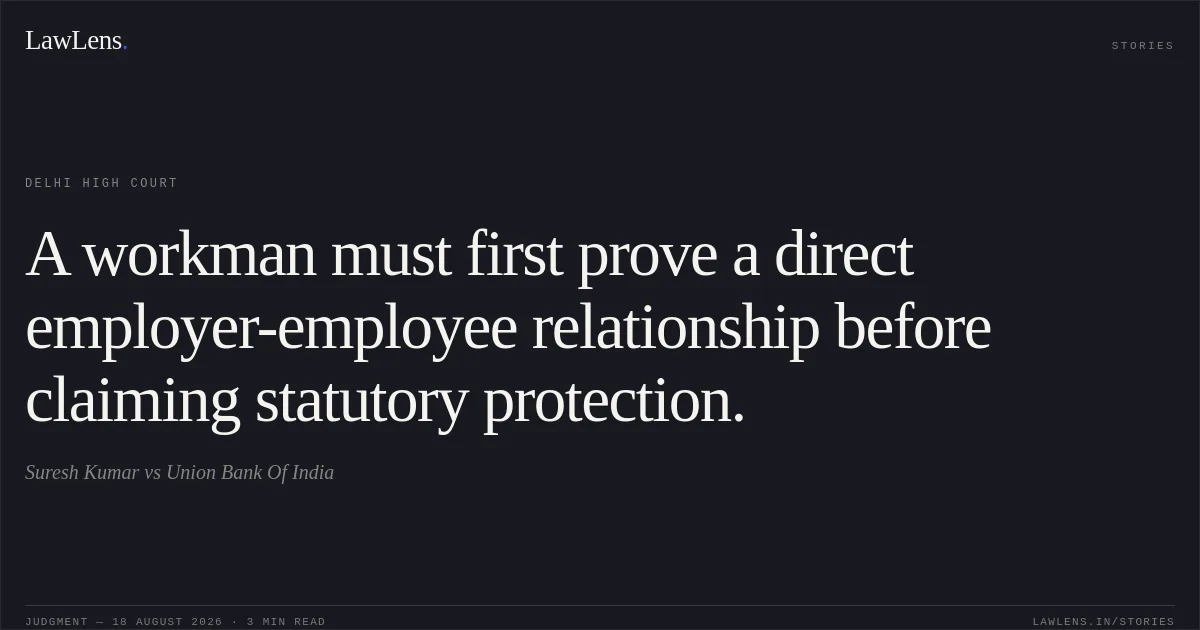
The Court applied the principle that a workman claiming relief under the Industrial Disputes Act, 1947 must first establish the foundational fact of an employer–employee relationship, ordinarily through cogent documentary evidence such as appointment letters, wage records, identity cards, PF/ESI documents, or statutory registers; oral testimony or self-serving affidavits alone are insufficient.
Source reference: p. 6, para. 16The burden of proving 240 days of continuous service also rests initially on the workman, and Section 25F of the Industrial Disputes Act can be invoked only after that requirement is established.
Source reference: p. 6, para. 18The Court considered Article 12 of the Constitution and the principle that a nationalised bank cannot adopt arbitrary “hire and fire” practices, but held that such protection presupposes a proved employment relationship.
Source reference: pp. 3–4, 6–7, paras. 10, 19, 21Royal Western India Turf Club Ltd. v. E.S.I. Corpn., (2016) 4 SCC 521, concerning the wider meaning of “employee” under the Employees’ State Insurance Act, 1948, was held inapplicable without foundational proof under the Industrial Disputes Act.
Source reference: p. 6, para. 19The Court likewise distinguished Bank of India v. O.P. Swarnakar, AIR 2003 SC 858, and Dharam Singh v. State of U.P., 2025 INSC 998, and held that Director, Fisheries Terminal Department v. Bhikubhai Meghajibhai Chavda, (2010) 1 SCC 47, did not shift the evidentiary burden because the Appellant had not made the requisite averment regarding completion of 240 days.
Source reference: p. 6, para. 19Reasoning
The Court found that the Appellant had produced no appointment letter, wage slip, identity card, PF or ESI record, or other contemporaneous service document establishing direct employment by the Respondent.
Source reference: p. 6, para. 17The attendance register relied upon by him was vague and did not demonstrate that it related to regular or directly employed staff rather than casual workers or persons engaged through a contractor.
Source reference: p. 6, para. 17The Appellant also failed to produce muster rolls, wage registers, or equivalent material proving 240 days of continuous service during the relevant twelve-month period.
Source reference: p. 6, para. 18Consequently, the Court held that the preliminary burden remained undischarged and that the evidentiary burden could not shift to the Respondent.
Source reference: no citationSince the existence of employment itself was not proved, the arguments concerning perennial work, Article 12 protection, arbitrary “hire and fire,” and regularisation could not arise for consideration.
Source reference: pp. 6–7, paras. 19–22The concurrent factual findings of the Labour Court and the learned Single Judge were therefore found to be legally sustainable.
Source reference: p. 7, paras. 20–22Holding
The Court held that the Appellant failed to prove a direct employer–employee relationship with Union Bank of India and also failed to establish 240 days of continuous service preceding his termination.
Accordingly, he could not claim protection under Section 25F of the Industrial Disputes Act or invoke constitutional safeguards applicable to established employees.
Source reference: p. 8, paras. 22–23Finding no ground to interfere with the Award dated 10 January 2022 or the judgment dated 8 August 2025, the Division Bench dismissed the appeal.
Source reference: p. 8, paras. 22–23There was no order as to costs.
Source reference: p. 8, paras. 22–23Acts & Sections Cited
1 provisions across 1 statute referred to in this judgment. Linked provisions open on LawLens.
Employees1
Original Court PDF
Suresh KumarvsUnion Bank Of India
Click to open original judgment
Original judgment, available to read, download and summarize on LawLens.in