Facts
Nishant Sureshbhai Patel, aged about 20 years, was employed as a ward boy with Superscan Imaging Centre and was assigned night duty from 8:00 p.m. to 8:00 a.m.
Source reference: paras. 2.1, 6–7During the intervening night of 4–5 October 2011, three persons, including a former employee of the Centre, entered the premises, allegedly looted Rs.1,20,000 kept in a drawer, and killed Nishant by multiple stab injuries and strangulation.
Source reference: paras. 2.1–2.3, 8His parents filed a claim under Section 3 of the Employees’ Compensation Act, 1923, seeking compensation on the ground that the death occurred by an accident arising out of and in the course of employment.
Source reference: paras. 2.4–2.5The employer contended that the death was murder simpliciter, unrelated to employment, and further alleged that the deceased and the accused had consumed liquor and quarrelled.
Source reference: paras. 2.6–2.7The Commissioner awarded Rs.8,45,000 with 12% interest from 5 November 2011, costs, and funeral expenses.
Source reference: paras. 1, 2.8The employer challenged the award under Section 30 of the Employees’ Compensation Act.
Source reference: paras. 1, 2.9Issues
Whether the deceased’s murder constituted an “accident” arising out of and in the course of his employment under Section 3(1) of the Employees’ Compensation Act, 1923, or was merely murder simpliciter unconnected with employment?
Source reference: paras. 9–11, 18Whether the employer established that the deceased was murdered pursuant to a personal altercation after consuming liquor, thereby breaking the causal connection between the employment and the death?
Source reference: paras. 4.1–4.3, 15–16Law Applied
Section 3(1) of the Employees’ Compensation Act, 1923, imposes liability where personal injury or death is caused by an accident arising out of and in the course of employment.
Source reference: para. 10An “accident” means an untoward or unexpected mishap, and a murder may qualify as an employment-related accident depending on the dominant intention behind the felony.
Source reference: para. 11In Rita Devi v. New India Assurance Co. Ltd., (2000) 5 SCC 113, the Supreme Court held that murder intended principally to kill a particular person is murder simpliciter, whereas murder committed incidentally in furtherance of another felonious act may constitute an accidental murder.
Source reference: para. 12Relying on Union of India v. Shantaben Wd/o Vithaldas Gobardas Patel, 1985 (0) GLH 754, and the principles discussed therein, the Court held that a causal connection exists where the employee was required to be at the place of occurrence because of employment and encountered the peril there; the peril need not be exclusive to the employee.
Source reference: para. 17The Court also applied the principle that murder committed during robbery can constitute an accident arising out of employment where the employee was exposed to the risk because of his employment.
Source reference: para. 17Reasoning
The Court found the employment and presence of the deceased at the Centre conclusively established: he was on night duty, and opening the door to persons who knocked during the night was part of his duties.
Source reference: paras. 6.1–6.3, 13–14One of the assailants was a former employee who gained entry with two others, after which Rs.1,20,000 was looted and the deceased was killed.
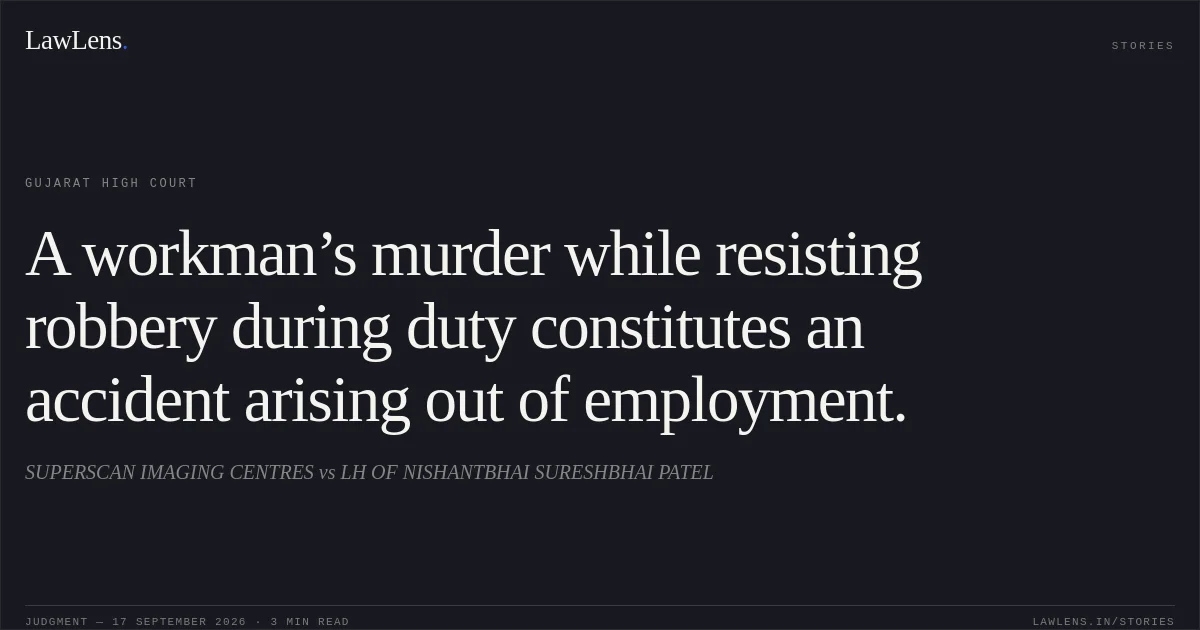
Source reference: paras. 8, 14Applying Rita Devi, the Court held that the dominant felonious act was robbery, while the killing occurred when the deceased resisted or obstructed the looting; therefore, the murder was an accidental murder rather than murder simpliciter.
Source reference: paras. 12, 14–15The employer’s theory of a liquor-fuelled personal altercation was unsupported: the alleged FSL and serological material was not properly proved, the recovery of the liquor bottle was not established through evidence, and no prior animosity between the deceased and the former employee was shown.
Source reference: para. 16The 27 injuries, mostly stab wounds, were more consistent with resistance during the robbery than with the alleged private quarrel.
Source reference: para. 15Since the deceased faced the peril at the workplace while performing his employment duties, the requisite causal nexus under Section 3(1) was established.
Source reference: paras. 17–18Holding
The Court answered the issues in favour of the claimants and held that Nishant’s death was an accident arising out of and in the course of his employment under Section 3(1) of the Employees’ Compensation Act, 1923.
The murder was connected with the robbery occurring at the workplace and was not proved to be a personal murder unrelated to employment.
Source reference: paras. 18–20The appeal was dismissed, and the Commissioner’s award of Rs.8,45,000 with 12% interest, costs, and funeral expenses was upheld.
Source reference: paras. 19–20Any decretal amount deposited before the Commissioner was directed to be paid in full to the claimants, and the record was ordered to be returned to the concerned court.
Source reference: paras. 20–21Acts & Sections Cited
3 provisions across 1 statute referred to in this judgment. Each provision opens on LawLens.
Indian Penal Code, 18603
Original Court PDF
SUPERSCAN IMAGING CENTRESvsLH OF NISHANTBHAI SURESHBHAI PATEL
Click to open original judgment
Original judgment, available to read, download and summarize on LawLens.in