Facts
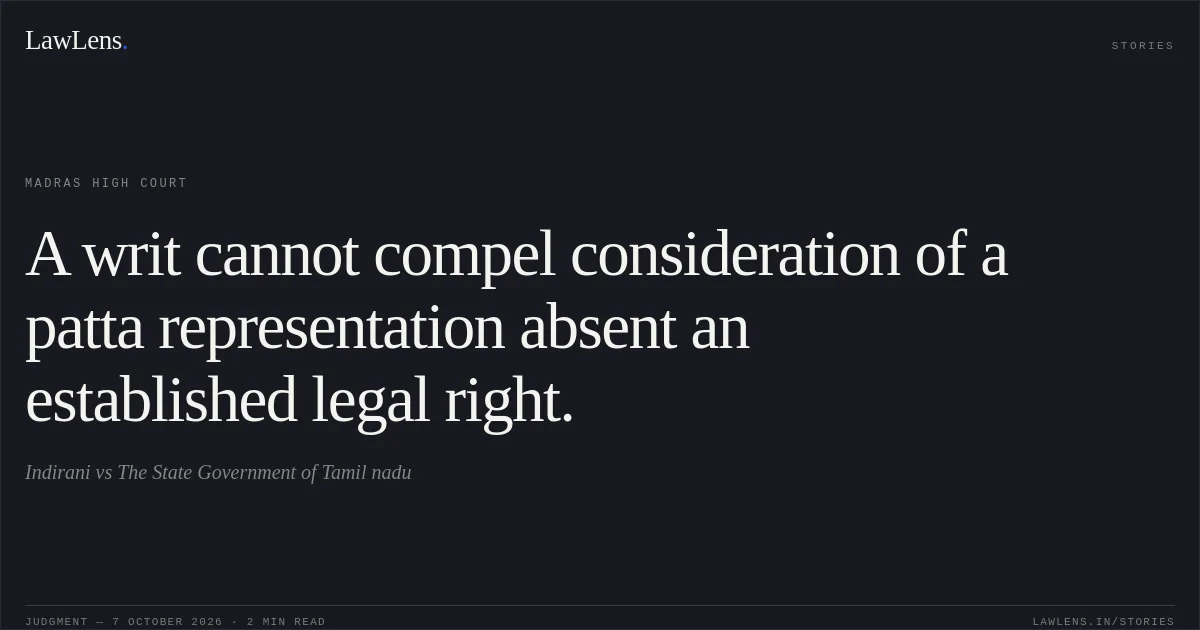
The petitioner sought a direction requiring the respondents to consider her representation for patta over land in Kovilambakkam, stated to be classified as “Meikkal Poramboke,” and also sought compensation for the alleged demolition of her house, structures, household articles, and well.
Source reference: p.1–2The Court recorded that the petitioner’s case concerned a representation dated 10 July 2026, while the prayer referred to a representation dated 1 July 2026.
Source reference: p.2–3The petition was brought under Article 226 of the Constitution.
Source reference: p.2Issues
1. Whether the Court should direct the respondents to consider the petitioner’s representation for patta when she had not established a right to the land and it was classified as “Meikkal Poramboke”.
Source reference: p.3–4, 82. Whether the petitioner could establish a claim to patta over the disputed land through a writ petition, rather than by proving title or ownership before the competent civil court.
Source reference: p.4–5Law Applied
Article 226 relief, including a direction to consider a representation, is not to be granted routinely where the petitioner has not established a legal right or its infringement.
Source reference: p.3–4Section 3 of the Tamil Nadu Patta Passbook Act provides for issuance of a patta passbook to an owner upon application; Rule 4 of the Tamil Nadu Patta Passbook Rules prescribes the procedure, including a summary enquiry by the Tahsildar under Rule 4(3).
Source reference: p.4The Court stated that claims of title or ownership over land classified as “Meikkal Poramboke” must be established before the competent civil court.
Source reference: p.4It also referred to Revenue Standing Order No. 21 concerning assignment of house sites and stated that occupation of Natham land does not, by itself, confer an automatic right; unauthorised occupation may be addressed under the Tamil Nadu Land Encroachment Act, 1905.
Source reference: p.4–5The Court further held that public lands, including lands under the classifications discussed, are to be protected and used in the public interest.
Source reference: p.5–6Reasoning
The petitioner’s own case acknowledged that the subject land was classified as “Meikkal Poramboke,” and she had not established ownership or another legal right warranting relief under Article 226.
Source reference: p.3–4The Court considered that a direction merely requiring the authorities to decide the representation would not resolve the underlying claim and could lead to further litigation.
Source reference: p.3Because the claim concerned title to land classified as public land, the Court held that the petitioner would need to establish any asserted ownership before the competent civil court; mere occupation would not create an automatic entitlement to patta.
Source reference: p.4–6It therefore declined to issue the requested direction.
Source reference: p.8Holding
The Court dismissed the writ petition, declining to direct the respondents to consider the representation for patta.
It made no order as to costs and closed the connected miscellaneous petition.
Source reference: p.8The petition also sought compensation for the alleged demolition and loss of property, but the judgment does not separately analyse or grant that relief.
Source reference: p.2, 8Acts & Sections Cited
2 provisions across 1 statute referred to in this judgment. Each provision opens on LawLens.
Tamil Nadu Patta Pass Book Act, 1983.2
Original Court PDF
IndiranivsThe State Government of Tamil nadu
Click to open original judgment
Original judgment, available to read, download and summarize on LawLens.in