01Facts
The dispute arose from a 2001 Concession Agreement for the development, operation and maintenance of a State Highway.
After Viva Highways invoked arbitration, MPRDC maintained that the dispute fell within the exclusive jurisdiction of the Tribunal under the Madhya Pradesh Madhyastham Adhikaran Adhiniyam, 1983.
The Sole Arbitrator rejected MPRDC’s jurisdictional objection under Section 16 of the Arbitration and Conciliation Act, 1996.
Following an earlier direction of the High Court to decide jurisdiction as a preliminary issue, the Arbitrator again rejected the objection by order dated 25 February 2025.
¶ 2–5, 24MPRDC challenged that decision under Section 34; the Commercial Court held the application premature and not maintainable because the jurisdictional ruling was not an award.
¶ 6, 13Although the writ petition initially challenged an order extending the arbitral mandate, the challenge during arguments was directed to the Commercial Court’s Section 34 ruling.
¶ 1The respondents objected that the writ was not maintainable and that MPRDC had a statutory remedy under Section 37.
¶ 9–1002Issues
i.1. Whether the Arbitrator’s final determination of the jurisdictional issue, made as a preliminary issue pursuant to the High Court’s direction, could be treated as an interim award amenable to challenge under Section 34 of the 1996 Act.
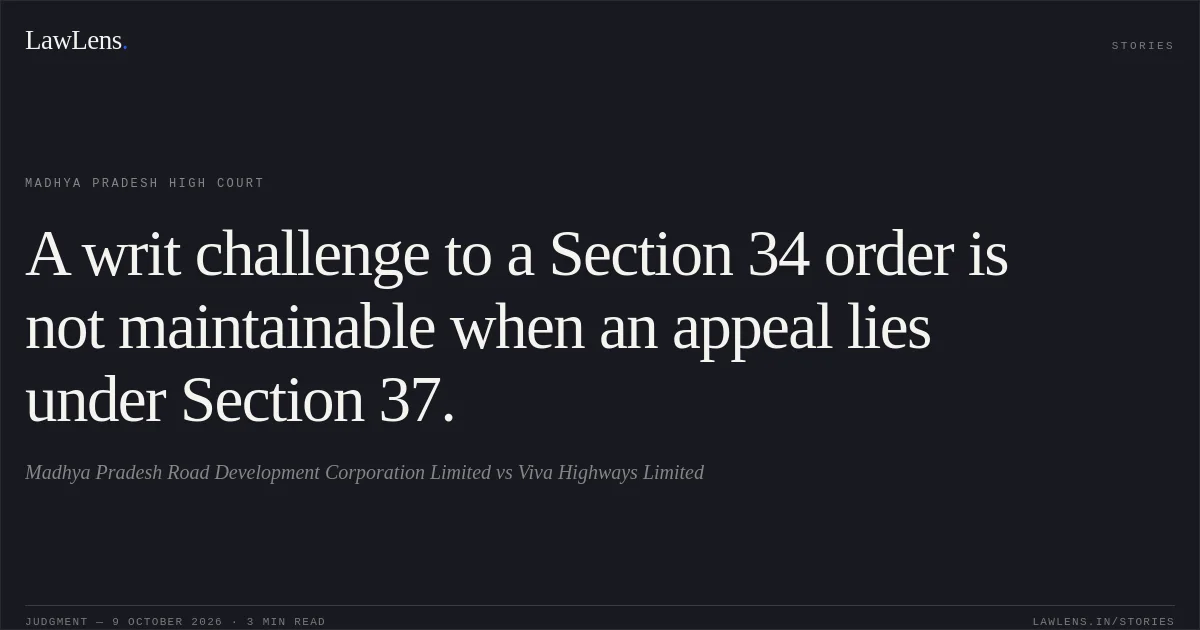
¶ 16–17, 21–29ii.2. Whether a writ petition under Articles 226 or 227 was maintainable against the Commercial Court’s order rejecting the Section 34 application, or whether MPRDC had to pursue an appeal under Section 37.
¶ 16, 33–3603Law Applied
Under Sections 16(5) and 16(6) of the Arbitration and Conciliation Act, 1996, where an arbitral tribunal rejects a plea that it lacks jurisdiction, it continues the proceedings and the objection ordinarily remains available for challenge under Section 34 after the final award; an order rejecting a Section 16 plea is generally not independently challengeable under Section 34.
¶ 18–20, 27–28However, a determination of a discrete preliminary issue that finally disposes of that issue and will not be reconsidered in the final award may, in the circumstances identified in MCM Worldwide (P) Ltd. v. Construction Industry Development Council, be treated as an interim award.
¶ 18–20, 27–28Section 37(1)(c) provides an appeal from an order setting aside or refusing to set aside an arbitral award, while Section 37(2) provides an appeal from an arbitral tribunal’s acceptance—not rejection—of a Section 16 jurisdictional plea.
¶ 18–20, 27–28, 35–36The Court also applied the principle of minimal judicial intervention in arbitration and the limited, exceptional exercise of constitutional supervisory jurisdiction, relying on Manash Kamal Bezboruah, Tarini Prasad Mohanty, Deep Industries and Gayatri Projects.
¶ 20, 31–33Provisions in the judgment · 14 · Linked ones open on LawLens
Arbitration and Conciliation Act, 1996 13 provisions
Section 2Section 5Section 8Section 9Section 11Section 16Section 17Section 31Section 33Section 34Section 37Section 75Section 81Code of Civil Procedure, 1908 Section 115
04Reasoning
The Court distinguished an ordinary rejection of a Section 16 objection—which must generally await the final award—from the present procedural history.
¶ 24–29, 32–34MPRDC had raised its objection, and the High Court had directed the Arbitrator to decide jurisdiction first; the Arbitrator then conclusively decided the issue against MPRDC.
¶ 24–29, 32–34Given that the arbitration had reached final hearing and jurisdiction would not be adjudicated again, the Court treated the ruling as an interim award capable of challenge under Section 34, applying MCM Worldwide.
¶ 24–29, 32–34It therefore held that the Commercial Court had erred in rejecting the Section 34 application as premature.
¶ 24–29, 32–34But because the Commercial Court’s order refusing to set aside the award was appealable under Section 37(1)(c), and the Arbitrator had rejected rather than accepted the jurisdictional plea, Section 37(2) did not provide a direct appeal from the Arbitrator’s ruling.
¶ 35–36The available statutory appeal from the Commercial Court’s order meant that the writ petition should not be entertained.
¶ 35–3605Holding
The High Court held that the Arbitrator’s preliminary determination of jurisdiction, in the circumstances of this case, was an interim award amenable to challenge under Section 34.
¶ 34Nevertheless, the challenge to the Commercial Court’s order had to be pursued by a statutory appeal under Section 37, not by writ petition.
¶ 36The writ petition was dismissed as not maintainable, with no order as to costs.
¶ 36–37Original Court PDF
Madhya Pradesh Road Development Corporation LimitedvsViva Highways Limited
Click to open original judgment
Original judgment, available to read, download and summarize on LawLens.in