Facts
The appellants were arrayed as respondent Nos. 5 and 7 in a writ petition concerning a complaint allegedly made against them in relation to a dispute involving construction of the “Golden Aura Hotel.”
Source reference: paras. 1, 5; pp. 1, 3The Writ Court disposed of the petition ex parte on the first date of hearing and directed the police to conduct a preliminary enquiry into the complaint, register an FIR if a cognizable offence was disclosed, or inform the complainant if no such offence was made out, within 90 days.
Source reference: paras. 1, 5; pp. 1, 3The appellants contended that they were necessary and directly affected parties, but were not heard before the direction was issued.
Source reference: para. 2; p. 2They also alleged that the complaint was a false counterblast to an existing dispute between the parties.
Source reference: para. 2; p. 2They challenged the order in the present writ appeal under Section 2(i) of the Uchcha Nyayalaya Khandpith Ko Appeal Adhiniyam, 2005.
Source reference: para. 1; p. 1Issues
Whether the Writ Court could, ex parte, direct the police to conduct a preliminary enquiry and possibly register an FIR against private parties who had been impleaded but were not afforded an opportunity of hearing?
Source reference: paras. 5, 9; pp. 3, 6Whether the writ petition under Article 226 ought to have been entertained and such directions issued despite the availability of statutory remedies and the existence of disputed questions of fact?
Source reference: paras. 4–9; pp. 2–6Law Applied
The Court applied the principle that proceedings concerning non-registration of an FIR or improper police investigation should ordinarily be pursued through the statutory remedies under Sections 154(3), 36 and 156(3) of the Code of Criminal Procedure, as explained in Sakiri Vasu v. State of Uttar Pradesh, (2008) 2 SCC 409, and followed in Sudhir Bhaskarrao Tambe v. Hemant Yashwant Dhage, (2016) 6 SCC 277.
Source reference: paras. 5–6; pp. 4–5It also considered Lalita Kumari v. Government of Uttar Pradesh, (2014) 2 SCC 1, concerning registration of an FIR where a cognizable offence is disclosed, and the statutory framework of Section 173 of the Bharatiya Nagarik Suraksha Sanhita, 2023.
Source reference: paras. 4–5; pp. 2–3Under Divine Retreat Centre v. State of Kerala, (2008) 3 SCC 542, a judicial order directing an enquiry or investigation having adverse consequences for a person should not ordinarily be passed without a reasonable opportunity of hearing, particularly where reputation and other rights may be affected.
Source reference: para. 7; pp. 4–5The Court further relied on the principle that extraordinary jurisdiction under Article 226 cannot be invoked casually to direct police action on complaints involving disputed facts.
Source reference: para. 8; p. 5Reasoning
The Division Bench found that the appellants were impleaded respondents before the Writ Court and were directly affected by the direction that could lead to registration of an FIR against them, yet the petition was decided ex parte on the first day.
Source reference: para. 5; p. 3Although the respondents argued that the direction merely required a preliminary police enquiry and that the appellants would receive an opportunity only at the stage of trial, the Court held that the judicial direction itself set the criminal process in motion and therefore could not be issued without hearing the affected parties.
Source reference: paras. 4, 7, 9; pp. 2, 4–6The Court also considered that the dispute involved disputed questions of fact and that the complainant had other statutory remedies for alleged police inaction.
Source reference: paras. 5–9; pp. 4–6In these circumstances, the principles in Sakiri Vasu, Divine Retreat Centre and the Court’s earlier decisions militated against the ex parte exercise of extraordinary writ jurisdiction.
Source reference: paras. 5–9; pp. 4–6Holding
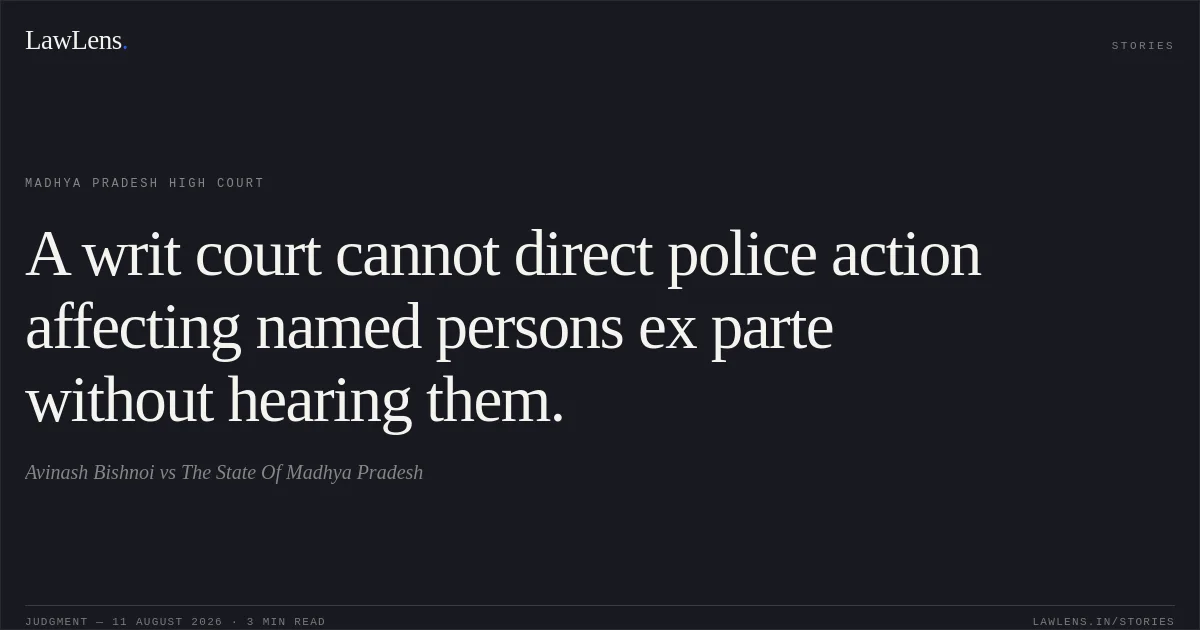
The Court held that the Writ Court erred in passing an ex parte order directing the police to conduct a preliminary enquiry and potentially register an FIR without affording the appellants an opportunity of hearing.
The order dated 14 May 2026 in W.P. No. 15120 of 2026 was set aside, and the writ petition was restored to its original number for fresh consideration after giving due opportunity of hearing to all concerned parties.
Source reference: para. 10; p. 6The appellants were directed to mark their presence when the matter was listed before the Writ Court to prevent delay.
Source reference: para. 11; p. 6The writ appeal was accordingly allowed and disposed of, without expressing any opinion on the merits of the underlying dispute.
Source reference: paras. 10–12; p. 6Acts & Sections Cited
10 provisions across 2 statutes referred to in this judgment. Each provision opens on LawLens.
Bharatiya Nagarik Suraksha Sanhita, 20231
Code of Criminal Procedure, 1973
Original Court PDF
Avinash BishnoivsThe State Of Madhya Pradesh
Click to open original judgment
Original judgment, available to read, download and summarize on LawLens.in