01Facts
Ratnalaya Jewellers, a partnership firm, obtained two PANs in 2020.
It sought cancellation of the second PAN, ABBFR3082R, but continued to use it for HDFC and IDBI bank accounts, including accounts in which substantial cash deposits were made.
pp. 3–7, 9–10, 13–15The firm filed its return for A.Y. 2021–22 under its first PAN, ABBFR2514C, and claimed that the deposits were accounted for in its declared sales.
pp. 3–7, 9–10, 13–15Following an inquiry under Section 133(6), the Department’s verification process flagged ₹4,59,91,700 as potential escaped income.
pp. 3–7, 9–10, 13–15The Assessing Officer issued a notice under Section 148 on 29 March 2025 using the second PAN.
pp. 3–7, 9–10, 13–15The firm challenged the notice as having been issued against a non-existent entity and disputed the basis for reopening.
pp. 3–7, 9–10, 13–15The High Court dismissed the writ petition.
p. 2902Issues
i.1. Whether the notice under Section 148 was invalid because it was issued under the firm’s second PAN, which the firm claimed it had surrendered.
pp. 7–8, 13ii.2. Whether the recorded information and material provided a lawful basis to initiate reassessment for A.Y. 2021–22.
pp. 8–9, 15–17, 26–29iii.3. Whether the High Court should interfere with the reassessment notice in its writ jurisdiction.
pp. 17–19, 28–2903Law Applied
Sections 147 and 148 of the Income-tax Act, 1961 permit reassessment where the Assessing Officer, on the basis of relevant material, forms a bona fide belief that taxable income has escaped assessment.
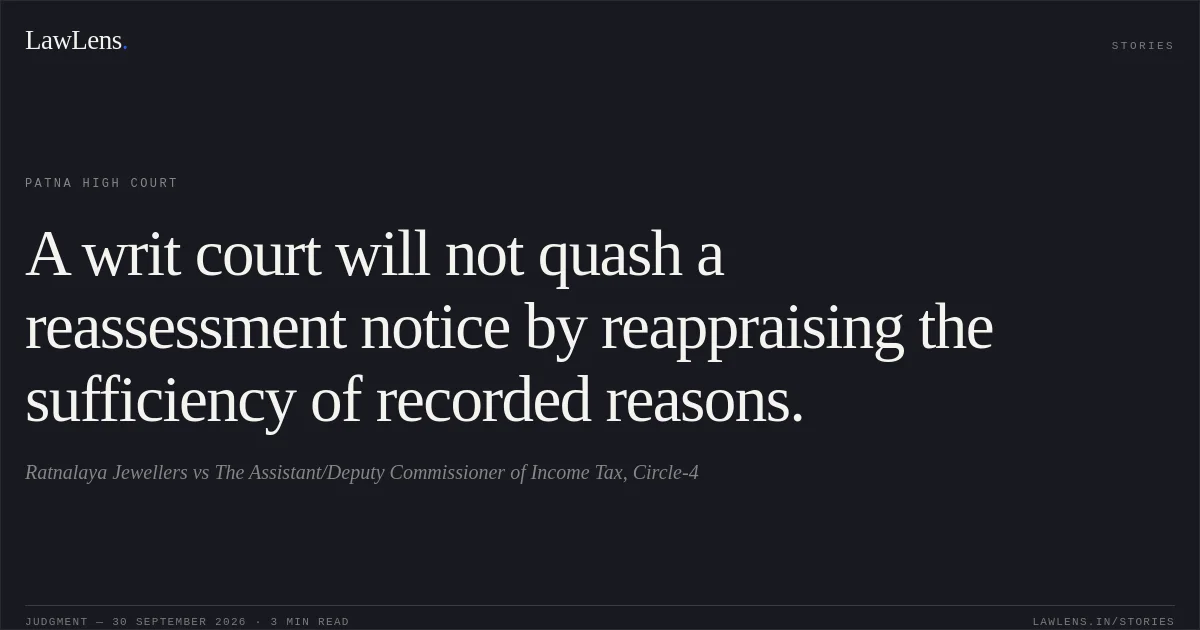
pp. 23–28Under the principles discussed in Sanand Properties Private Limited v. Joint Commissioner of Income Tax, the validity of reopening is tested by reference to the reasons recorded when the notice was issued; the court may examine whether relevant material has a rational connection to the belief, but does not assess its sufficiency.
pp. 23–28The Court also relied on Commissioner of Income Tax v. Chhabil Dass Agarwal for the principle that a writ petition ordinarily should not be entertained where the tax statute provides an effective remedial process, subject to recognised exceptions.
pp. 17–19The Department’s High-Risk e-Verification process was grounded in Section 135A and the e-Verification Scheme, 2021; the Directorate of Income Tax (Systems) communication advised Assessing Officers to use the resulting information for action under Sections 147 and 148.
pp. 15–17Provisions in the judgment · 27
Income Tax Act, 1961 27 provisions
Section 148Section 147Section 143Section 133Section 135Section 148Section 148Section 139ASection 44ABSection 148ASection 148ASection 148Section 147Section 149Section 150Section 151Section 152Section 153Section 143Section 139Section 142Section 92ESection 133Section 148Section 133ASection 131Section 14704Reasoning
The Court noted that the firm had applied for two PANs, filed no return under the second PAN, and nevertheless used it in HDFC and IDBI accounts during the relevant and subsequent financial years.
pp. 11–14It also found that the second PAN remained active and that the firm did not dispute the relevant bank use or the deposits.
pp. 11–14The Department’s information was generated through the e-Verification process and flagged ₹4,59,91,700 as potential escaped income; the Court held that it could not determine in writ proceedings whether the deposits were ultimately explained by the sales reported under the first PAN.
pp. 15–17, 24–26Applying Sanand Properties, the Court declined to reassess the sufficiency of the material and found no basis to conclude that the Assessing Officer’s belief was non-bona fide or founded on vague or irrelevant information.
pp. 26–29It also referred to the alternative statutory remedy principle in Chhabil Dass Agarwal.
pp. 17–1905Holding
The Court declined to interfere with the Section 148 notice, finding no ground to hold it invalid at that stage.
p. 29It dismissed the writ petition.
p. 29Original Court PDF
Ratnalaya JewellersvsThe Assistant/Deputy Commissioner of Income Tax, Circle-4
Click to open original judgment
Original judgment, available to read, download and summarize on LawLens.in