Facts
The petitioner, daughter-in-law of respondent no. 2, lived in a ground-floor portion of the property owned by her mother-in-law.
Source reference: para. 1–8Amid matrimonial discord, the petitioner sought a residence order under the Protection of Women from Domestic Violence Act, 2005 (“DV Act”); those proceedings remained pending.
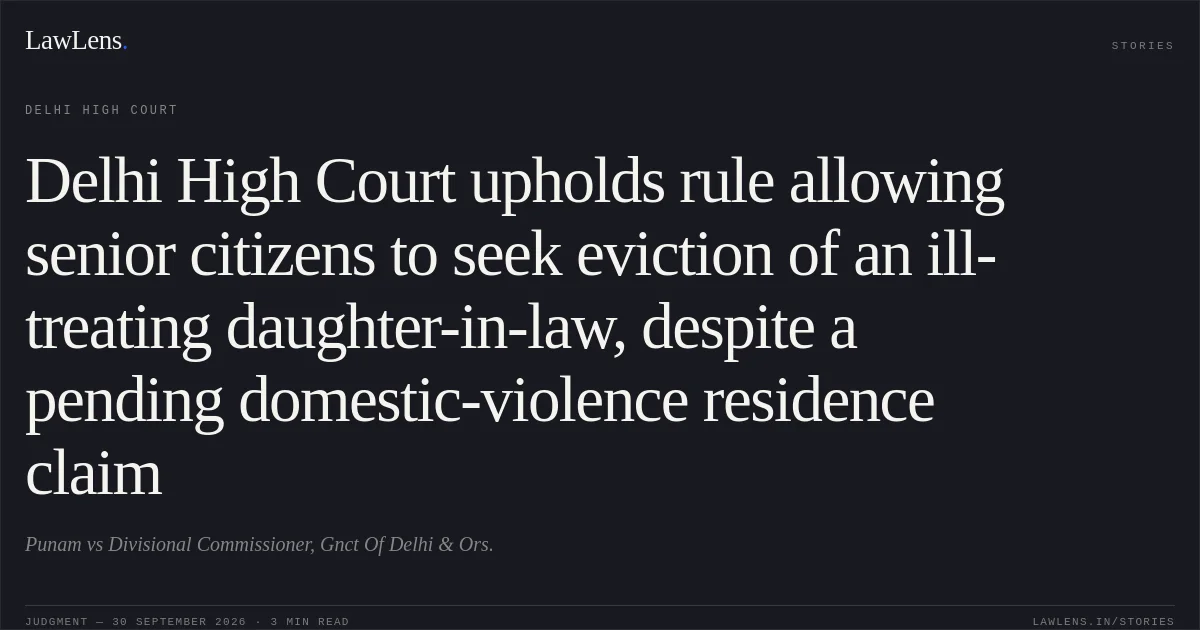
Source reference: para. 1–8Respondent no. 2 applied under Rule 22(3)(1) of the Delhi Maintenance and Welfare of Parents and Senior Citizens Rules, 2009 (“2009 Rules”) for the petitioner’s eviction.
Source reference: para. 1–8The District Magistrate rejected the application, but the Divisional Commissioner allowed respondent no. 2’s appeal and directed the petitioner to vacate.
Source reference: para. 1–8The petitioner challenged that order and the validity of Rule 22(3)(1)(i) and (iv).
Source reference: para. 1–8Issues
1. Whether Rule 22(3)(1)(i) and (iv) of the 2009 Rules are ultra vires the Maintenance and Welfare of Parents and Senior Citizens Act, 2007 (“Senior Citizens Act”) or unconstitutional
Source reference: para. 9–17, 22–352. Whether the eviction order could stand despite the petitioner’s claimed right to reside in a shared household under the DV Act and the pendency of her residence-order proceedings
Source reference: para. 36–393. Whether Rule 22(3)(1) extends to a daughter-in-law and permits eviction proceedings independently of a maintenance claim
Source reference: para. 40–44Law Applied
Sections 21 and 22 of the Senior Citizens Act require State measures to protect senior citizens’ life and property; Section 22(2) mandates a comprehensive action plan for that protection, while Section 32 authorises rule-making to carry out the Act.
Source reference: para. 19–20, 22–35The Court held that these provisions support Rule 22(3)(1), which permits a District Magistrate to consider eviction where a senior citizen is not maintained or is ill-treated.
Source reference: para. 22–35Section 3 gives the Senior Citizens Act overriding effect, but S. Vanitha v. Deputy Commissioner, Bengaluru Urban District, (2021) 15 SCC 730, requires the Senior Citizens Act and the DV Act—including the right to reside in a shared household under Section 17—to be harmoniously construed, with competing claims considered before eviction.
Source reference: para. 22–35The Court also relied on Ravi Kant Gupta v. State of Uttar Pradesh (4 August 2026), Samtola Devi v. State of Uttar Pradesh, 2025 SCC OnLine SC 669, and related Supreme Court authorities recognising that eviction may be ordered where necessary and expedient to protect a senior citizen.
Source reference: para. 22–35Shadab Khairi v. State and Darshna v. Govt. of NCT of Delhi support a liberal interpretation of Rule 22(3)(1) that can encompass a daughter-in-law.
Source reference: para. 40–44Proceedings for eviction under the Rules are distinct from maintenance proceedings under Sections 4 and 5 of the Senior Citizens Act.
Source reference: para. 40–44Reasoning
The Court found that Section 22’s mandate to protect senior citizens’ life and property, read with the rule-making power in Section 32, authorised the State to provide an eviction procedure; Rule 22(3)(1) was therefore not ultra vires.
Source reference: para. 29–35Applying S. Vanitha, the Court considered the competing claims rather than treating the petitioner’s pending DV Act proceedings as an automatic bar to eviction.
Source reference: para. 36–44It relied on the Divisional Commissioner’s findings that the petitioner was employed as a postgraduate teacher and had a separate residence at Bahadurgarh, and concluded that her claim to occupy the shared household did not outweigh respondent no. 2’s interest in living peacefully.
Source reference: para. 36–44The Court further held that the Rule could extend to the petitioner as a daughter-in-law and that an eviction application did not depend on a separate claim for maintenance.
Source reference: para. 40–44Holding
The Court rejected the challenge to Rule 22(3)(1)(i) and (iv), held that the provision could apply to a daughter-in-law and operate independently of maintenance proceedings, and found no basis to interfere with the Divisional Commissioner’s eviction order.
The writ petition was dismissed; pending applications were disposed of, with no order as to costs.
Source reference: para. 35, 40–46Acts & Sections Cited
18 provisions across 2 statutes referred to in this judgment. Each provision opens on LawLens.
Protection of Women from Domestic Violence Act, 20057
Maintenance and Welfare of Parents and Senior Citizens Act, 2007
Original Court PDF
PunamvsDivisional Commissioner, Gnct Of Delhi & Ors.
Click to open original judgment
Original judgment, available to read, download and summarize on LawLens.in