01Facts
The petitioners invoked Article 226 of the Constitution challenging the order dated 7 August 2026 passed by the Chief Judicial Magistrate, Indore, in Case No. 2742/2026, and the consequential notice/order dated 18 August 2026 issued by the Tehsildar, Tehsil Kanadia, concerning proposed dispossession from the northern part of Plot No. 338A, admeasuring 1,500 sq. ft., situated at Manavata Nagar, Bicholi Hapsi, Indore.
p. 1The petitioners sought quashing of the impugned proceedings, protection against dispossession, and restraint against coercive action.
p. 1The Court noted that the property had been purchased by the petitioners during the subsistence of a loan that remained outstanding to the bank.
p. 402Issues
i.Whether the writ petition under Article 226 was maintainable when the petitioners had an alternative and efficacious remedy under Section 17 of the SARFAESI Act, 2002 before the Debts Recovery Tribunal.
p. 4ii.Whether the petitioners’ claim that they were bona fide purchasers justified interference by the High Court with the measures taken pursuant to the SARFAESI proceedings.
p. 403Law Applied
The Court applied Article 226 of the Constitution in light of the rule that a writ petition ordinarily should not be entertained where the aggrieved person has an alternative and efficacious statutory remedy.
pp. 1–3The Court treated the SARFAESI Act, 2002 as a self-contained code and relied on Section 17, which permits any person, including a borrower or other aggrieved person, to challenge measures taken under Section 13(4) by the secured creditor before the Debts Recovery Tribunal within the prescribed period.
pp. 1–3Section 17(2) empowers the Tribunal to examine whether the secured creditor’s measures comply with the Act and the Rules, while Section 17(3) permits invalid measures to be set aside and possession to be restored.
pp. 2–3The Court also applied the principle that a purchaser of property must remain vigilant, verify the title and relevant documents, and cannot ordinarily claim protection as a bona fide purchaser when the property is acquired during the subsistence of an outstanding secured loan.
p. 4Provisions in the judgment · 4 · Linked ones open on LawLens
Securitisation and Reconstruction of Financial Assets and Enforcement of Security Interest Act, 2002 Section 13Section 14Section 17Section 34
04Reasoning
The Court held that the SARFAESI framework provided the petitioners with an effective statutory remedy before the Debts Recovery Tribunal to challenge the measures connected with enforcement of the security interest.
pp. 1–4Since the petitioners’ grievance concerned action arising from the SARFAESI proceedings, the High Court declined to exercise its writ jurisdiction.
pp. 1–4The Court further observed that the petitioners had purchased the property while the loan remained outstanding and, therefore, their assertion of bona fide purchase was prima facie unpersuasive.
p. 4A purchaser is required to verify the title and obtain the original title documents before entering into the transaction; the petitioners’ claim therefore did not warrant interference under Article 226.
p. 405Holding
The High Court answered both issues against the petitioners.
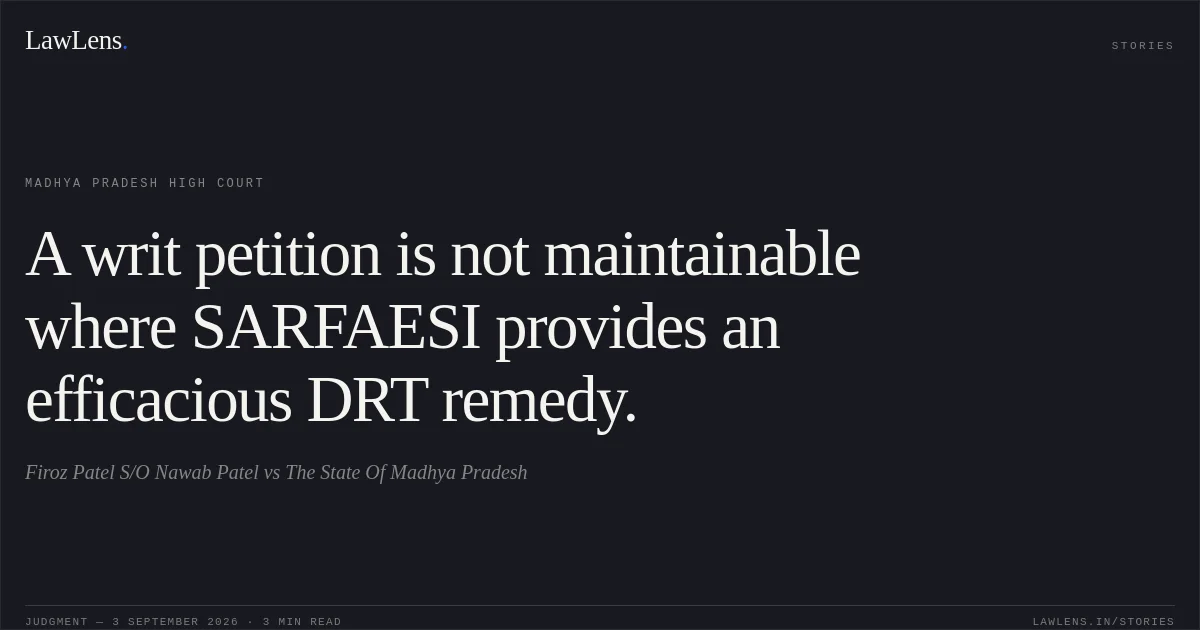
p. 4It held that the petition was not maintainable in view of the alternative and efficacious remedy available under Section 17 of the SARFAESI Act before the Debts Recovery Tribunal.
p. 4The Court also found no prima facie merit in the petitioners’ claim of being bona fide purchasers.
p. 4Accordingly, the writ petition seeking quashing of the CJM’s order and the Tehsildar’s consequential action, along with protection against dispossession and coercive measures, was dismissed.
p. 4Original Court PDF
Firoz Patel S/O Nawab PatelvsThe State Of Madhya Pradesh
Click to open original judgment
Original judgment, available to read, download and summarize on LawLens.in