01Facts
The petitioner instituted a declaratory suit under Section 229-B of the U.P. Zamindari Abolition and Land Reforms Act before the Assistant Collector, First Class, Roorkee, initially numbered Suit No. 24 of 1996 and subsequently renumbered as Suit No. 29 of 2006. He sought permission to withdraw the suit with liberty to file a fresh suit. The application was allowed on 16 January 2007 subject to payment of ₹1,000 as costs, of which ₹500 was to be deposited with the Gram Sabha and ₹500 was to be paid to defendants nos. 3 and 4.
¶ 3The petitioner thereafter instituted a fresh suit without depositing the stipulated costs. The Assistant Collector dismissed the fresh suit on 19 March 2012 for non-compliance with the condition attached to the withdrawal order. The petitioner initially challenged that order before the High Court but withdrew the writ petition on 13 September 2012 with liberty to pursue an appropriate remedy. He subsequently filed an appeal in February 2021, more than eight years and eleven months after the Assistant Collector’s order. The Additional Commissioner dismissed the appeal as barred by delay on 12 November 2021, and the Board of Revenue dismissed the petitioner’s revision under Section 333 of the Uttarakhand Zamindari Abolition and Land Reforms Act on 25 July 2022.
¶ 4The petitioner then invoked the High Court’s supervisory jurisdiction under Article 227 of the Constitution.
¶ 602Issues
i.1. Whether the Assistant Collector was justified in dismissing the petitioner’s subsequent declaratory suit for failure to comply with the condition requiring payment of ₹1,000 as costs before filing a fresh suit?
¶ 3–5ii.2. Whether the Additional Commissioner and the Board of Revenue were justified in refusing to entertain the petitioner’s challenge on account of the unexplained delay of eight years and eleven months?
¶ 4–6iii.3. Whether the High Court ought to exercise its supervisory jurisdiction under Article 227 of the Constitution to interfere with the concurrent orders of the subordinate revenue courts?
¶ 603Law Applied
The Court applied Section 229-B of the U.P. Zamindari Abolition and Land Reforms Act, under which the petitioner had instituted the declaratory proceedings, and Section 333 of the Uttarakhand Zamindari Abolition and Land Reforms Act, under which the revision was filed.
¶ 3–4The governing principle was that where permission to withdraw a suit with liberty to institute a fresh suit is granted subject to a specific condition, the party must comply with that condition before pursuing the fresh proceeding.
¶ 3–5The Court also applied the principle that an appellate remedy pursued after an inordinate and unexplained delay may be rejected on the ground of limitation, particularly where the litigant had already challenged the order before the High Court and withdrawn that proceeding with liberty to pursue an appropriate remedy.
¶ 4–6Interference under Article 227 is supervisory and is not warranted where the subordinate courts have given valid reasons and committed no jurisdictional or patent legal error.
¶ 6Provisions in the judgment · 2
U.P. Zamindari Abolition and Land Reforms Act, 1950 Section 229B
Uttarakhand Zamindari Abolition and Land Reforms Act, 1950 Section 333
04Reasoning
The Assistant Collector had expressly made the grant of liberty to file a fresh suit conditional upon payment of ₹1,000 as costs. Since the petitioner filed the subsequent suit without fulfilling that condition, its dismissal on 19 March 2012 was legally justified.
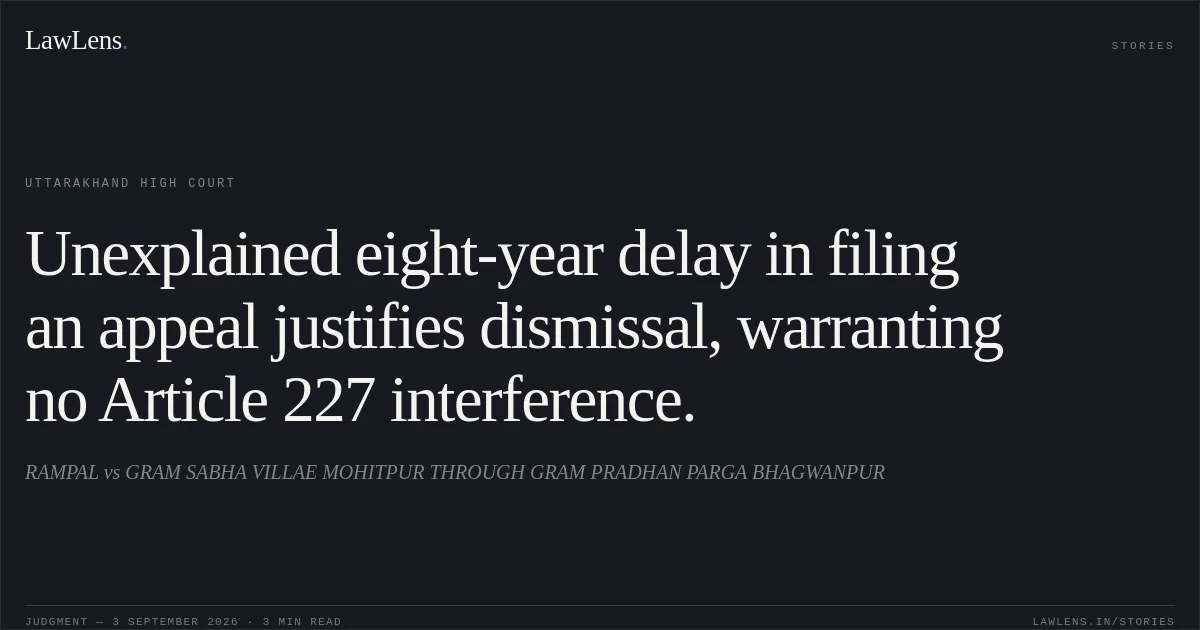
¶ 3–5The petitioner’s prior writ petition challenging the dismissal was withdrawn on 13 September 2012, yet he waited until February 2021 to file an appeal. The Court held that the delay of more than eight years and eleven months was unexplained and that the Additional Commissioner was justified in dismissing the appeal as time-barred.
¶ 4–6The Board of Revenue correctly affirmed that decision. As the subordinate courts had provided valid reasons and the petitioner failed to demonstrate any ground warranting supervisory correction, the High Court declined to interfere under Article 227.
¶ 605Holding
The High Court held that the subsequent suit was rightly dismissed because the petitioner had not complied with the condition requiring deposit of ₹1,000 as costs.
¶ 5–6It further held that the appeal filed after an unexplained delay of eight years and eleven months was rightly dismissed as time-barred, and that the Board of Revenue had correctly affirmed the decision.
¶ 5–6Finding no reason to exercise supervisory jurisdiction under Article 227, the Court dismissed the writ petition. No order was made as to costs.
¶ 6Original Court PDF
RAMPALvsGRAM SABHA VILLAE MOHITPUR THROUGH GRAM PRADHAN PARGA BHAGWANPUR
Click to open original judgment
Original judgment, available to read, download and summarize on LawLens.in