Facts
The petitioner, a Punjab Police Constable appointed on 14 October 2011, was part of an escort party transporting an undertrial prisoner from Nabha Jail to the District Courts at Amritsar. While returning, armed persons intercepted the police vehicle, forcibly freed the prisoner, and took away police weapons.
Source reference: para. 2An FIR was registered against the petitioner and two other police officials, and the petitioner was suspended with effect from 8 June 2015. Although a separate investigation found him innocent and he was placed in Column No. 2 of the criminal case, a departmental inquiry found him guilty of negligence.
Source reference: para. 2By order dated 28 April 2016, the Senior Superintendent of Police imposed temporary forfeiture of one year’s sanctioned service for the purpose of annual increment and directed that the period from 8 June 2015 to 1 September 2015 be treated as suspension.
Source reference: paras. 1, 7His appeal and revision were dismissed on 4 May 2017 and 26 March 2018, respectively.
Source reference: paras. 1, 7He was also denied permission to appear in the 2016 Basic Proficiency Test because departmental and criminal proceedings were pending.
Source reference: paras. 2–3After the criminal trial concluded in 2022 with the conviction of the two co-officials, the petitioner sought restoration of salary, increments, the forfeited service, and seniority; those applications were rejected on 2 May 2023 and 12 July 2023.
Source reference: paras. 1–2He thereafter filed the present writ petition in 2023, challenging all the orders.
Source reference: no citationIssues
1. Whether the departmental punishment could be sustained when the petitioner was found innocent during the criminal investigation and was placed in Column No. 2 of the criminal case.
Source reference: para. 92. Whether the departmental proceedings and punishment were vitiated by violation of natural justice, including the alleged denial of a personal hearing.
Source reference: paras. 4, 8, 103. Whether the punishment of temporary forfeiture of one year’s service and treatment of the relevant period as suspension was arbitrary, disproportionate, or otherwise amenable to interference under Articles 226/227 of the Constitution.
Source reference: para. 104. Whether the petitioner was entitled to restoration of service benefits and retrospective consideration of seniority on the basis of the 2016 Basic Proficiency Test.
Source reference: paras. 1–35. Whether the writ petition was liable to be dismissed on the ground of delay and laches, having been filed more than five years after rejection of the statutory revision.
Source reference: para. 14Law Applied
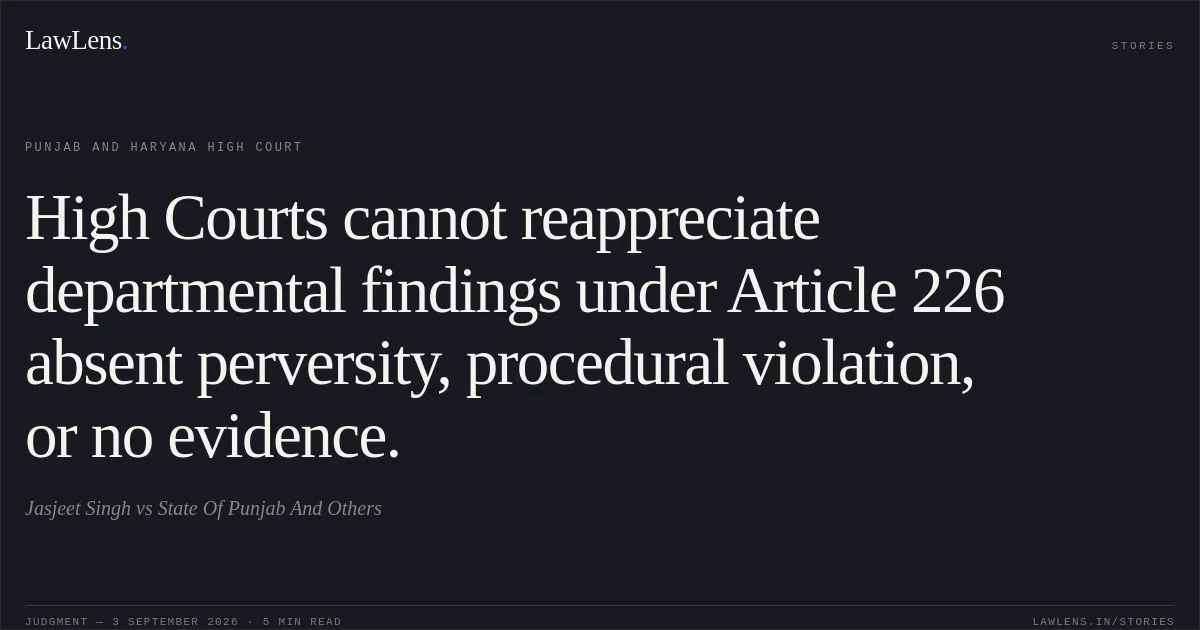
The Court applied Articles 226 and 227 of the Constitution, under which judicial review in disciplinary matters is supervisory and is directed primarily to the legality of the decision-making process, not to reappreciation of evidence or substitution of the Court’s view on punishment.
Source reference: paras. 10–13It relied on State of Andhra Pradesh v. S. Sree Rama Rao, AIR 1963 SC 1723, and State of Andhra Pradesh v. Chitra Venkata Rao, (1975) 2 SCC 557, for the rule that interference is permissible where the inquiry is conducted by an incompetent authority, statutory procedure or natural justice is violated, the finding is based on no evidence, or the conclusion is perverse.
Source reference: paras. 11–12Union of India v. P. Gunasekaran, 2015 (1) SCT 5, and CISF v. Abrar Ali, 2017 (1) SCT 682, were relied upon to hold that the High Court cannot act as an appellate authority, reassess evidence, or interfere merely because another view is possible.
Source reference: para. 12–13The Court further applied State of Rajasthan v. B.K. Meena, (1996) 6 SCC 417, and Nelson Motis v. Union of India, (1992) 4 SCC 711, for the principle that criminal and departmental proceedings operate in distinct fields and employ different standards of proof.
Source reference: para. 9The proportionality principle was applied in its limited form: punishment may be interfered with only if it is shockingly disproportionate.
Source reference: para. 10On delay and laches, the Court relied on Yunus (Baboobhai) A. Hamid Padvekar v. State of Maharashtra, 2009 (2) SCT 24, and Mrinmoy Maity v. Chhanda Koley, 2024 SCC OnLine SC 551, which hold that unexplained and inordinate delay ordinarily disentitles a litigant to discretionary relief under Article 226.
Source reference: paras. 15–16Reasoning
The Court held that the petitioner’s placement in Column No. 2 of the FIR and the absence of his criminal prosecution did not exonerate him from departmental liability, since the departmental inquiry concerned negligence and dereliction of official duty rather than proof of a criminal offence beyond reasonable doubt.
Source reference: para. 9The record showed that the petitioner had been informed of the allegations, given an opportunity to submit his defence, and heard before the punishment order was passed; no specific procedural violation or resulting prejudice was established.
Source reference: paras. 8, 10Since the departmental findings were supported by material on record and were neither perverse nor based on no evidence, the Court declined to reassess the evidence under Articles 226/227.
Source reference: paras. 10–13The conviction of the two co-officials did not assist the petitioner because it did not negate the independent departmental finding regarding his role as a member of the escort party.
Source reference: para. 9The punishment was one available under the applicable disciplinary framework and was not shown to be shockingly disproportionate.
Source reference: para. 10In addition, the challenge to the original punishment was brought more than five years after dismissal of the revision, with no satisfactory explanation for the delay; subsequent representations could not revive the stale cause of action.
Source reference: paras. 14–16Holding
The Court answered the issues against the petitioner. It held that the departmental proceedings and punishment were lawful, that the criminal investigation and the petitioner’s placement in Column No. 2 did not bar departmental action, and that no violation of natural justice, perversity, lack of evidence, or shocking disproportionality was established.
The claims for restoration of suspension-period benefits, increments, forfeited service, and retrospective seniority based on the 2016 Basic Proficiency Test were consequently rejected.
Source reference: no citationIndependently, the petition was also barred by inordinate and unexplained delay and laches.
Source reference: paras. 14–16The writ petition was dismissed with no order as to costs.
Source reference: para. 17Acts & Sections Cited
9 provisions across 2 statutes referred to in this judgment. Each provision opens on LawLens.
Indian Penal Code, 18605
Arms Act, 19594
Original Court PDF
Jasjeet SinghvsState Of Punjab And Others
Click to open original judgment
Original judgment, available to read, download and summarize on LawLens.in