01Facts
The petitioner, an Assistant Engineer (Civil), challenged the order dated 13 July 2007 by which he and 33 other Assistant Engineers were reverted to the post of Sub-Engineer (Civil).
¶ 1–2Before the reversion order, show-cause notices were issued and the petitioner submitted his reply on 29 January 2007.
¶ 2The petitioner contended that the respondents rejected the representations without considering the individual grounds raised in them and passed an unreasoned, non-speaking order.
¶ 2Operation of the impugned order was stayed on 17 August 2007. During the pendency of the petition, the petitioner retired from service.
¶ 2The State maintained that an opportunity of hearing had been granted and that the reversion order was passed after consideration of the petitioner’s reply.
¶ 3The impugned order relied, inter alia, on Rule 12 of the M.P. Civil Services (General Conditions of Service) Rules, 1961, under which seniority was to be determined from the date of appointment pursuant to the selection list, without counting service rendered in work-charged or other posts.
¶ 502Issues
i.Whether the order dated 13 July 2007 reverting the petitioner from Assistant Engineer to Sub-Engineer was invalid for failure to consider his specific reply and for want of adequate reasons.
¶ 6–10ii.Whether the petitioner was entitled to consequential service, salary, seniority and pensionary benefits after quashing of the reversion order.
¶ 11–1303Law Applied
The Court exercised jurisdiction under Article 226 of the Constitution of India to review the legality of the impugned administrative order.
¶ 1Rule 12 of the M.P. Civil Services (General Conditions of Service) Rules, 1961 provides that seniority in the cadre is to be determined on the basis of the selection list and the date of appointment, and that service rendered in work-charged or other posts is not to be counted.
¶ 5The Court relied on Kranti Associates (P) Ltd. v. Masood Ahmed Khan, (2010) 9 SCC 496, which holds that administrative and quasi-judicial decisions affecting rights must contain clear, cogent and adequate reasons, and that reasons are an essential component of fairness, transparency and judicial review.
¶ 10It also relied on State of Punjab v. Bandeep Singh, (2016) 1 SCC 724, which establishes that every administrative or executive decision must be composite, self-sustaining and supported by reasons, and that the Government cannot act arbitrarily or capriciously.
¶ 8–904Reasoning
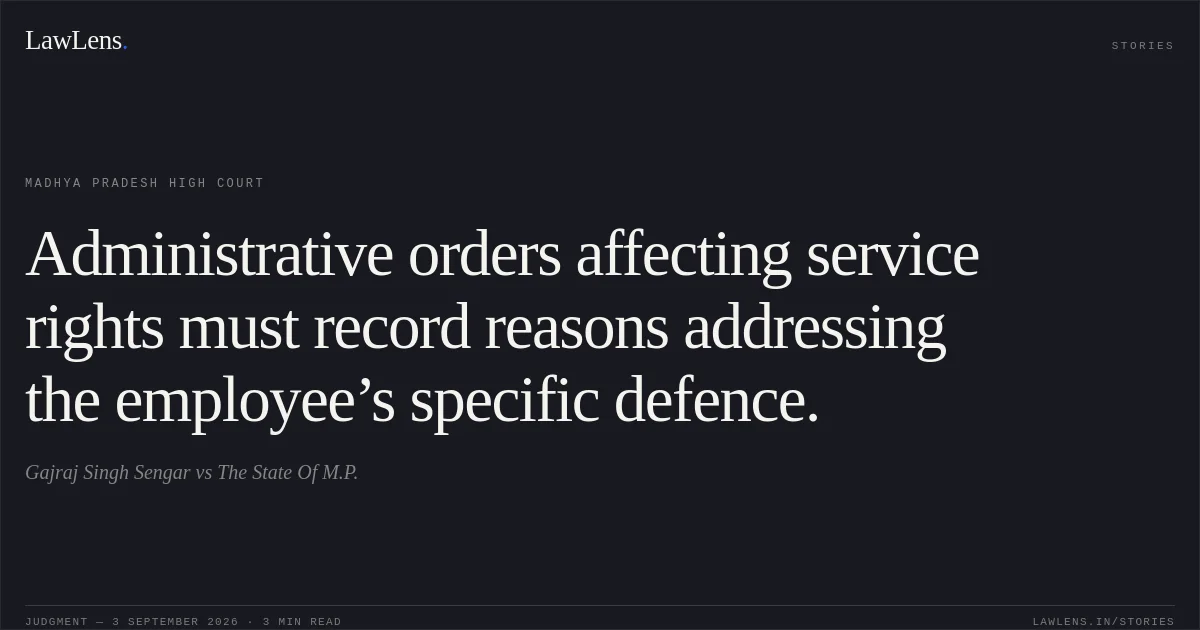
Although the respondents had issued a show-cause notice and received the petitioner’s reply, the impugned order merely referred generally to the representations of 34 Assistant Engineers and stated that their claims were rejected on the basis of Rule 12 and the treatment of an earlier employee, H.S. Nagaraj.
¶ 5–6It did not disclose any consideration of the specific grounds raised by the petitioner or provide individual reasons for rejecting his defence.
¶ 6–10Since the order adversely affected the petitioner’s service status, the authority was required to apply its mind to his particular case and record cogent reasons.
¶ 6–10The Court therefore found the order non-speaking, unreasoned and contrary to the settled requirement that an administrative order affecting legal or service rights must itself disclose the reasons supporting the decision.
¶ 6–1005Holding
The High Court quashed the order dated 13 July 2007 insofar as it related to the petitioner.
¶ 11The respondents were directed to extend all consequential benefits to him within three months from receipt of the certified copy of the judgment.
¶ 12In view of the petitioner’s advanced age and retirement, the Court granted no liberty to the respondents to initiate further proceedings against him concerning the subject matter of the petition.
¶ 12The writ petition was accordingly allowed and disposed of.
¶ 13Original Court PDF
Gajraj Singh SengarvsThe State Of M.P.
Click to open original judgment
Original judgment, available to read, download and summarize on LawLens.in