Facts
The appellant, an Assistant Scientific Officer in the Drug Testing Laboratory of the Indian Medicine and Homeopathy Department, possessed M.Sc. (Microbiology) and M.Phil. (Biotechnology) qualifications.
Source reference: p.2, para. 2She submitted representations seeking appointment/promotion as Government Analyst (Indian Medicine).
Source reference: p.2, para. 2After an earlier writ petition, the authorities were directed to consider her representations.
Source reference: p.2, para. 2The respondents rejected her request on 6 May 2021, stating that the post was governed by the Drugs and Cosmetics Act, 1940 and the Drugs and Cosmetics Rules, 1945; that the relevant qualifications required expertise in Ayurveda, Siddha or Unani medicine; and that the appellant’s science qualifications did not satisfy the applicable requirements under Rules 33F, 160B, 165 and Schedule T.
Source reference: p.2–3, paras. 2–3The writ court’s order dated 7 November 2023 was challenged in the present writ appeal.
Source reference: p.1, prayer; p.2, para. 1Issues
Whether an employee has a legally enforceable right to seek appointment or promotion to the post of Government Analyst merely by submitting a representation, in the absence of an administrative decision to fill the post.
Source reference: p.5–6, paras. 6–8Whether the appellant’s qualifications in Microbiology and Biotechnology satisfied the qualifications applicable to the post of Government Analyst (Indian Medicine) under the Drugs and Cosmetics Act, 1940 and the Drugs and Cosmetics Rules, 1945.
Source reference: p.3–4, paras. 3–4; p.6–7, paras. 8–9Whether the authorities or the Court could direct the respondents to fill the post or appoint the appellant when filling the post remained within the competent authority’s administrative discretion.
Source reference: p.5, para. 6; p.7, paras. 8–9Law Applied
Appointment or promotion is not a vested right, although an employee has a right to consideration in accordance with the applicable service rules when the competent authority decides to fill the post.
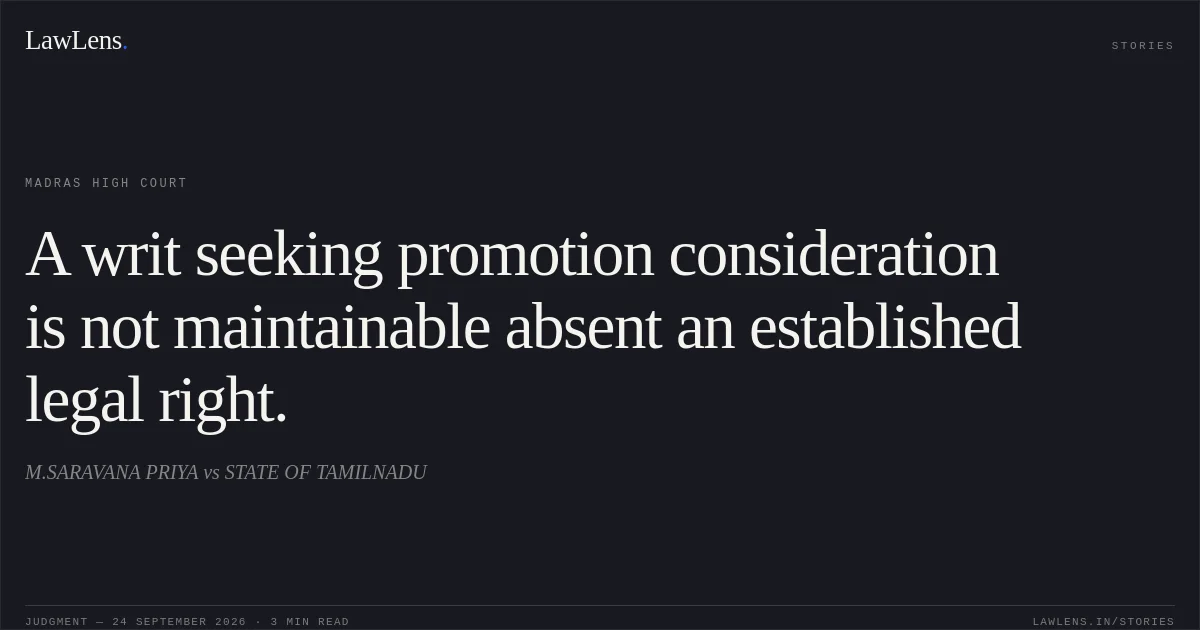
Source reference: p.5–6, para. 6A writ petition seeking merely a direction to consider a representation is not maintainable unless the petitioner first establishes a corresponding legal right.
Source reference: p.5–6, para. 7The Court also applied the Drugs and Cosmetics Act, 1940 and the Drugs and Cosmetics Rules, 1945, including Rules 44, 33F, 160B and 165 and Schedule T, which regulate the qualifications and functioning of Government Analysts and Indian Medicine drug-testing laboratories.
Source reference: p.2–4, paras. 2–4The qualifications must be construed in the context of the distinct posts of Government Analyst (Indian Medicine) and Government Analyst (Allopathy), and only eligible and duly qualified persons may be appointed.
Source reference: p.6–7, paras. 8–9Reasoning
The Court held that the appellant could not claim appointment or promotion as a matter of right merely because she had made a representation.
Source reference: p.5, para. 6Consideration of promotion would arise only after the competent authority took an administrative decision to fill the post, following which eligible employees could be considered under the relevant rules.
Source reference: p.5, para. 6The Court criticised the practice of filing successive writ petitions—first seeking consideration of a representation and then challenging the consequential rejection—without first establishing a legal entitlement.
Source reference: p.5–6, para. 7On qualifications, the Court rejected the appellant’s contention that the general reference to a science qualification under Rule 44 automatically entitled her to consideration for Government Analyst (Indian Medicine).
Source reference: p.3–4, paras. 3–4; p.6–7, paras. 8–9It construed the relevant provisions according to the nature of the post and distinguished the Indian Medicine and Allopathy streams, emphasising that the post involves significant public-health responsibilities and must be filled only by persons satisfying the applicable qualifications.
Source reference: p.3–4, paras. 3–4; p.6–7, paras. 8–9The Court nevertheless clarified that, if the authorities decide to fill the post, they must strictly comply with the governing rules and appoint only eligible persons.
Source reference: p.7, para. 9Holding
The Court held that the appellant had no enforceable right to seek appointment or promotion to the post of Government Analyst through a representation, and that the authorities were not required to fill the post or appoint her.
The applicable qualifications had to be assessed in the context of the specific post of Government Analyst (Indian Medicine), and only duly qualified candidates could be appointed.
Source reference: p.7, para. 10The writ appeal was dismissed, with no order as to costs.
Source reference: p.7, para. 10Original Court PDF
M.SARAVANA PRIYAvsSTATE OF TAMILNADU
Click to open original judgment
Original judgment, available to read, download and summarize on LawLens.in