Facts
Respondent No. 2 alleged that, after they met on Facebook, the petitioner promised to marry her and had sexual intercourse with her on 20 November 2024 on that promise.
Source reference: paras. 3–6She further alleged that he borrowed ₹5,00,000 from her, later married another woman on 22 January 2025, and returned the money on 4 February 2025.
Source reference: paras. 3–6She filed a complaint on 18 February 2025, leading to registration of an FIR under Sections 69, 352 and 351(2) of the Bharatiya Nyaya Sanhita, 2023 (BNS).
Source reference: paras. 3–6The petitioner sought quashing under Section 482 of the Code of Criminal Procedure, 1973 / Section 528 of the Bharatiya Nagarik Suraksha Sanhita, 2023 (BNSS), contending that the relationship was consensual and that the complaint followed his legal notice alleging blackmail.
Source reference: paras. 1–2, 7.1, 7.10–7.11Respondent No. 2 did not appear despite service; the State confirmed that she had subsequently married.
Source reference: paras. 8, 10Issues
1. Whether the complaint and FIR, on the material before the Court, disclosed an offence based on sexual relations allegedly induced by a false promise to marry.
Source reference: paras. 3–6, 11–162. Whether the circumstances justified exercising the Court’s inherent jurisdiction to quash the FIR and complaint.
Source reference: paras. 1–2, 7.8–7.11, 15–17Law Applied
The Court exercised its inherent jurisdiction under Section 482 CrPC / Section 528 BNSS to consider the request to quash the proceedings.
Source reference: para. 1Relying on Ankit Tomar v. State of Haryana, 2026 SCC OnLine SC 436, and Samadhan v. State of Maharashtra, 2025 SCC OnLine SC 2528, including the principle stated in Mahesh Damu Khare v. State of Maharashtra, (2024) 11 SCC 398, the Court considered whether the sexual relationship was directly attributable to a false promise to marry and whether consent was vitiated by misconception of fact; a relationship’s failure to culminate in marriage does not, by itself, retrospectively make intimacy an offence.
Source reference: paras. 7.3–7.7, 15The Court also referred to Iqbal @ Bala v. State of U.P., (2023) 8 SCC 734, for the principle that, when proceedings are alleged to be frivolous or vexatious, the Court may examine relevant surrounding circumstances and material beyond the complaint itself.
Source reference: paras. 7.8–7.9Reasoning
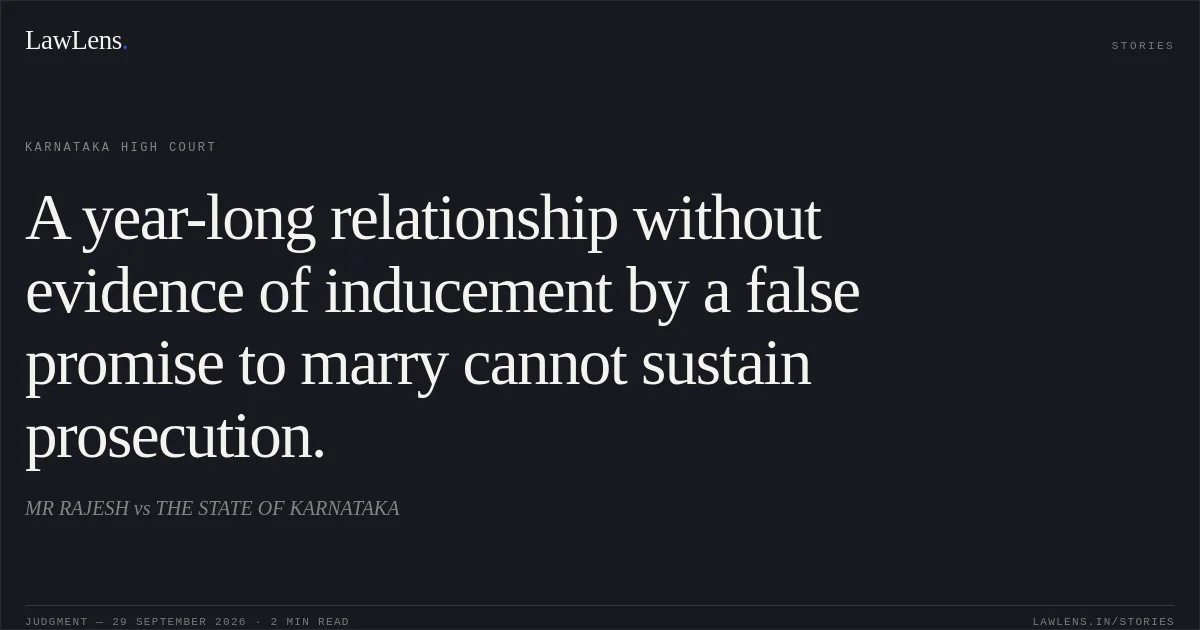
The Court considered that the parties had met through Facebook, remained in contact, and had a relationship that continued for about a year, during which they met on several occasions.
Source reference: paras. 11, 14Respondent No. 2 complained after learning that the petitioner had married another person; the Court also noted the petitioner’s earlier legal notice alleging threats and attempted blackmail, as well as material relating to payments.
Source reference: paras. 12–13In light of the nature and duration of the relationship, the Court found that the material did not indicate force, coercion or pressure based on a promise to marry, and that the allegation that sexual relations were solely induced by such a promise required consideration against the surrounding circumstances.
Source reference: paras. 15–16Holding
The Karnataka High Court allowed the petition and quashed the FIR and complaint in Crime No. 10/2025, registered by the Mangaluru Women Police Station and pending before the III JMFC Court, Mangaluru.
Pending applications were disposed of as no longer surviving.
Source reference: para. 17Acts & Sections Cited
5 provisions across 3 statutes referred to in this judgment. Each provision opens on LawLens.
Code of Criminal Procedure, 19731
Bharatiya Nagarik Suraksha Sanhita, 20231
Bharatiya Nyaya Sanhita, 20233
Original Court PDF
MR RAJESHvsTHE STATE OF KARNATAKA
Click to open original judgment
Original judgment, available to read, download and summarize on LawLens.in