Facts
Punjab National Bank sanctioned and subsequently renewed credit facilities for M.A. Enterprises. On 16.08.2021, the Bank approved restructuring under the RBI-approved One Time Restructuring (“OTR”) framework, granting concessions including reduced interest rates and restructured repayment terms. The borrower allegedly failed to comply with the OTR, following which two accounts were classified as NPAs on 02.07.2022 and SARFAESI proceedings were initiated through a demand notice and possession notice.
Source reference: paras. 4–6; pp. 2–3The borrower thereafter sought permission to sell the secured property and made payments claimed to discharge the dues. The Bank’s statements of account reflected a zero balance as on 31.03.2024; however, the Bank contended that this resulted from an inadvertent accounting treatment after NPA classification and that approximately ₹8.33 crores remained payable upon withdrawal of the OTR concessions.
Source reference: paras. 7–12, 20, 30–32; pp. 3–11The borrower filed a writ petition seeking a no-dues certificate, release of the title deeds, and correction of its credit record. The learned Single Judge accepted the borrower’s case, holding that the Bank had not separately communicated withdrawal of the OTR concessions and that the zero-balance statements supported discharge of liability.
Source reference: paras. 13–19; pp. 5–7The Bank challenged that decision in the intra-court appeal.
Source reference: no citationIssues
1. Whether the Bank was required to separately communicate withdrawal of the concessional rate of interest granted under the OTR after the borrower’s failure to comply with its terms.
Source reference: para. 29; p. 102. Whether the zero balance reflected in the Bank’s statements of account conclusively established discharge of the borrower’s liability and precluded the Bank from claiming further dues.
Source reference: para. 29; p. 103. Whether the disputed quantum of outstanding dues and the borrower’s entitlement to a no-dues certificate could be finally adjudicated in writ proceedings.
Source reference: paras. 43–46; pp. 16–18Law Applied
The Court applied the contractual terms governing the OTR and the original sanction. Clause 10 of the OTR expressly reserved the Bank’s right to withdraw concessions without assigning reasons, and, being a specific term of the restructuring arrangement, prevailed over Clause 13 of the Sanction Letter’s “Overall Terms and Conditions.”
Source reference: paras. 38–40; pp. 14–15Classification of the borrower’s accounts as NPAs and issuance of notices under Sections 13(2) and 13(4) of the SARFAESI Act, 2002 sufficiently indicated that the OTR had failed and that the original sanction terms had revived.
Source reference: paras. 35, 39–40; pp. 13–15The Court further applied the principle that writ jurisdiction is inappropriate for adjudicating seriously disputed questions of fact requiring evidence, including the actual quantum of loan liability.
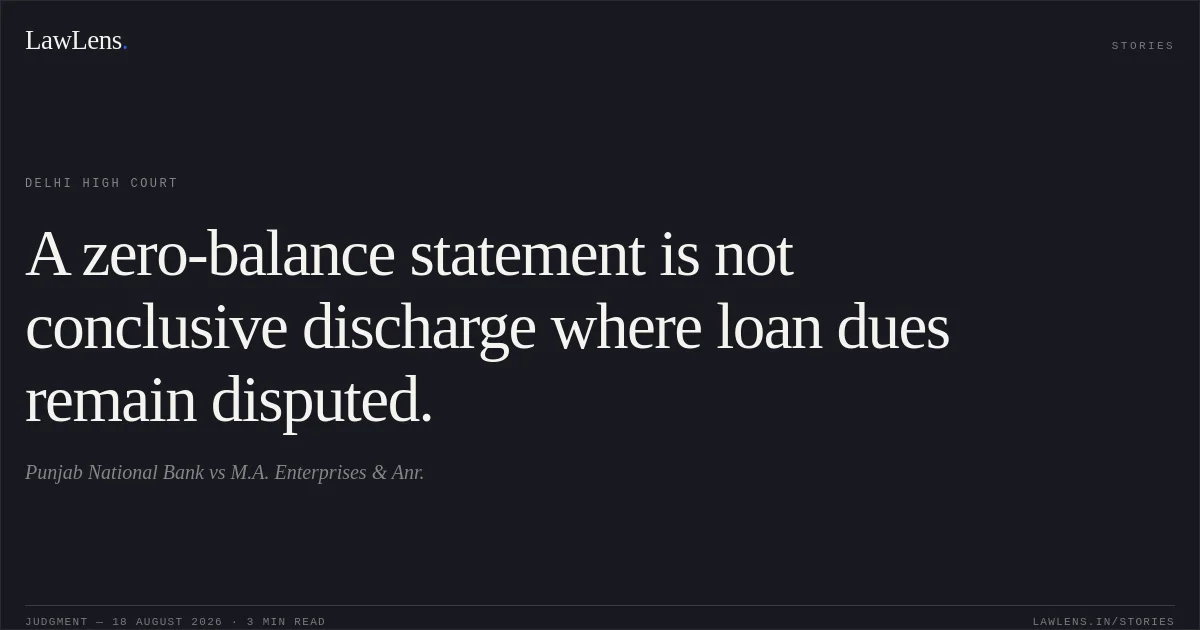
Source reference: paras. 43–46; pp. 16–18A zero balance in a bank statement is not conclusive proof of discharge where the Bank provides a plausible explanation and the underlying liability remains disputed.
Source reference: para. 44; p. 17Reasoning
The Court found that the borrower did not dispute non-compliance with the OTR or the subsequent NPA classification. Since Clause 10 specifically permitted withdrawal of the OTR concessions without assigning reasons, the Bank was not additionally required to issue a separate communication withdrawing the concessional interest rate. The NPA classification and SARFAESI notices sufficiently communicated that the restructuring terms were no longer operative and that the original sanction terms applied.
Source reference: paras. 34, 37–40; pp. 12–15The Court also accepted as plausible the Bank’s explanation that, after NPA classification, interest was not recognised in the principal loan account on an accrual basis but was tracked in memorandum or interest-suspense accounts. Consequently, the zero balance did not conclusively establish that the borrower had discharged its entire liability. The competing claims—whether ₹8.33 crores remained payable and whether the OTR amount had been fully paid—required examination of evidence and could not be finally determined in writ proceedings.
Source reference: paras. 41–44; pp. 15–17The inter-branch email dated 01.04.2024 was likewise conditional and did not constitute a binding admission that no dues remained.
Source reference: para. 45; p. 17Holding
The Division Bench allowed the appeal and set aside the learned Single Judge’s judgment.
It held that the Bank was entitled to calculate the borrower’s dues in accordance with the original Sanction Letter, applicable guidelines, and law, since the OTR concessions stood withdrawn upon the borrower’s default.
Source reference: paras. 46–48; p. 18The Bank was directed to issue the no-dues certificate and release the title deeds only upon payment of the entire dues so calculated.
Source reference: paras. 46–48; p. 18The borrower was left at liberty to seek recovery of any excess amount paid in appropriate civil proceedings.
Source reference: paras. 46–48; p. 18Acts & Sections Cited
1 provisions across 1 statute referred to in this judgment. Each provision opens on LawLens.
Securitisation and Reconstruction of Financial Assets and Enforcement of Security Interest Act, 20021
Original Court PDF
Punjab National BankvsM.A. Enterprises & Anr.
Click to open original judgment
Original judgment, available to read, download and summarize on LawLens.in