01Facts
The deceased, Shareef @ Sharief, died on 18.12.2021 when the car he was travelling in, driven rashly and negligently, hit a standing tree near Navilahalli village, Belur Taluk. He was taken to hospital and died en route to another hospital.
¶ 3The claimants (wife, minor daughter, and mother) sought compensation, pleading that the deceased was 35 years old, earned Rs. 1,000/day as a mason, and supported the family.
¶ 4Respondent No. 2 (insurer) contested, alleging that the driver lacked a valid licence. Respondent No. 1 (owner) was ex parte.
¶ 5–6The Tribunal awarded Rs. 26,73,100 (loss of dependency Rs. 25,20,000; funeral Rs. 15,000; estate Rs. 15,000; consortium Rs. 1,20,000; medical Rs. 3,100).
¶ 9The claimants appealed for enhancement.
¶ 10Negligence and insurer liability were not disputed on appeal.
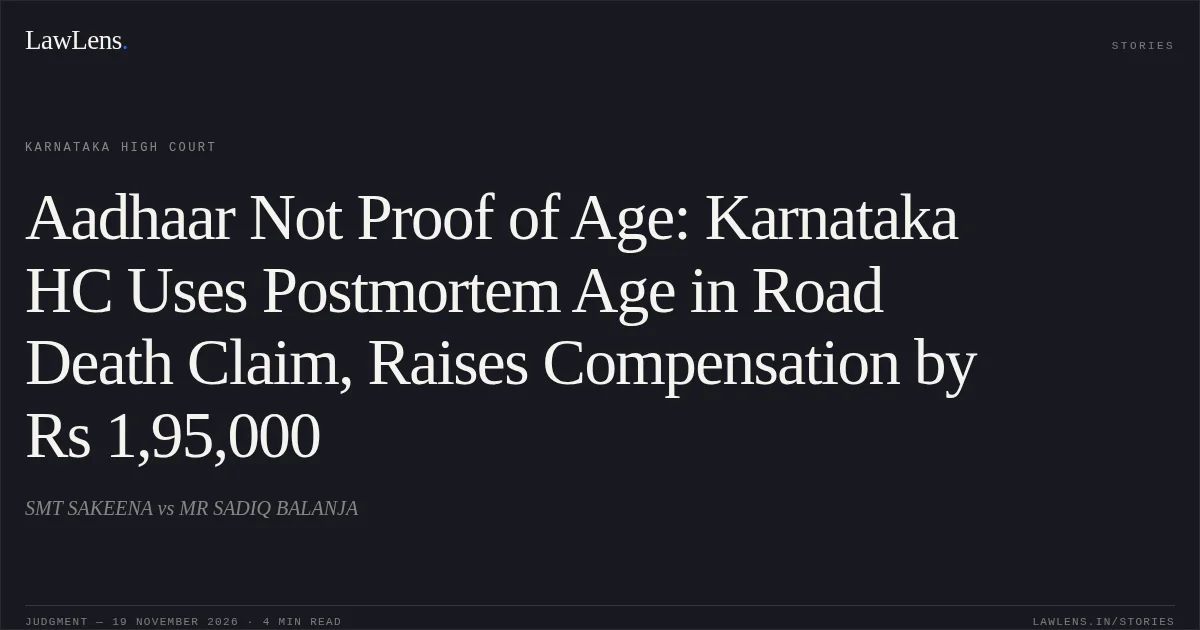
¶ 12, 15The age evidence consisted of the Aadhaar card (Ex. P-10), showing 35 years 7 months 25 days at accident, and the postmortem report (Ex. P-5), stating 32 years.
¶ 13, 15The claimants produced no documents to prove income or age beyond these.
¶ 22–2302Issues
i.1. Whether the age recorded in the Aadhaar card can be accepted as proof of age for determining the multiplier and, if so, whether the age is 35 or 36 years.
¶ 16(i)ii.2. Whether, if the Aadhaar age is not acceptable, the age in the postmortem report can be adopted for applying the multiplier.
¶ 16(ii)iii.3. Whether the claimants are entitled to a 10% escalation every three years on funeral expenses, loss of estate, and loss of consortium under Pranay Sethi.
¶ 13, 2403Law Applied
The court relied on Saroj & Ors. v. IFFCO-TOKIO General Insurance Co. Ltd. (2024) 10 SCR 939 for the rule that an Aadhaar card establishes identity but is not, by itself, proof of date of birth or age, and that other age documents take primacy.
¶ 14, 18The court applied Sunita & Ors. v. Vinod Singh (SLP (Civil) 1114/2019) for the proposition that a postmortem report is a scientific assessment of age and may be used to fix the multiplier where no other reliable age evidence exists.
¶ 20–21The court applied National Insurance Co. Ltd. v. Pranay Sethi (2017) 16 SCC 680 for the multiplier table (age 32 = multiplier 16), the conventional heads (funeral Rs. 15,000, estate Rs. 15,000, consortium Rs. 40,000 per claimant), the 40% future-prospects addition for a deceased aged 31–50 with three dependants (one-third deduction for personal expenses), and the 10% escalation every three years on conventional heads.
¶ 21, 23–24The court also referred to Magma General Insurance Co. Ltd. v. Nanu Ram (2018) 18 SCC 130 (as quoted in Sunita) on the scope of consortium.
¶ 20Provisions in the judgment · 2 · Linked ones open on LawLens
Motor Vehicles Act, 1988 Section 173
Juvenile Justice (Care and Protection of Children) Act, 2015. Section 94
04Reasoning
The court held that the Aadhaar card, which records age only as an identity document, cannot establish age under Saroj. The Tribunal's acceptance of the Aadhaar age, and its resulting use of age 36 and multiplier 15, was therefore unsustainable, and the appellate court did not adopt either the Aadhaar age or the Tribunal's age.
¶ 18, 21The insurer's plea that the claimants be directed to produce further age documents was rejected because the claimants had not produced any, and the Tribunal could only rely on the postmortem report in that situation.
¶ 22Relying on Sunita, the court treated the postmortem age of 32 as a scientific assessment, with no contrary material on record, and adopted multiplier 16.
¶ 20–21Income was taken at Rs. 15,000 per month as correctly assessed by the Tribunal for a 2021 accident, despite the claimants' unproven Rs. 1,000/day plea. Applying 40% future prospects, a one-third personal-expense deduction (three dependants), and multiplier 16, loss of dependency is Rs. 26,88,000.
¶ 23The court then applied Pranay Sethi's 10% escalation for three years to the conventional heads, which raised funeral expenses and loss of estate to Rs. 18,000 each and consortium to Rs. 1,44,000.
¶ 24The enhancement is Rs. 1,95,000 (rounded from Rs. 1,94,900) over the Tribunal's award.
¶ 2505Holding
The Aadhaar card cannot be treated as proof of age; the age of the deceased is not 35 or 36 as the Tribunal found, and the Aadhaar age is rejected under Saroj.
¶ 18, 21In the absence of other age evidence, the postmortem age of 32 may be adopted, and multiplier 16 applies under Pranay Sethi and Sunita.
¶ 21–22Escalation of 10% per three years applies to funeral expenses, loss of estate, and loss of consortium, which yields Rs. 28,68,000 in total compensation.
¶ 24–25The appeal is allowed in part. The claimants receive enhanced compensation of Rs. 1,95,000 with 6% p.a. interest from the date of the petition until realisation, excluding a stated delayed period of 388 days. The insurer (Respondent No. 2) must deposit the amount within six weeks, and apportionment, deposit, and release follow the Tribunal's award. The records are to be returned to the Tribunal.
¶ 26–27(iii), 27(iv)–(v)Original Court PDF
SMT SAKEENAvsMR SADIQ BALANJA
Click to open original judgment
Original judgment, available to read, download and summarize on LawLens.in