Facts
The petitioner, a 71-year-old person with 78% hearing impairment, sought permission to establish an Aavin milk booth in a 10 ft. × 10 ft. space at the Erode District Collectorate, relying on G.O. (Ms.) No. 20 dated 14 July 2022, which exempts eligible booths from rent and advance.
Source reference: pp. 2–3The Aavin Union recommended his application, and the Commissioner for the Welfare of Differently Abled later sought reports on the proposed allotment.
Source reference: pp. 3–4The District Collector rejected the request, citing the potential effect of commercial activity on the Collectorate’s functioning; the respondents also relied on a 2010 circular discouraging commercial establishments in government offices and asserted that the Collectorate lacked suitable space.
Source reference: pp. 4–5The authorities offered four alternative sites outside the Collectorate, which the petitioner declined.
Source reference: p. 6He sought certiorari to quash the rejection and a direction to permit the booth.
Source reference: p. 2Issues
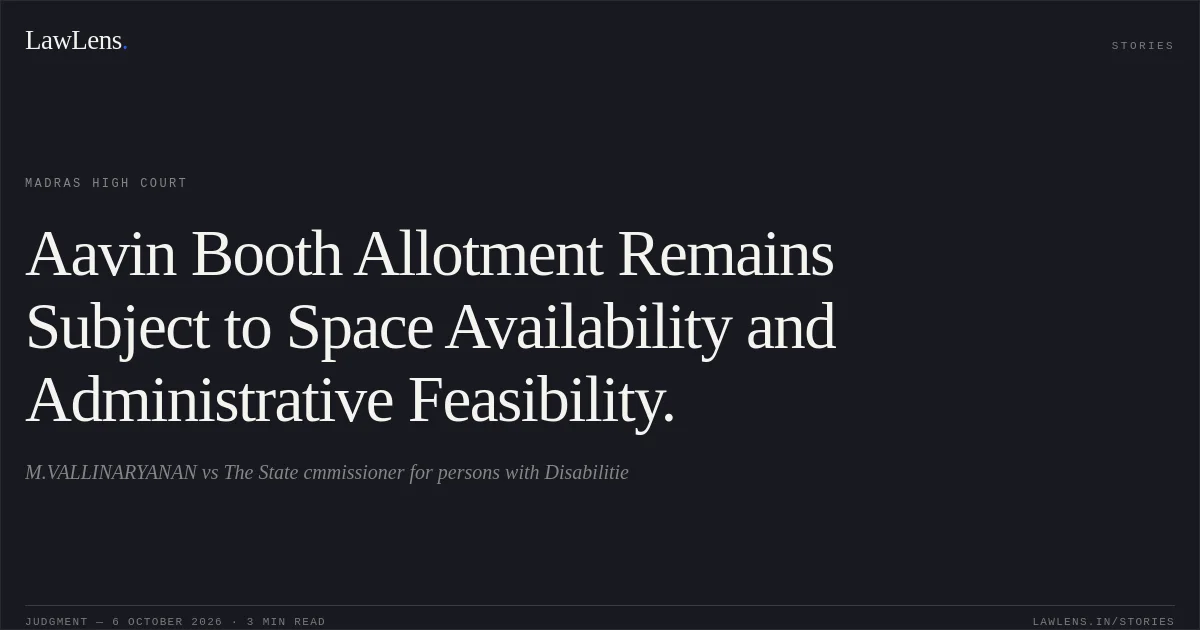
Whether G.O. (Ms.) No. 20 required the District Collector to allot the petitioner space for an Aavin milk booth within the Collectorate.
Source reference: pp. 7–8Whether, in the circumstances, the Court could direct allotment of space under Article 226 despite the Collector’s assessment that it was not feasible.
Source reference: pp. 8–9Whether preference should be given to persons with disabilities if permission is granted for a tea shop or Aavin booth.
Source reference: p. 9Law Applied
G.O. (Ms.) No. 20 dated 14 July 2022 dispenses with advance/security deposit and rent for Aavin milk booths established by persons with disabilities, but does not impose a positive obligation on a District Collector to allot space; allotment remains subject to availability and the authority’s assessment of desirability.
Source reference: p. 8The Court referred to the State’s duties under the Rights of Persons with Disabilities Act, 2016, observing that beneficial measures for persons with disabilities should be implemented to the extent possible.
Source reference: p. 8In exercising Article 226 jurisdiction, the Court does not act as an appellate authority over the Collector’s assessment of feasibility, and cannot compel establishment of a booth where no Government Order or statutory provision mandates one.
Source reference: pp. 8–9If permission is granted, preference should be given to persons with disabilities, with priority among them to the person with the greater degree of disability.
Source reference: p. 9Reasoning
The Court found that G.O. (Ms.) No. 20 provided rent and advance relief but did not create an enforceable right to a particular site or require a booth at every Collectorate.
Source reference: p. 8The Collector had assessed the proposed location as unsuitable because it could interfere with office functioning; the Court held that it could not substitute its assessment for the Collector’s on feasibility under Article 226.
Source reference: pp. 8–9While recognizing the welfare purpose of the scheme, the Court considered that purpose insufficient to compel allotment in the absence of a mandatory legal provision.
Source reference: pp. 8–9It nevertheless clarified the preference to be applied if a decision is made to permit such an establishment.
Source reference: p. 9Holding
The Court declined to quash the rejection or direct the Collector to allot the requested space.
It disposed of the writ petition with the observation that, if permission is granted for a tea shop or Aavin booth, persons with disabilities should receive preference, with priority to the person with the greater degree of disability.
Source reference: p. 9No costs were awarded, and the connected miscellaneous petition was closed.
Source reference: p. 9Original Court PDF
M.VALLINARYANANvsThe State cmmissioner for persons with Disabilitie
Click to open original judgment
Original judgment, available to read, download and summarize on LawLens.in