Facts
The five respondent-workmen claimed that they had been employed by the petitioner, M/s Shaurya Enterprises, an LPG cylinder distribution agency, since various dates between 1985 and 1988.
Source reference: p.3–4, paras. 3–4They alleged that, after raising claims concerning statutory benefits and unpaid wages before the ESI, PF and Labour authorities, the management stopped assigning them work and terminated their services in July/August 2014 without notice, enquiry or payment of retrenchment compensation under Section 25F of the Industrial Disputes Act, 1947 (“ID Act”).
Source reference: p.3–4, paras. 3–4The management denied termination and pleaded that the workmen had voluntarily abandoned employment, had not completed 240 days of continuous service, and had failed to resume duties despite letters calling upon them to do so.
Source reference: p.4, para. 4The Labour Courts found that the workmen had completed 240 days of continuous service, rejected the plea of abandonment, and held the termination to be contrary to Section 25F of the ID Act.
Source reference: p.4–5, para. 6They directed reinstatement with full back wages and consequential benefits calculated from 1 July 2014 at the last drawn wages of ₹9,000 per month.
Source reference: p.4–5, para. 6The management challenged the awards through the present writ petitions.
Source reference: no citationIssues
Whether the workmen had completed 240 days of continuous service preceding the alleged termination so as to attract the protection of Section 25F of the ID Act?
Source reference: p.4–7, paras. 5–6, 11Whether the workmen had voluntarily abandoned their employment, or whether their services had been illegally terminated by the management?
Source reference: p.4–7, paras. 4–6, 12–14Whether the Labour Court’s findings warranted interference under the High Court’s limited writ jurisdiction under Articles 226 and 227 of the Constitution?
Source reference: p.6, para. 10Whether reinstatement with full back wages was an appropriate relief, considering the passage of time and the age of the workmen?
Source reference: p.8–9, paras. 16–20Law Applied
The Court applied Section 25F of the ID Act, which requires compliance with prescribed conditions, including notice and retrenchment compensation, before retrenchment of a workman who has completed the requisite period of continuous service.
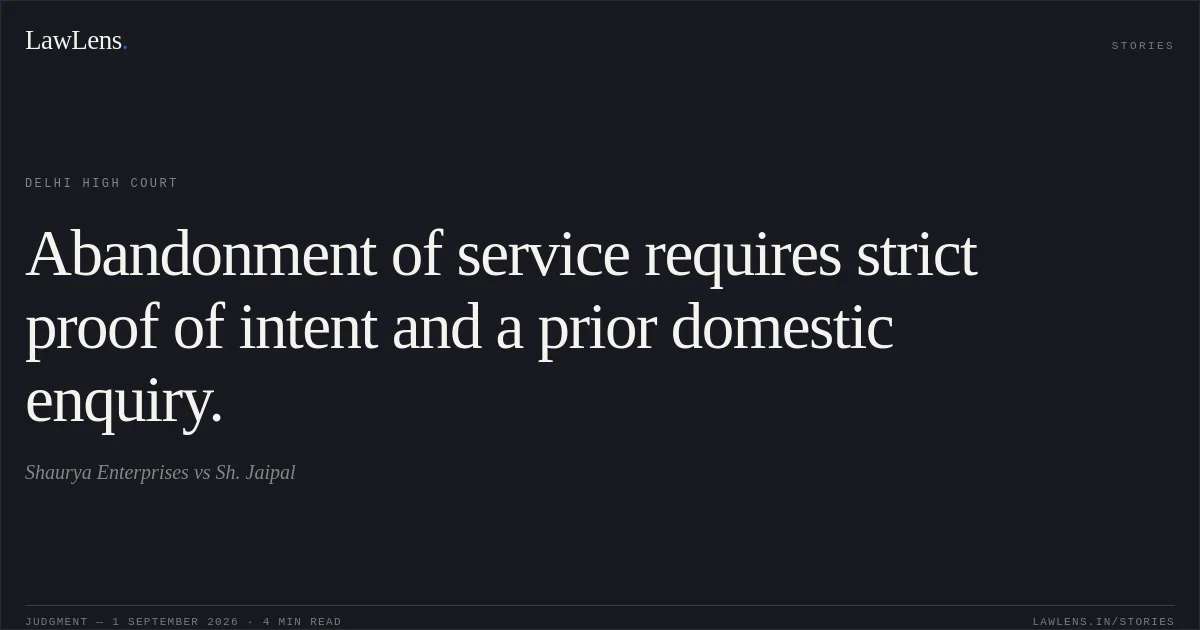
Source reference: no citationIt relied on the principle that abandonment of employment is a matter of intention requiring strict proof; where an employer asserts that a workman has abandoned service, the employer must establish the abandonment, and ordinarily cannot strike the workman off the rolls without issuing a show-cause notice or charge-sheet and conducting an enquiry where abandonment is treated as misconduct.
Source reference: p.7, para. 14The Court also applied the limited scope of judicial review under Articles 226 and 227, under which interference is justified only where the Labour Court’s decision is without jurisdiction, perverse, or contrary to natural justice, relying on Syed Yakoob v. K.S. Radhakrishnan, 1963 SCC OnLine SC 24, International Airport Authority of India v. International Air Cargo Workers Union, (2009) 13 SCC 374, and Ritz Theatre Private Limited v. Ramesh Chandra, 2024 SCC OnLine Del 3633.
Source reference: p.6, para. 10The Court further recognised that, in appropriate cases involving substantial delay and changed circumstances, reinstatement may be substituted by lump-sum monetary compensation.
Source reference: p.8–9, paras. 16–19Reasoning
The Court found no reason to interfere with the Labour Court’s finding that the workmen had completed 240 days, since that conclusion was based on attendance registers produced by the management itself.
Source reference: p.7, para. 11The plea of abandonment was rejected because the management failed to prove a clear intention to abandon employment.
Source reference: p.7, para. 12Its witness admitted that the workmen had approached statutory authorities regarding unpaid wages and other benefits, that inspections had taken place, and that Labour Inspectors had accompanied the workmen to the premises to secure their reinstatement, but the management did not permit them to resume work.
Source reference: p.7, para. 12The management had also taken inconsistent positions, describing the workmen as monthly-salaried employees before the Labour Court but as piece-rate workers in replies to demand notices, which undermined its defence.
Source reference: p.7, para. 13In the absence of any show-cause notice, charge-sheet or domestic enquiry, the Court upheld the finding that the management had failed to establish abandonment and that the termination violated Section 25F.
Source reference: p.7, paras. 14–15However, because approximately twelve years had elapsed since the termination, the workmen had attained or approached superannuation, and they had not resumed duties when called upon during the proceedings, reinstatement with full back wages was considered impracticable and inappropriate.
Source reference: p.8, para. 17Holding
The writ petitions were dismissed insofar as they challenged the findings that the workmen had completed 240 days of service and had been illegally terminated in violation of Section 25F of the ID Act.
The relief of reinstatement with full back wages was modified into lump-sum compensation of ₹5,00,000 to each of the five workmen.
Source reference: p.9, paras. 19–21Any amount of ₹2,00,000 already deposited for a workman, together with accrued interest, was directed to be released to that workman, and the management was directed to pay the balance ₹3,00,000 within four weeks.
Source reference: p.9, para. 20If the deposit had not been made, the management was required to pay the entire ₹5,00,000 within four weeks.
Source reference: p.9, para. 20Any unpaid amount would carry interest at 9% per annum from the date of judgment until realisation.
Source reference: p.9, para. 20Acts & Sections Cited
1 provisions across 1 statute referred to in this judgment. Linked provisions open on LawLens.
Industrial Disputes Act, 19471
Original Court PDF
Shaurya EnterprisesvsSh. Jaipal
Click to open original judgment
Original judgment, available to read, download and summarize on LawLens.in