Facts
The deceased, Mitaben, was married to the respondent-accused for 21 years.
Source reference: p. 2, 7On 10.03.1998, she sustained 100% burn injuries and succumbed the following day.
Source reference: p. 2, 7The complainant (father of the deceased) alleged that the accused physically and mentally harassed the deceased, specifically taunting her for being "barren".
Source reference: p. 2The prosecution relied on a dying declaration (Exh. 18) and a police statement (Exh. 28) where the deceased stated she set herself ablaze because the accused taunted her and told her to kill herself.
Source reference: p. 6-7However, the deceased's mother and brothers (PW3, PW4, PW5) turned hostile, testifying that the couple had cordial relations and the deceased was undergoing psychiatric treatment for depression and dementia.
Source reference: p. 8-10The trial court acquitted the accused on 21.07.2009.
Source reference: p. 1-4The State preferred this appeal against the acquittal.
Source reference: p. 1-4Issues
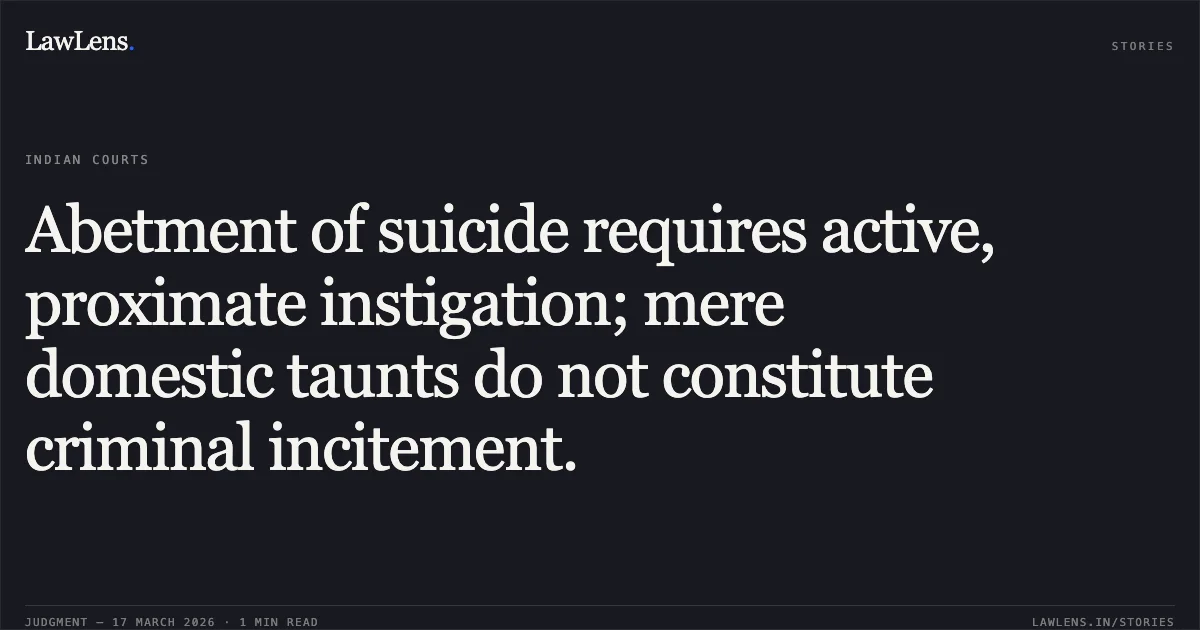
1. Whether the words uttered by the accused, specifically taunts regarding infertility, constitute "instigation" or "abetment" under Section 306 of the IPC.
Source reference: para 9.1, 10.12. Whether the appellate court can interfere with an order of acquittal in the absence of patent perversity or misreading of evidence.
Source reference: para 16, 18Law Applied
The court primarily applied Section 306 of the IPC regarding abetment of suicide and Section 107 of the IPC, which defines abetment as instigation, conspiracy, or intentional aiding.
Source reference: para 9.4It relied on Mahendra K.C. v. State of Karnataka, establishing that "instigation" requires a reasonable certainty to incite a consequence and that words uttered in a fit of anger do not constitute abetment.
Source reference: para 10Further, it applied the principle from Amalendu Pal v. State of West Bengal, which necessitates proof of a direct or indirect act of incitement proximate to the time of suicide.
Source reference: para 10.2Regarding the scope of appeal, it followed Chandrappa v. State of Karnataka, emphasizing the double presumption of innocence in favor of the accused in acquittal cases.
Source reference: para 17Reasoning
The Court observed that for a conviction under Section 306 IPC, the prosecution must establish a mens rea and a direct causal link between the accused’s conduct and the deceased's decision to commit suicide.
Source reference: para 9.5In this case, the dying declaration only alleged constant taunting and a verbal provocation ("you should die"), which the court held did not meet the legal threshold of "instigation" under Section 107 IPC.
Source reference: para 9.1, 9.6The court noted the significant testimony that the deceased was treated for dementia and depression, suggesting a fragile mental state independent of the accused's actions.
Source reference: para 8.4, 9.1Furthermore, the prosecution failed to examine the doctor who certified the deceased's consciousness during the dying declaration and failed to produce the hospital treatment records.
Source reference: para 8.3-8.4Since the primary witnesses (family members) turned hostile and denied any harassment, there was no positive evidence of cruelty under Section 498(A) or abetment under Section 306.
Source reference: para 8.4, 9.2Holding
The Court held that "mere occurrence of a suicide does not automatically trigger rigours of the Section" without proof of an active role in provoking the act.
The High Court dismissed the appeal and upheld the acquittal.
Source reference: no citationIt concluded that the trial court's view was reasonable and plausible, and in the absence of manifest illegality or perversity, the appellate court should not disturb a finding of acquittal.
Source reference: para 15, 20The respondent-accused was cleared of all charges under Sections 498(A) and 306 of the IPC.
Source reference: para 21Acts & Sections Cited
4 provisions across 2 statutes referred to in this judgment. Each provision opens on LawLens.
Indian Penal Code, 18602
Code of Criminal Procedure, 19732
Original Court PDF
STATE OF GUJARATvsDINESHBHAI BABULAL SHAH
Click to open original judgment
Original judgment, available to read, download and summarize on LawLens.in