Facts
On 16 February 2019, Rakesh Ramabhai set himself on fire and later died from his injuries.
Source reference: para. 2The prosecution relied principally on multiple dying declarations alleging that the accused and others had induced him to sign documents relating to a tractor and later harassed him by warning that he would be implicated in a theft case.
Source reference: paras. 4–7The tractor transaction took place in November 2018; the theft FIR had been registered earlier that month.
Source reference: paras. 13–14The Sessions Court acquitted the accused of offences under Sections 306, 406, 420 read with Section 114 of the IPC and Section 3(2)(v) of the SC/ST (Prevention of Atrocities) Act, 1989.
Source reference: para. 2The State appealed against the acquittal.
Source reference: paras. 2, 4–7, 13–14Issues
Whether the Sessions Court was justified in acquitting the accused, or whether its findings warranted appellate interference
Source reference: para. 10Whether the evidence, including the deceased’s dying declarations, established abetment of suicide or the other charged offences beyond reasonable doubt
Source reference: paras. 14–18Law Applied
The Court considered the State’s appeal under Section 419 of the Bharatiya Nagarik Suraksha Sanhita, 2023, corresponding to Section 378 of the Code of Criminal Procedure.
Source reference: para. 1In an appeal against acquittal, the appellate court should respect the reinforced presumption of innocence and avoid interference where the trial court’s view is reasonably possible; interference is justified in exceptional cases involving compelling circumstances or a perverse judgment.
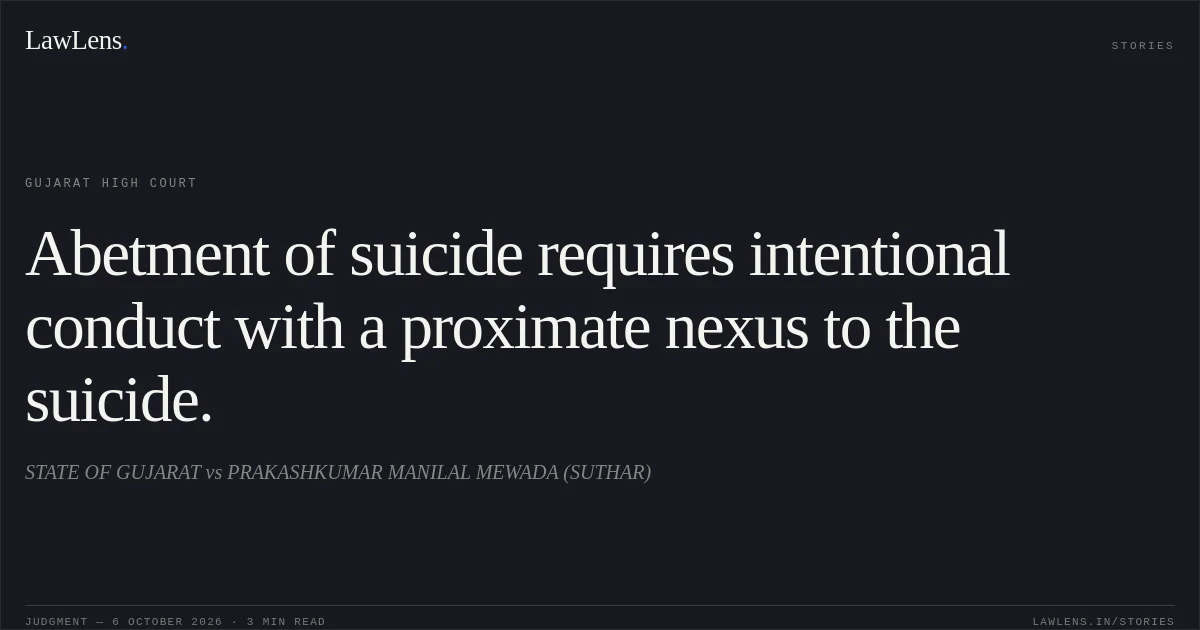
Source reference: para. 12For abetment of suicide under Section 306 IPC, read with Section 107 IPC, the prosecution must establish the accused’s intention to provoke, urge, or encourage suicide, including the requisite instigation or intentional aid.
Source reference: para. 15Ramesh Kumar v. State of Chhattisgarh, (2001) 9 SCC 618, recognises that instigation may be inferred where the accused’s acts or continuing conduct leave the deceased with no option but suicide;
Source reference: para. 15Madan Mohan Singh v. State of Gujarat, (2010) 8 SCC 628, requires the requisite intention and an active or direct act leading to suicide.
Source reference: para. 15The Court also considered whether the evidence proved the offences under Sections 406, 420 and 114 IPC and Section 3(2)(v) of the SC/ST Act.
Source reference: paras. 2, 18Reasoning
The Court found that the dying declarations established the suicide and the deceased’s distress over his name being connected with the tractor theft, but did not establish the accused’s alleged inducement, harassment, or intention to instigate suicide.
Source reference: paras. 14, 16The tractor documents showed the deceased’s presence before the notaries, while the prosecution did not produce the theft-case papers to establish that he had been arraigned as an accused.
Source reference: para. 14The transactions occurred in November 2018, whereas the suicide occurred in February 2019; the Court found no proximate nexus between the accused’s conduct and the suicide.
Source reference: paras. 13–14, 17It therefore concluded that the evidence did not establish abetment or the other alleged offences beyond reasonable doubt, and that the prosecution had not proved the offence was committed on the ground that the deceased belonged to an SC/ST community.
Source reference: para. 18The acquittal disclosed no perversity or other compelling basis for appellate interference.
Source reference: para. 19Holding
The Court held that the Sessions Court was justified in acquitting the accused and found no ground to interfere with its judgment.
It declined to grant leave to appeal and dismissed the State’s appeal at the admission stage.
Source reference: para. 20Acts & Sections Cited
8 provisions across 4 statutes referred to in this judgment. Each provision opens on LawLens.
Bharatiya Nagarik Suraksha Sanhita, 20231
Code of Criminal Procedure, 19731
Indian Penal Code, 18605
Scheduled Castes and the Scheduled Tribes (Prevention of Atrocities) Act, 19891
Original Court PDF
STATE OF GUJARATvsPRAKASHKUMAR MANILAL MEWADA (SUTHAR)
Click to open original judgment
Original judgment, available to read, download and summarize on LawLens.in