Facts
The deceased, Kailashben, married Accused No. 1 (Rameshbhai) approximately ten years prior to the incident
Source reference: p. 1Accused Nos. 2 to 7 are her in-laws.
Source reference: no citationThe prosecution alleged that because the deceased was childless, the accused subjected her to physical and mental torture, taunted her as "barren," and harassed her for insufficient dowry
Source reference: p. 2On March 5, 2008, the deceased committed suicide by jumping into a well
Source reference: p. 2The Trial Court (2nd Additional Sessions Judge, Panchmahals at Godhra) acquitted the accused of charges under Sections 498A, 306, and 114/34 of the IPC on December 31, 2009
Source reference: p. 1The State of Gujarat preferred this appeal against the acquittal, arguing that the Trial Court failed to appreciate reliable evidence and gave undue weight to minor contradictions
Source reference: p. 5Issues
1. Whether the prosecution established a direct causal link and "instigation" as required for a conviction of abetment of suicide under Section 306 IPC
Source reference: para 9.3, 9.62. Whether the evidence regarding dowry harassment and cruelty under Section 498A IPC was sufficient and specific enough to overcome the presumption of innocence
Source reference: para 8.6, 8.73. Whether the judgment of acquittal by the Trial Court was perverse or suffered from manifest illegality warranting interference by the Appellate Court
Source reference: para 11, 18Law Applied
The court applied Section 306 (Abetment of suicide) and Section 498A (Cruelty) of the IPC, read with the definition of "abetment" under Section 107 IPC, which requires instigation, conspiracy, or intentional aiding
Source reference: para 9.4It relied on Mahendra K.C. v. State of Karnataka (2022) to define instigation as "goading" or "provoking" with reasonable certainty of the consequence
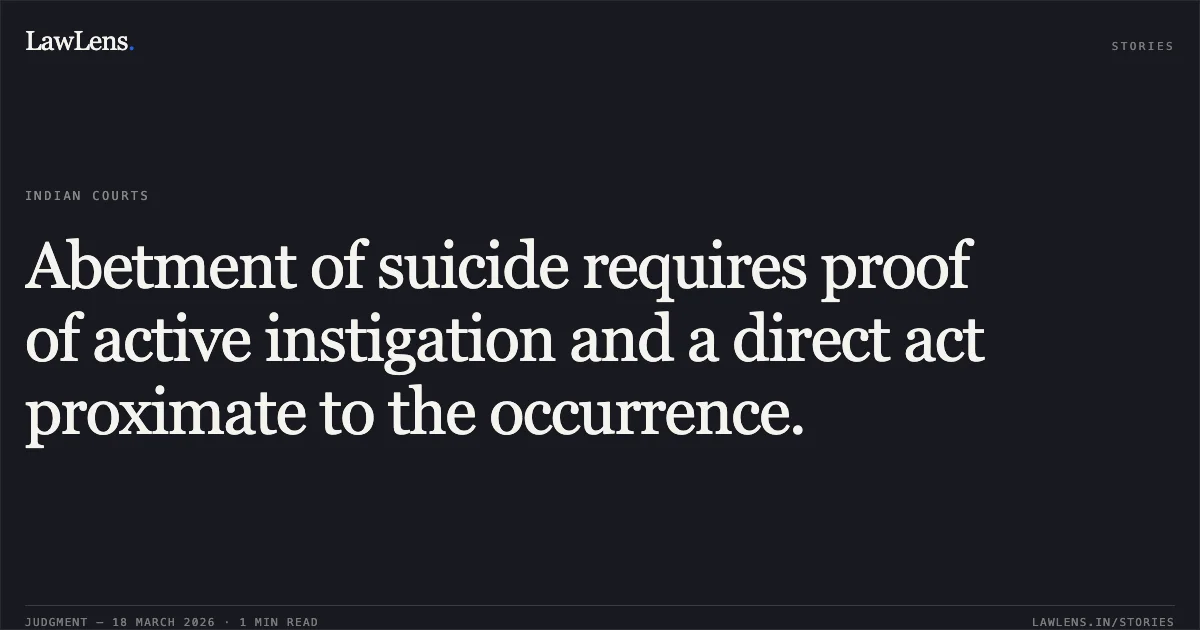
Source reference: para 10following Amalendu Pal v. State of West Bengal (2010), the court emphasized that harassment alone, without positive action proximate to the time of suicide, is insufficient for a conviction under Section 306
Source reference: para 10.2Regarding appellate review of acquittals, the court applied the "double presumption of innocence" principle from Chandrappa v. State of Karnataka (2007) and Constable 907 Surendra Singh v. State of Uttarakhand (2025), holding that if two reasonable views are possible, the Appellate Court must not disturb an acquittal
Source reference: para 17, 18Reasoning
The Court observed that the prosecution’s evidence, primarily the testimony of the deceased’s brother (P.W.3), lacked specificity regarding the nature, dates, or specific words used during the alleged harassment
Source reference: para 8.6It was noted that during the 10-year marriage, no prior complaints or community meetings regarding domestic discord were ever initiated
Source reference: para 8.4, 8.7Critically, the Court found no evidence of any "proximate act" or immediate provocation by the accused that triggered the suicide; mere routine domestic disagreements or taunts about childlessness do not legally constitute "instigation" under Section 107 IPC
Source reference: para 9.1, 9.5, 9.7The Court highlighted that for Section 306 to apply, there must be a mens rea (culpable mental state) to drive the person to suicide, which was absent here
Source reference: para 9.6Since the Trial Court’s view—that the evidence was insufficient—was a "possible view," the High Court determined it could not be labeled "perverse"
Source reference: para 12, 16Holding
The High Court dismissed the State's appeal and confirmed the judgment of acquittal
The Court held that the prosecution failed to prove the foundational elements of abetment, specifically failing to demonstrate a direct or indirect act of incitement proximate to the death
Source reference: para 9.8, 10.4The Court found no patent perversity or misreading of evidence in the Trial Court's decision and maintained the reinforced presumption of innocence in favor of the respondents
Source reference: para 18, 20Acts & Sections Cited
7 provisions across 2 statutes referred to in this judgment. Each provision opens on LawLens.
Indian Penal Code, 18605
Code of Criminal Procedure, 19732
Original Court PDF
STATE OF GUJARATvsRAMESHBHAI KANABHAI CHAMAR
Click to open original judgment
Original judgment, available to read, download and summarize on LawLens.in