Facts
The State of Gujarat appealed the acquittal of the respondents (the husband and in-laws of the deceased) for offences under Sections 498(A), 306, and 114 of the Indian Penal Code (IPC)
Source reference: p. 1The prosecution alleged that the deceased, Kailashben, was subjected to continuous mental and physical harassment regarding her character by the accused
Source reference: p. 1-2On March 4, 2009, the deceased committed suicide by jumping into a well along with her minor son, Hardik.
Source reference: no citationPost-mortem reports confirmed the cause of death as asphyxia from drowning, with no external injuries noted
Source reference: p. 7, 11During the trial, the deceased's brother admitted she was emotionally sensitive to minor matters
Source reference: p. 8Several independent witnesses, including the husband of the village Sarpanch and other villagers, did not support the prosecution's claims of harassment
Source reference: p. 8-9The trial court acquitted the accused on August 26, 2010, finding the evidence insufficient to prove the charges beyond reasonable doubt
Source reference: p. 4Issues
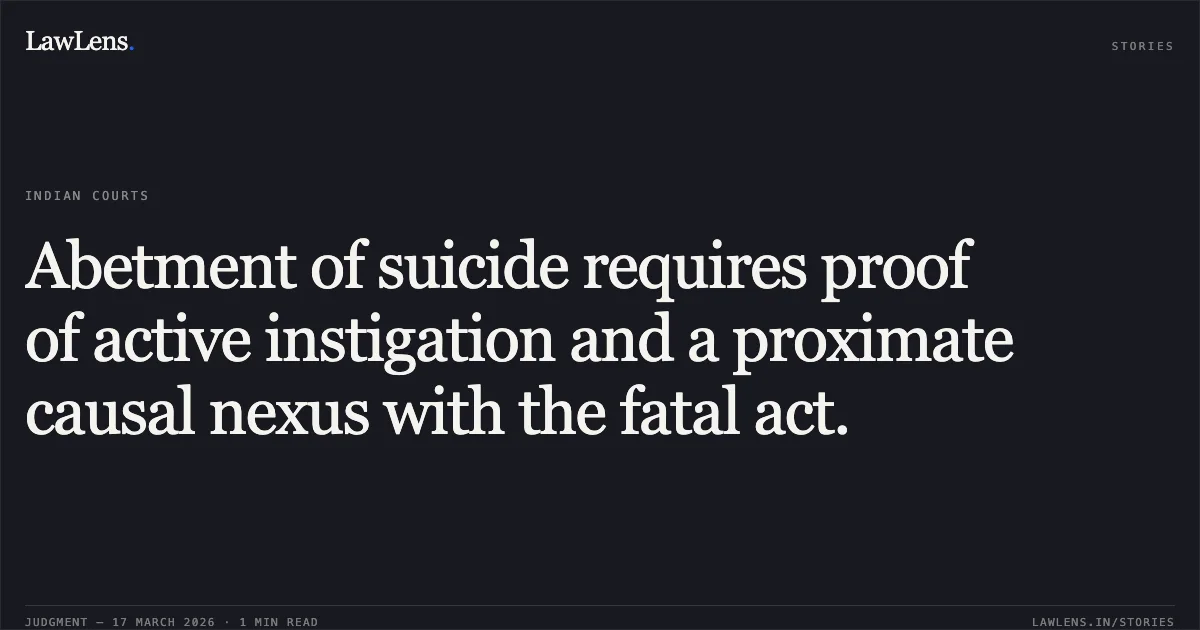
1. Whether the prosecution established a "live link" or proximate act of instigation by the accused that led the deceased to commit suicide under Section 306 IPC
Source reference: p. 14, 192. Whether the allegations of harassment met the legal threshold of "cruelty" required under Section 498A IPC
Source reference: p. 113. Whether the trial court’s order of acquittal was perverse or based on a misreading of material evidence, warranting interference by the appellate court
Source reference: p. 25Law Applied
The court primarily applied Section 306 IPC (Abetment of suicide) read with Section 107 IPC, which requires evidence of instigation, conspiracy, or intentional aiding
Source reference: p. 1, 12-13It relied on the principle from Mahendra K.C. v. State of Karnataka, stating that instigation requires a "reasonable certainty" to incite the consequence and that words spoken in anger do not constitute abetment
Source reference: p. 15-16Furthermore, the court applied the doctrine from Amalendu Pal v. State of West Bengal, which holds that mere harassment without a positive, proximate act of incitement is insufficient for conviction under Section 306
Source reference: p. 17Regarding appellate powers, it followed Chandrappa v. State of Karnataka, emphasizing the "double presumption of innocence" in favor of the accused in acquittal appeals
Source reference: p. 23-24Reasoning
The Court found that the prosecution failed to prove any specific act of cruelty or instigation immediately preceding the suicide.
Source reference: no citationAlthough the complainant alleged character assassination, the testimony of the deceased's brother revealed that she was emotionally fragile
Source reference: p. 8The evidence suggested that a disagreement regarding the availability of a vehicle to take the deceased to her parental home may have triggered her distress, but this did not legally constitute "instigation" to commit suicide
Source reference: p. 10The Court reasoned that Section 306 IPC requires a clear mens rea and a direct causal link, neither of which were established here
Source reference: p. 14Furthermore, the lack of external injuries on the body and the fact that independent witnesses turned hostile weakened the prosecution's case
Source reference: p. 11The Court emphasized that routine domestic disagreements do not ipso facto amount to abetment
Source reference: p. 14Holding
The High Court held that the prosecution failed to prove that the accused stimulated or compelled the deceased to end her life.
It affirmed that without a positive act proximate to the time of the incident, a conviction under Section 306 IPC is unsustainable
Source reference: p. 17-18Finding no patent perversity or manifest illegality in the trial court's reasoning, the Court dismissed the appeal and upheld the judgment of acquittal
Source reference: p. 25-26Acts & Sections Cited
6 provisions across 2 statutes referred to in this judgment. Each provision opens on LawLens.
Indian Penal Code, 18604
Code of Criminal Procedure, 19732
Original Court PDF
STATE OF GUJARATvsASHOKBHAI PARSHOTTAMBHAI GOHIL
Click to open original judgment
Original judgment, available to read, download and summarize on LawLens.in


