Facts
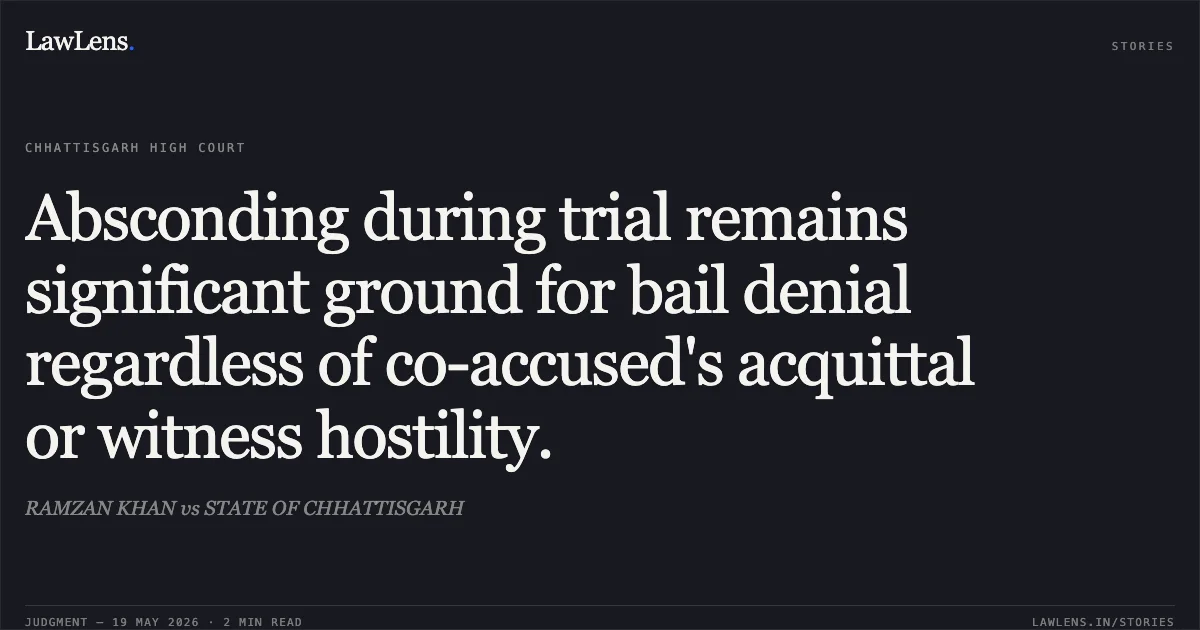
The applicant, Ramzan Khan, was arrested in connection with Crime No. 249/2023 for allegedly participating in a pre-planned conspiracy to defraud individuals by promising Group D railway jobs using forged documents.
Source reference: para. 1, 3While co-accused persons were tried and some acquitted, the applicant remained absconding, leading to the separation of his trial.
Source reference: para. 3, 7His first bail application (MCRC No. 3889 of 2025) was rejected on 20.05.2025 specifically due to his abscondence.
Source reference: para. 2The applicant filed this second bail application arguing that the main accused had been acquitted, two out of six witnesses had turned hostile, and he had been in custody since 15.01.2025.
Source reference: para. 4Issues
1. Whether the acquittal of a co-accused and the hostile testimony of two witnesses entitle an applicant, who was previously absconding, to regular bail under Section 483 of the Bhartiya Nagarik Suraksha Sanhita, 2023.
Source reference: para. 4, 7Law Applied
The court followed the principles governing regular bail under Section 483 of the Bhartiya Nagarik Suraksha Sanhita, 2023 (corresponding to Section 439 of the CrPC) for offences under Sections 420 (Cheating), 467 (Forgery of valuable security), 468 (Forgery for purpose of cheating), 120-B (Criminal conspiracy), and 34 (Common intention) of the Indian Penal Code.
Source reference: para. 1The court emphasized the judicial principle that the conduct of the accused, specifically the history of absconding during trial, is a critical factor in determining the likelihood of the accused fleeing justice if released.
Source reference: para. 2, 7Reasoning
The court analyzed the applicant's plea by weighing the evidentiary developments—the acquittal of the main accused and hostile witnesses—against the applicant’s prior conduct.
Source reference: para. 7The Chief Justice noted that while two witnesses failed to support the prosecution, this circumstance alone is insufficient to override the gravity of the applicant's previous abscondence.
Source reference: para. 7The court reasoned that since the applicant’s trial had to be separated from the co-accused due to his unavailability, the acquittal of others does not automatically translate to his entitlement for bail.
Source reference: para. 7The court maintained that the risk of the applicant absconding again outweighed the arguments regarding the merits of the evidence produced thus far.
Source reference: para. 7Holding
The court answered the issue in the negative, holding that the applicant's history of absconding remains a primary ground for denial of bail.
The High Court rejected the bail application but clarified that the trial court is at liberty to conclude proceedings expeditiously.
Source reference: para. 8, 9The office was directed to communicate the order to the trial court for compliance.
Source reference: para. 10Acts & Sections Cited
9 provisions across 3 statutes referred to in this judgment. Each provision opens on LawLens.
Bharatiya Nagarik Suraksha Sanhita, 20231
Indian Penal Code, 18607
Code of Criminal Procedure, 19731
Original Court PDF
RAMZAN KHANvsSTATE OF CHHATTISGARH
Click to open original judgment
Original judgment, available to read, download and summarize on LawLens.in