Facts
The petitioner, a 1996 batch Bihar Administrative Service officer, was transferred to Katihar in 2021. Suffering from a long-standing psychosomatic disorder, he had previously availed four years of extraordinary leave for treatment at AIIMS and Medanta.
Source reference: para. 6In April 2023, after being granted four days of casual leave, his health deteriorated; he sought extensions via email, enclosing medical prescriptions advising bed rest.
Source reference: paras. 7-8The State treated his absence as "unauthorized misconduct".
Source reference: para. 8Consequently, the petitioner was placed under suspension on 23.01.2025 and departmental proceedings were initiated on 19.08.2025.
Source reference: paras. 9-10The petitioner challenged the suspension, the charge memo, and the initiation of proceedings, while also seeking consideration for induction into the Indian Administrative Service (IAS).
Source reference: paras. 1-5, 11Issues
1. Whether the petitioner’s absence from duty, supported by contemporaneous medical records of a bona fide illness, constitutes "willful" misconduct justifying disciplinary action.
Source reference: para. 412. Whether the continued suspension of the petitioner for over fifteen months is legally sustainable under Rule 9(1)(a) of the Bihar CCA Rules and Supreme Court mandates.
Source reference: para. 40, 48Law Applied
The Court primarily applied the principle from Krushnakant B. Parmar v. Union of India, which establishes that "unauthorized absence" does not amount to misconduct unless it is proved to be "willful" rather than due to compelling circumstances like illness.
Source reference: para. 41The Court relied on Chhel Singh v. M.G.B. Gramin Bank, holding that disciplinary authorities cannot disbelieve medical certificates from reputable institutions like AIIMS without valid evidence of forgery.
Source reference: para. 46The Court invoked Rule 180(b) of the Bihar Service Code, which allows post-facto regularization of leave.
Source reference: para. 26The Court applied the time-limit mandates for suspension set in Ajay Kumar Choudhary v. Union of India and State of Tamil Nadu v. Promod Kumar, IPS.
Source reference: paras. 48-49Reasoning
The Court observed that the petitioner’s illness was not in dispute, as the State’s counter-affidavit admitted it did not view the illness as a "pretence".
Source reference: para. 45Applying Krushnakant B. Parmar, the Court reasoned that since the absence was caused by a documented medical condition (psychosomatic disorder) and communicated regularly with prescriptions, it lacked the element of "willfulness" necessary to constitute misconduct under Rule 3 of the Bihar Government Servant Conduct Rules, 1976.
Source reference: paras. 43, 49The Court dismissed the State's argument regarding the "prescribed format" of leave applications as a mere procedural irregularity that cannot defeat substantive rights during a genuine medical crisis.
Source reference: para. 47The Court found the suspension, which exceeded fifteen months, to be in violation of the three-month threshold for review established in Ajay Kumar Choudhary, especially since the departmental proceedings were initiated mechanically without addressing the petitioner's medical explanations.
Source reference: paras. 48-49Holding
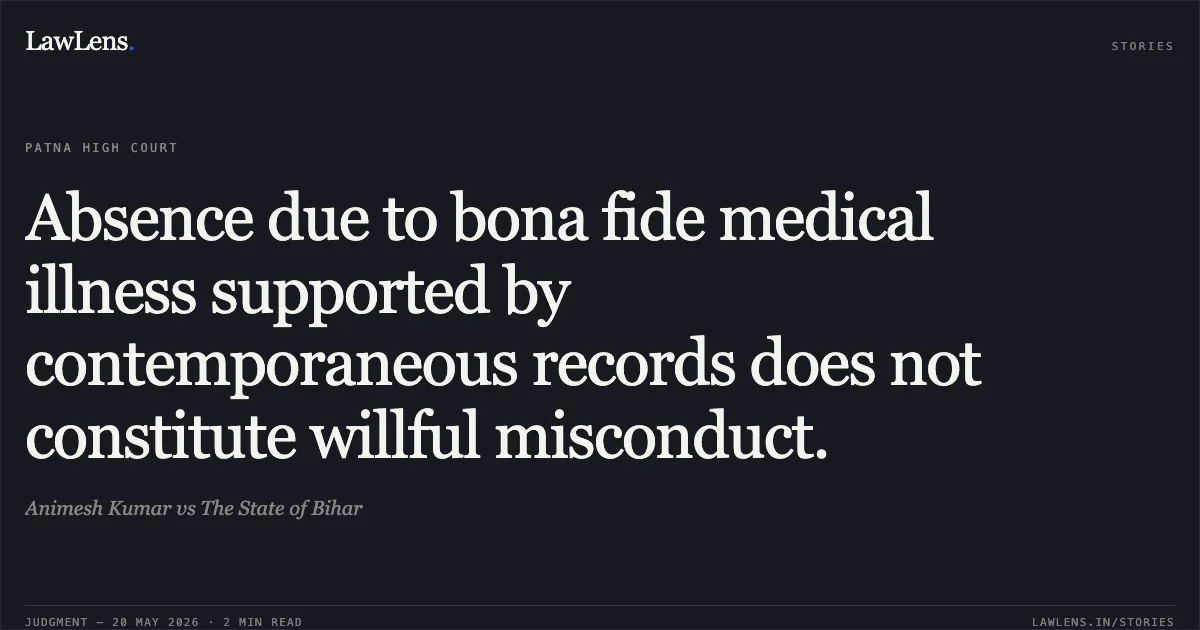
The Court held that unauthorized absence due to bona fide illness does not constitute misconduct.
The Court allowed the writ petition and quashed the suspension order (23.01.2025), the charge memo (27.12.2023), and the initiation of departmental proceedings (19.08.2025).
Source reference: para. 50The respondents were directed to reinstate the petitioner with all consequential benefits.
Source reference: para. 50The UPSC and State authorities were directed to reconsider the petitioner's induction into the IAS cadre afresh, uninfluenced by the quashed penalties, in accordance with the IAS (Appointment by Promotion) Regulations, 1955.
Source reference: paras. 51-52Original Court PDF
Animesh KumarvsThe State of Bihar
Click to open original judgment
Original judgment, available to read, download and summarize on LawLens.in