Facts
The Appellants (landowners) challenged the acquisition of 27 hectares of land in Village Sheopura, Jaipur, for Phase II of the Jaipur Metro Rail Project.
Source reference: para. 3Following a Section 4(1) notification under the Land Acquisition Act, 1894 ("LA Act") on May 26, 2011, the Appellants filed objections under Section 5A.
Source reference: para. 4a-bAfter several hearings, the Appellants failed to appear on April 9, 2012, to file a rejoinder.
Source reference: para. 4dSubsequently, the Land Acquisition Officer ("LAO") reported that the land was needed for public purpose, stating "objections are not being considered," and recommended acquisition.
Source reference: para. 4eA Section 6 declaration was issued on July 5, 2012.
Source reference: para. 4fA Single Judge of the High Court quashed the acquisition for lack of effective hearing, but a Division Bench reversed this decision, holding that the Appellants abandoned their right to hearing by their absence.
Source reference: para. 4jIssues
1. Whether there was substantial non-compliance or colorable compliance with the mandatory requirement of a personal hearing under Section 5A of the LA Act.
Source reference: para. 102. Whether the Appellants’ objections were duly considered by the LAO and the State Government before issuing the Section 6 declaration.
Source reference: para. 553. Whether the objections regarding ecological sensitivity and alternative land availability were sufficient to invalidate the acquisition.
Source reference: para. 55Law Applied
The Court applied Section 5A and Section 6 of the Land Acquisition Act, 1894. Section 5A provides a mandatory right to object and an opportunity to be heard, acting as a safeguard against arbitrary expropriation.
Source reference: paras. 11, 18The Court relied on Farid Ahmed v. Municipal Corporation of Ahmedabad, affirming that Sections 5A is mandatory and personal hearing is a duty of the Collector.
Source reference: para. 16Women Education Trust v. State of Haryana, which establishes that the Collector must objectively consider objections with brief reasons.
Source reference: para. 20Surinder Singh Brar v. Union of India that hearing must be effective, not a sham.
Source reference: para. 19Regarding the choice of land, the Court applied the "responsible discretion" of the executive from State of Punjab v. Gurdial Singh.
Source reference: para. 76For ecological claims, it applied Naveen Solanki v. Rail Land Development Authority, holding that existence of trees does not automatically equate to "deemed forest" status.
Source reference: para. 83Reasoning
The Court analyzed the procedural history and found that the LAO afforded multiple opportunities for hearing over nearly a year.
Source reference: para. 45It held that the Appellants' absence on April 9, 2012, and their failure to seek an adjournment or inquire about the next date constituted an abandonment of their right to a hearing.
Source reference: paras. 49, 54The Court clarified that the LAO’s remark that "objections are not being considered" meant they did not merit acceptance in light of the overarching public purpose, rather than a total failure to look at them.
Source reference: para. 63Regarding the substance of the objections, the Court reasoned that the State is the best judge of "public purpose" and land suitability; thus, a landowner cannot dictate alternative sites like RIICO or IOCL land.
Source reference: paras. 76-79, 81Finally, the Court noted that the land was not recorded as "forest" in any Master Plan, and the Division Bench's direction for transplantation of trees sufficiently addressed ecological concerns.
Source reference: paras. 84-85Holding
The Supreme Court dismissed the appeals and upheld the Division Bench's judgment, confirming the validity of the acquisition.
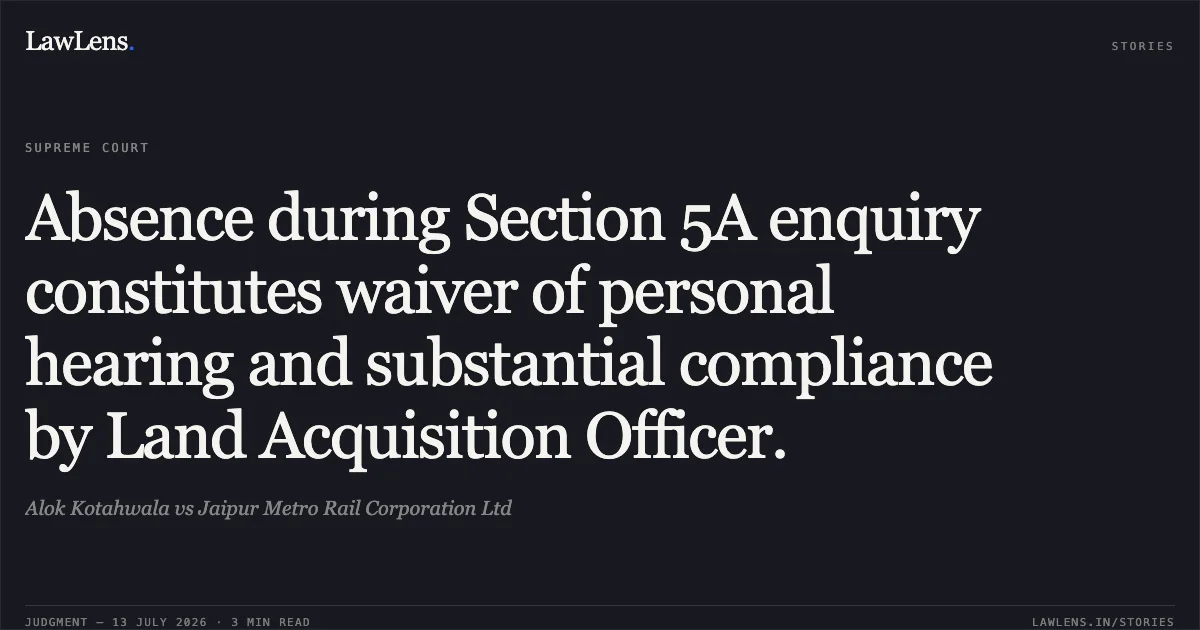
The Court held that the mandate of Section 5A was substantially complied with and that the Appellants, through their own lack of diligence, waived their right to a personal hearing.
Source reference: para. 54It further held that the objections regarding alternative land and ecological impact were unmeritorious and could not override the expert planning of the Metro project.
Source reference: paras. 86, 88The interim stay was vacated, but the Appellants were granted liberty to pursue remedies for enhanced compensation regarding the award passed on May 7, 2026.
Source reference: paras. 89-90Acts & Sections Cited
6 provisions across 2 statutes referred to in this judgment. Each provision opens on LawLens.
Right to Fair Compensation and Transparency in Land Acquisition, Rehabilitation and Resettlement Act, 20134
Original Court PDF
Alok KotahwalavsJaipur Metro Rail Corporation Ltd
Click to open original judgment
Original judgment, available to read, download and summarize on LawLens.in


