Facts
The claimants (Respondents No. 1 & 2) were awarded compensation of ₹9,26,800 by the Motor Accident Claims Tribunal, Kondagaon, in Claim Case No. 38/2017
Source reference: p. 2, para 1The Tribunal fastened liability on the Appellant (Insurance Company) despite finding that the owner of the offending vehicle (Respondent No. 4) lacked a valid fitness certificate at the time of the accident
Source reference: p. 3, para 5The Tribunal relied on the Single Bench decision in National Insurance Company Limited v. Ghanaram Sahu to hold the insurer liable
Source reference: p. 3, para 5-6The Insurance Company appealed, seeking exoneration based on the fundamental breach of policy conditions
Source reference: p. 2, para 2Issues
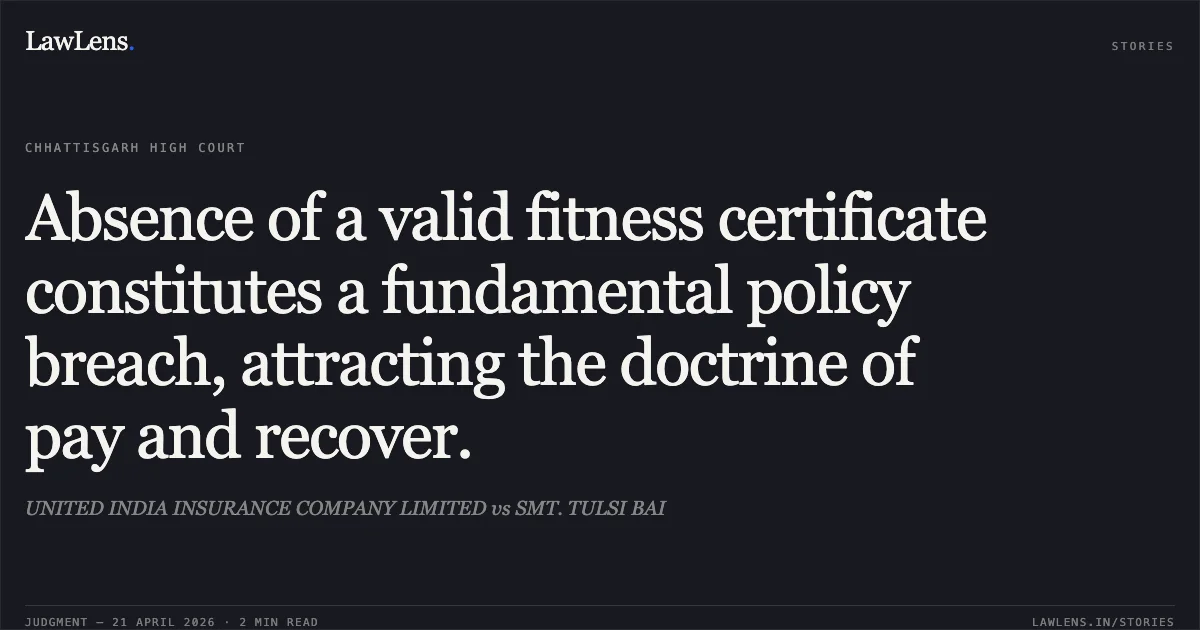
1. Whether the absence of a valid fitness certificate for an offending vehicle constitutes a fundamental breach of policy conditions exonerating the Insurance Company from liability
Source reference: p. 2, para 22. Whether the doctrine of "pay and recover" is applicable when a vehicle is plied without a valid fitness certificate
Source reference: p. 4-5, para 8Law Applied
The Court primarily considered Section 149 of the Motor Vehicles Act regarding statutory defenses for insurers
Source reference: p. 4, para 6The Division Bench precedent of the Chhattisgarh High Court in Adesh Kumar v. Smt. Satarupa Bai Yadav (2020:CGHC:18660-DB), which incorporated the Kerala High Court Full Bench decision in Ramankutty v. Pareed Pillai, establishing that plying a vehicle without a fitness certificate is a fundamental breach of policy
Source reference: p. 4, para 7The Court applied the "pay and recover" doctrine as settled by the Supreme Court in Amrit Paul Singh v. Tata AIG General Insurance Company Limited (2018) 7 SCC 558
Source reference: p. 4-5, para 8Reasoning
The Court observed that while the Claims Tribunal relied on Ghanaram Sahu to hold the insurer liable, the subsequent Division Bench ruling in Adesh Kumar is the binding authority
Source reference: p. 4, para 7The Division Bench clearly held that the absence of a fitness certificate represents a fundamental breach
Source reference: p. 4, para 7Applying this to the present facts, the Court confirmed that the owner (Respondent No. 4) violated policy conditions
Source reference: p. 4, para 8Following the equitable principles laid down in Amrit Paul Singh, the Court reasoned that the insurer's statutory obligation to third parties remains, though they are entitled to reimbursement from the tortfeasor
Source reference: p. 5, para 8Holding
The Court partly allowed the appeal and modified the impugned award
It held that while the lack of a fitness certificate is a fundamental breach, the Insurance Company must first deposit the entire compensation amount plus interest for the claimants and is subsequently authorized to recover the same from the owner and driver of the offending vehicle in accordance with law
Source reference: p. 5, para 8Acts & Sections Cited
1 provisions across 1 statute referred to in this judgment. Each provision opens on LawLens.
Motor Vehicles Act, 19881
Original Court PDF
UNITED INDIA INSURANCE COMPANY LIMITEDvsSMT. TULSI BAI
Click to open original judgment
Original judgment, available to read, download and summarize on LawLens.in