Facts
The Petitioner was prosecuted for an offense under Section 138 of the Negotiable Instruments Act in Criminal Case No. 882 of 2024.
Source reference: no citationAlthough the Petitioner initially pleaded not guilty.
Source reference: p. 2He subsequently failed to appear before the Trial Court.
Source reference: p. 2Consequently, his rights to cross-examine the complainant and record a statement under Section 313 of the CrPC were closed.
Source reference: p. 2The Trial Court proceeded ex parte, convicting the Petitioner on January 8, 2026, and issued a Non-Bailable Warrant (NBW) due to his absence during the pronouncement of judgment.
Source reference: p. 2The Petitioner approached the High Court seeking to convert the NBW into a Bailable Warrant to facilitate the filing of an appeal without immediate arrest.
Source reference: p. 3Issues
Whether the Non-Bailable Warrant issued by the Trial Court upon conviction should be converted into a Bailable Warrant to enable the Petitioner to file an appeal.
Source reference: p. 3Whether the Petitioner’s justifications for absence (pendency of other FIRs and lack of communication from counsel) warrant discretionary relief under Articles 226 and 227 of the Constitution.
Source reference: p. 3-4Law Applied
The court considered the procedural mandates of the Code of Criminal Procedure regarding the presence of the accused during judgment and the discretionary powers of the High Court under Articles 226 and 227 of the Constitution of India.
Source reference: p. 1The court balanced the statutory right to appeal under the Negotiable Instruments Act, 1881, against the conduct of the accused and the necessity of surrendering to the jurisdiction of the court following a conviction.
Source reference: p. 4-5Reasoning
The Court rejected the Petitioner's arguments that an FIR in a different district or the negligence of his advocate excused his continuous absence.
Source reference: p. 3It noted that the Petitioner had stopped appearing long before the date of the cited FIR, indicating a deliberate attempt to evade proceedings.
Source reference: p. 3The Court observed that the Trial Court was "constrained to proceed ex parte" because the Petitioner showed "utter disregard" for the judicial process by staying absent during the cross-examination, the Section 313 statement, and the final pronouncement.
Source reference: p. 4-5The Court reasoned that since the Petitioner willfully bypassed the trial, he cannot now seek an equitable remedy to bypass the legal requirement of surrendering before the Trial Court to seek bail or file an appeal.
Source reference: p. 5Holding
The Court answered the issues in the negative, holding that the Petitioner's request for conversion of the warrant could not be accepted due to his "utter disregard" for the Trial Court.
The High Court maintained that the Petitioner must first surrender before the learned Trial Court to pursue further legal remedies.
Source reference: p. 5The Petition was dismissed.
Source reference: p. 5Acts & Sections Cited
2 provisions across 2 statutes referred to in this judgment. Each provision opens on LawLens.
Negotiable Instruments Act, 18811
Code of Criminal Procedure, 19731
Original Court PDF
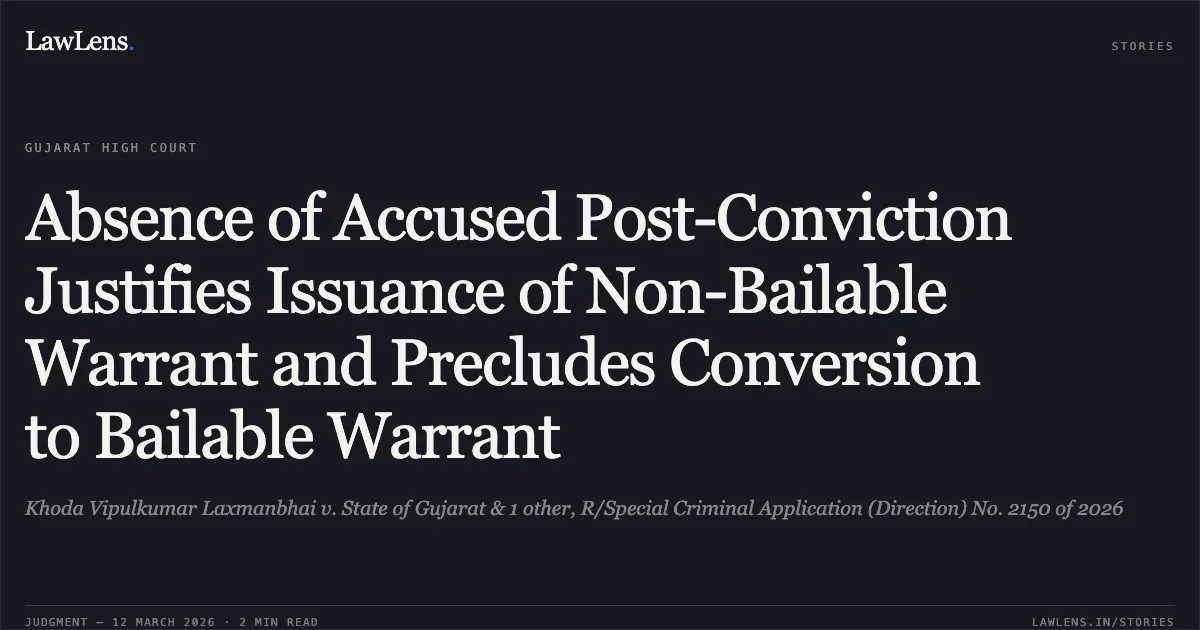
Khoda Vipulkumar Laxmanbhai v. State of Gujarat & 1 other, R/Special Criminal Application (Direction) No. 2150 of 2026
Click to open original judgment
Original judgment, available to read, download and summarize on LawLens.in