Facts
On January 31, 2024, the Petitioner was intercepted at IGI Airport, Delhi, while traveling to Auckland via Singapore. During inline baggage screening, security officials discovered one live cartridge (engraved "32 KFS & WI") in his checked luggage
Source reference: p. 1, 2Consequently, FIR No. 94/2024 was registered under Section 25 of the Arms Act, 1959
Source reference: p. 1The Petitioner contended that the possession was not "conscious," as the cartridge belonged to his brother’s licensed firearm and was inadvertently left in the bag due to oversight
Source reference: p. 2The State’s investigation confirmed that the Petitioner’s brother held a valid arms license for a .32 bore weapon and was authorized to purchase ammunition
Source reference: p. 2A charge-sheet was filed, though cognizance had not yet been taken by the Trial Court
Source reference: p. 2Issues
1. Whether the mere physical recovery of a live cartridge, in the absence of mens rea or "conscious possession," is sufficient to sustain a prosecution under Section 25 of the Arms Act, 1959.
Source reference: p. 2, 62. Whether the high court should exercise its inherent powers to quash the FIR to prevent the abuse of the process of law.
Source reference: p. 6Law Applied
Section 25 of the Arms Act, 1959, which penalizes the possession of unlicensed firearms and ammunition
Source reference: p. 1Constitutional Bench decision in Gunwantlal v. State of Madhya Pradesh, establishing that "possession" must comprise both physical custody and an element of consciousness or knowledge
Source reference: p. 4Sanjay Dutt v. State Through CBI, which clarified that "possession" in statutory offences means "conscious possession" and not mere custody without awareness
Source reference: p. 4, 5Section 45(d) of the Arms Act, which provides certain protections regarding "minor ammunition," and Section 528 of the BNSS (formerly Section 482 CrPC regarding inherent powers)
Source reference: p. 2, 6Reasoning
The Court analyzed the facts against the established precedent that "conscious possession" is a prerequisite for a conviction under the Arms Act. It noted that the Petitioner was unaware of the cartridge’s presence and possessed no firearm at the time of the search, which negated any animus possidendi or intent to use the ammunition
Source reference: p. 6The Court observed that the cartridge belonged to the Petitioner's brother, a valid licensee, supporting the claim of accidental oversight
Source reference: p. 2Citing Mohd. Nazim v. State and Chan Hong Saik v. State, the Court reasoned that the recovery of a solitary cartridge without any suspicious circumstances or accompanying weapon constitutes "minor ammunition" and does not warrant criminal prosecution
Source reference: p. 5, 6Since the essential element of mens rea was conspicuously absent, the Court found that continuing the proceedings would result in an abuse of the legal process
Source reference: p. 6Holding
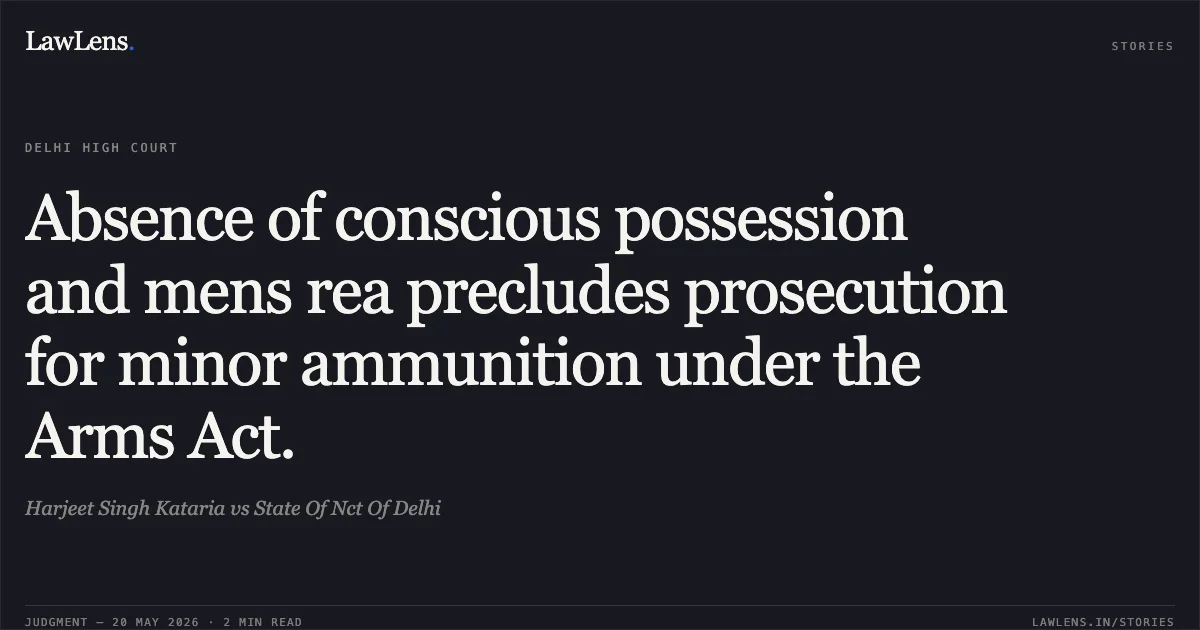
The Court answered the issues in the negative and affirmative respectively, holding that "conscious possession" is the significant ingredient for prosecution under the Arms Act
The Court exercised its inherent powers under Section 528 of the BNSS to quash FIR No. 94/2024 and all consequential proceedings. The relief was granted subject to the Petitioner depositing costs of Rs. 20,000 with the Delhi High Court Legal Services Committee within two weeks
Source reference: p. 6, 7Acts & Sections Cited
5 provisions across 2 statutes referred to in this judgment. Each provision opens on LawLens.
Arms Act, 19594
Bharatiya Nagarik Suraksha Sanhita, 20231
Original Court PDF
Harjeet Singh KatariavsState Of Nct Of Delhi
Click to open original judgment
Original judgment, available to read, download and summarize on LawLens.in


