Facts
The deceased, Chandrikaben, married Respondent No. 1 (accused) approximately one year prior to the incident; it was the second marriage for both parties.
Source reference: p. 8On May 15, 2010, Chandrikaben died by self-immolation (burning) at her matrimonial home.
Source reference: p. 2The father of the deceased filed an FIR alleging that the accused subjected her to physical and mental harassment over household work, insufficient dowry, and her inability to conceive.
Source reference: p. 2, 8The Trial Court (8th Ad-hoc Additional Sessions Judge, Panchmahal) acquitted the respondents of charges under Sections 306, 498(A), and 114 of the IPC and Sections 3 and 7 of the Dowry Prohibition Act.
Source reference: p. 1, 7The State of Gujarat filed this appeal against the acquittal.
Source reference: p. 1Issues
1. Whether the Trial Court was justified in passing the judgment and order of acquittal based on the appreciation of oral and documentary evidence.
Source reference: p. 7 / para. 102. Whether the prosecution proved the ingredients of "cruelty" and "abetment of suicide" beyond a reasonable doubt.
Source reference: p. 8 / para. 113. Whether there is any manifest illegality or perversity in the Trial Court’s findings that would warrant interference by the Appellate Court.
Source reference: p. 7 / para. 10Law Applied
The court applied Section 498A IPC (cruelty by husband or relatives), Section 306 IPC (abetment of suicide), and Section 114 IPC (abettor present during offence).
Source reference: p. 10-11It also considered Section 113A and 113B of the Evidence Act regarding presumptions as to dowry death and abetment of suicide.
Source reference: p. 11The court relied on the principle established in Chandrappa v. State of Karnataka, holding that an appellate court should not disturb an order of acquittal if two reasonable conclusions are possible, as the presumption of innocence is reinforced by the acquittal.
Source reference: p. 13-14Reasoning
The High Court found that the prosecution's allegations of harassment were contradicted by the evidence of its own witnesses. The father (P.W. 5) admitted that the deceased had previously attempted suicide during her first marriage over minor scolding, indicating a sensitive temperament.
Source reference: p. 9Testimony revealed the husband had returned most of a borrowed sum to the father, undermining the "dowry demand" theory.
Source reference: p. 10Allegations of harassment for infertility were disproven by the fact that the deceased had actually conceived but suffered a miscarriage.
Source reference: p. 9-10Crucially, the prosecution failed to examine the deceased’s younger brother, who lived with the couple shortly before the incident and could have confirmed any ill-treatment.
Source reference: p. 11-12The court noted significant omissions and contradictions between preliminary police statements and trial testimonies, suggesting the allegations were afterthoughts.
Source reference: p. 9Holding
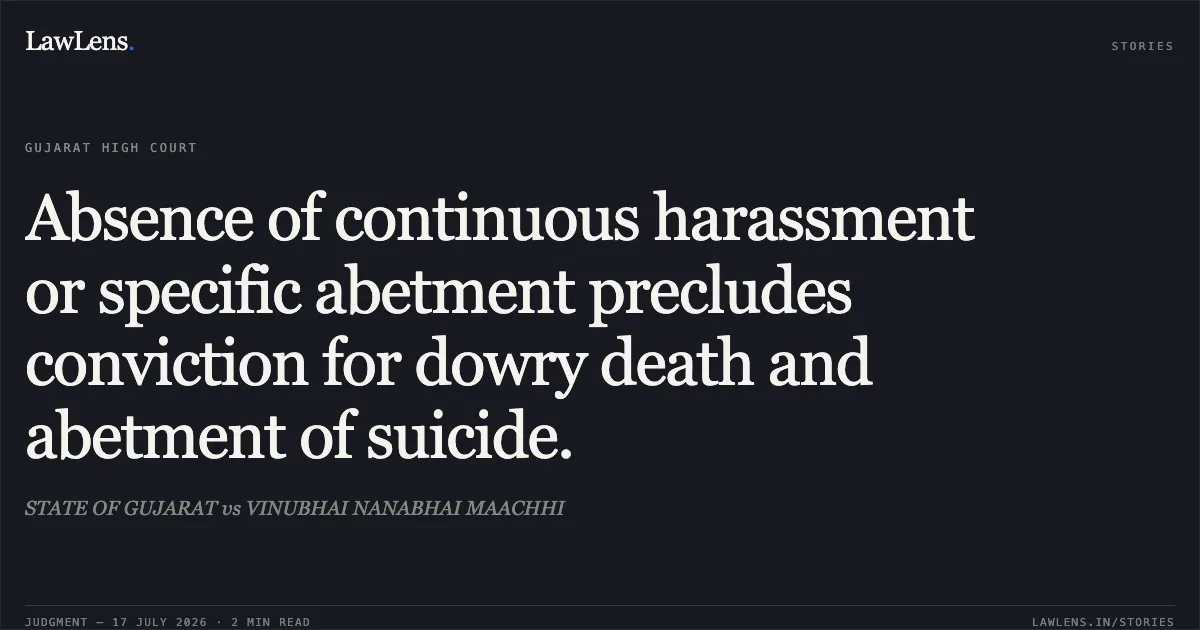
The High Court held that the prosecution miserably failed to prove the charges beyond a reasonable doubt.
The High Court dismissed the appeal and confirmed the Trial Court’s acquittal. The bail bonds were cancelled.
Source reference: p. 16Applying the standard for appeals against acquittal, the Court found no manifest illegality, perversity, or misreading of evidence in the Trial Court's judgment; therefore, the double presumption of innocence in favor of the accused remained intact.
Source reference: p. 13-15Acts & Sections Cited
6 provisions across 3 statutes referred to in this judgment. Each provision opens on LawLens.
Code of Criminal Procedure, 19732
Indian Penal Code, 18602
Original Court PDF
STATE OF GUJARATvsVINUBHAI NANABHAI MAACHHI
Click to open original judgment
Original judgment, available to read, download and summarize on LawLens.in