Facts
The appellant was convicted by the Trial Court on 27.09.2021 under Sections 376AB and 342 of the IPC, and Section 6 of the POCSO Act, for the alleged aggravated penetrative sexual assault of a six-year-old girl
Source reference: p. 1-2The prosecution alleged that on 24.12.2018, the appellant lured the victim into a room, bolted it, and committed the offence
Source reference: p. 3, 12-13The victim’s mother (PW-3) refused an internal medical examination to avoid further trauma to the child
Source reference: p. 15The appellant challenged the conviction on grounds of a defective charge, lack of medical corroboration, and inconsistencies in the victim's statement regarding the act of penetration
Source reference: p. 4-7Issues
Whether the failure to specify the exact room/floor in the Charge and the lack of a scaled site plan prejudiced the appellant's right to a fair trial
Source reference: p. 4, 19-20Whether an adverse inference should be drawn against the prosecution due to the refusal of a gynaecological medical examination of the victim
Source reference: p. 5, 21Whether the evidence established "penetration" beyond reasonable doubt to sustain a conviction for "Aggravated Penetrative Sexual Assault" under Section 6 of the POCSO Act
Source reference: p. 7, 29-32Law Applied
The court primarily applied Section 215 of the Cr.P.C., which stipulates that errors in a charge do not vitiate a trial unless they mislead the accused or cause a failure of justice
Source reference: p. 20It invoked Sections 29 and 30 of the POCSO Act, which mandate a legal presumption of guilt and culpable mental state once foundational facts are established
Source reference: p. 18-19The court relied on *B.C. Deva v. State of Karnataka* regarding conviction based on the cogent oral testimony of a victim without medical corroboration
Source reference: p. 22and *Balveer Singh v. State of M.P.* concerning the reliability and preliminary examination of child witnesses
Source reference: p. 23-27Section 18 of the POCSO Act was applied for punishment for attempting to commit an offence
Source reference: p. 30Reasoning
The Court found that the omission of the exact location in the Charge did not prejudice the appellant as he was well aware of the allegations and sequence of events
Source reference: p. 20Regarding the medical examination, the Court held that the mother’s refusal was a natural reaction to protect the child from trauma and did not invalidate the victim's consistent oral testimony
Source reference: p. 21However, on the core issue of penetration, the Court noted significant ambiguities: in her Section 164 statement, the victim stated the appellant "placed" his penis "on" her vagina, and only during the trial did she allege he "put" it "in"
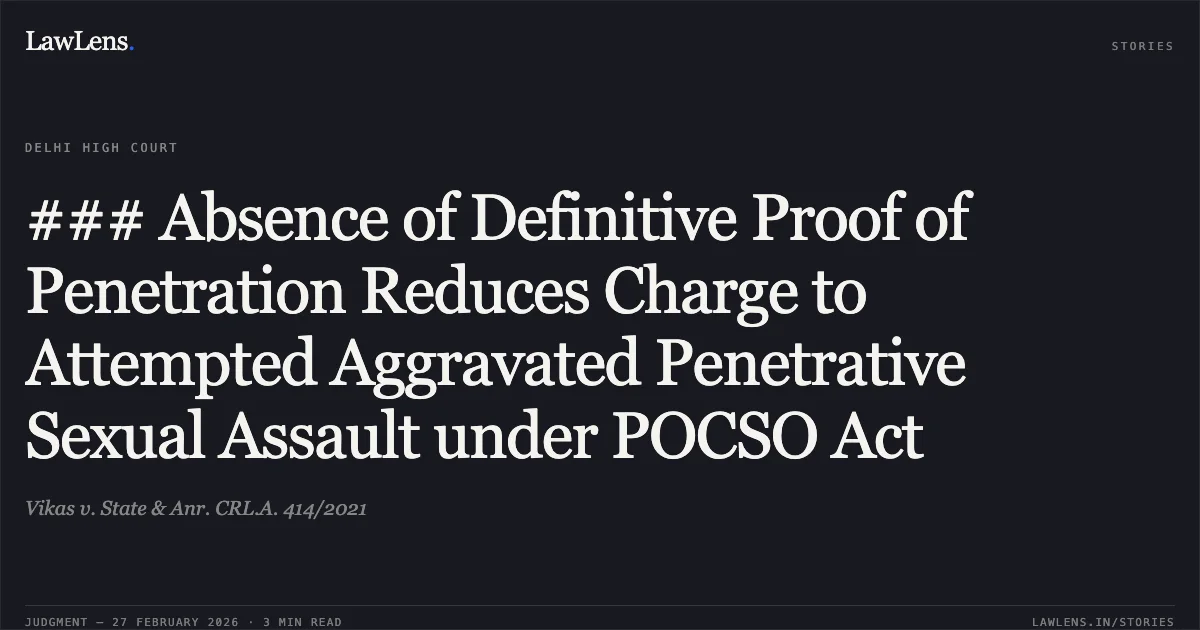
Source reference: p. 30-31Given these variations and the lack of medical evidence confirming penetration, the Court determined that the prosecution failed to prove "penetration" beyond reasonable doubt
Source reference: p. 32Nevertheless, the intent and preparation were evident, shifting the offence from completed assault to an "attempt"
Source reference: p. 32Holding
The Court partly allowed the appeal.
It set aside the conviction under Section 6 of the POCSO Act and Section 376AB of the IPC
Source reference: p. 32Instead, it held the appellant guilty of "Attempt to commit Aggravated Penetrative Sexual Assault" under Section 18 of the POCSO Act
Source reference: p. 32The sentence was reduced from 30 years to 10 years of rigorous imprisonment
Source reference: p. 33The conviction and sentence under Section 342 IPC (wrongful confinement) and the orders regarding fine and victim compensation were upheld
Source reference: p. 33Acts & Sections Cited
18 provisions across 3 statutes referred to in this judgment. Each provision opens on LawLens.
Indian Penal Code, 18601
Code of Criminal Procedure, 19736
Protection of Children from Sexual Offences Act, 2012
Original Court PDF
Vikas v. State & Anr. CRL.A. 414/2021
Click to open original judgment
Original judgment, available to read, download and summarize on LawLens.in