Facts
The appellant, a registered taxable person engaged in wholesale and distribution of cellular phones, challenged a show-cause notice dated 29.11.2024 issued under Section 73(1) of the Central Goods and Services Tax Act, 2017 and the corresponding Assam legislation for alleged wrongful availment of input tax credit for FY 2020–2021.
Source reference: para. 2–3The notice proposed a demand of ₹33,03,968 along with interest and penalty.
Source reference: para. 2–3The learned Single Judge rejected the limitation objection and held the notice to be within time.
Source reference: para. 8–13During the proceedings, an ex parte order dated 28.02.2025 was passed under Section 73(9), and ₹10 lakhs was recovered from the appellant.
Source reference: para. 14The appellant preferred the present intra-court appeal.
Source reference: no citationIssues
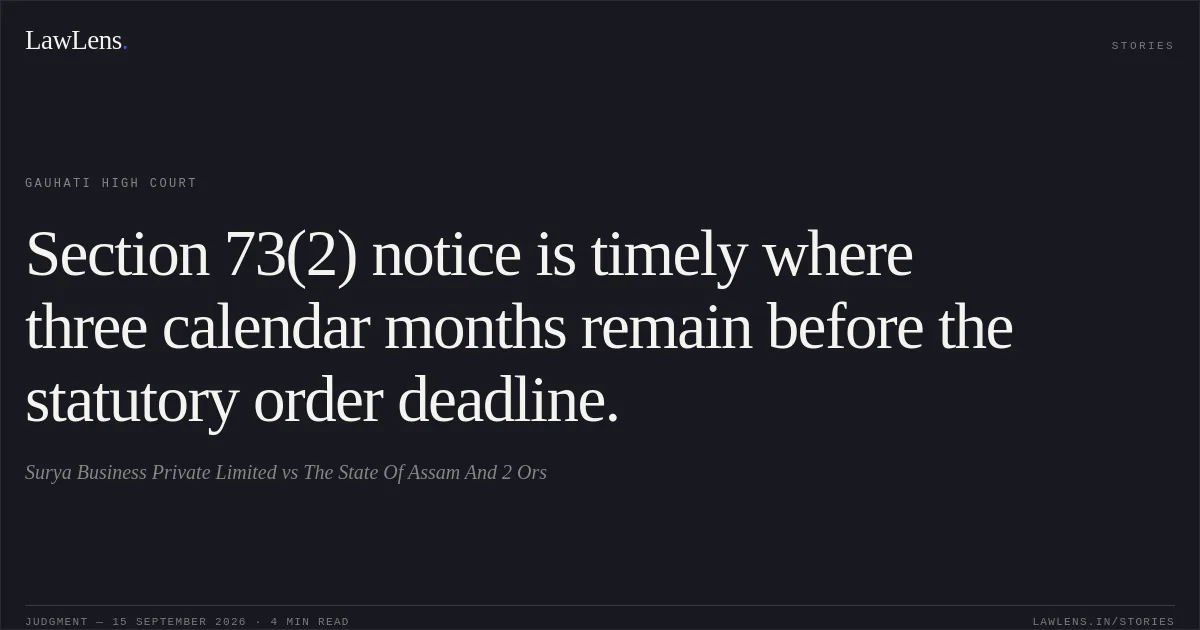
Whether the show-cause notice dated 29.11.2024 was issued within the period prescribed under Section 73(2) of the CGST/AGST Acts, having regard to the statutory deadline of 28.02.2025 under Section 73(10).
Source reference: para. 20, 29–40Whether the expression “at least three months prior to” in Section 73(2) requires computation by applying the corresponding-date principle, making 28.11.2024 the last permissible date for issuance of the notice.
Source reference: para. 29, 35–39Whether, in view of the interim proceedings and the ex parte order dated 28.02.2025, the appellant should be granted an opportunity to contest the notice.
Source reference: para. 44–46Law Applied
Section 73(1) of the CGST/AGST Acts authorises issuance of a show-cause notice for tax not paid or short-paid, erroneous refund, or wrongly availed or utilised input tax credit, in cases not involving fraud or wilful misstatement.
Source reference: p. 7–8; para. 21Section 73(2) requires the notice to be issued “at least three months prior to” the time limit under Section 73(10) for issuance of the adjudication order, while Section 73(9) provides for determination of tax, interest and penalty and Section 73(10) prescribes three years from the due date for furnishing the annual return as the outer limit for issuing the order.
Source reference: p. 8–9; para. 21Section 75(1) excludes any period during which service of notice or issuance of the order is stayed, and Section 75(10) deems the adjudication proceedings concluded if the order is not issued within the statutory period.
Source reference: p. 10–12; para. 25–28In interpreting “month,” the Court applied Section 3(35) of the General Clauses Act, 1897, under which a month is reckoned according to the British calendar.
Source reference: p. 5–6; para. 9–12, 32It also applied Section 9 of that Act and the principles recognised in Tarun Prasad Chatterjee v. Dinanath Sharma, (2000) 8 SCC 649, and Saketh India Ltd. v. India Securities Ltd., (1999) 3 SCC 1, that the first day is ordinarily excluded when computing a period from a specified date.
Source reference: p. 5–6; para. 9–12, 32The Court distinguished the corresponding-date approach discussed in Dodds v. Waker, (1981) 2 All ER 609, Bibi Salma Khatoon v. State of Bihar, (2001) 7 SCC 197, and State of Himachal Pradesh v. Himachal Techno-Engineers, (2010) 12 SCC 210, holding that Section 73(2) prescribes a minimum intervening period and not an independent backward-counting limitation date.
Source reference: p. 5–6; para. 10, 35–42Reasoning
The Court accepted 28.02.2022 as the relevant date for computing the three-year period under Section 73(10), resulting in 28.02.2025 as the outer limit for issuance of the order under Section 73(9).
Source reference: para. 17–18It held that the notice under Section 73(1), the opportunity to respond and be heard, and the final determination under Section 73(9) form part of one adjudicatory process, with Section 73(2) ensuring that a meaningful minimum period remains available before the terminal date.
Source reference: para. 22–28Since the notice was issued on 29.11.2024, excluding that date left the intervening calendar months of December 2024, January 2025 and February 2025 available before 28.02.2025.
Source reference: para. 31–34The Court rejected the appellant’s argument that the corresponding date, 28.11.2024, was the mandatory last date, reasoning that such an approach would impose a rigidity not expressed in Section 73(2), which is concerned with the availability of a minimum interval rather than a mechanically calculated independent cut-off.
Source reference: para. 35–39Accordingly, the notice was not time-barred.
Source reference: para. 40Nevertheless, because the proceedings had culminated in an ex parte order during the pendency of the writ proceedings and the interim order had restricted coercive action, the Court considered it just to restore the appellant’s opportunity to contest the notice.
Source reference: para. 44–45Holding
The Division Bench dismissed the appeal insofar as it challenged the validity of the notice dated 29.11.2024, affirming that the notice was issued within the period contemplated by Section 73(2).
However, it interfered with the order dated 28.02.2025 passed under Section 73(9) to enable the appellant to file a reply to the notice within four weeks.
Source reference: para. 44–45If a reply was filed, the adjudication was directed to be completed within three months thereafter; if not, the order dated 28.02.2025 would revive and the Revenue could proceed in accordance with law.
Source reference: para. 44–45The Court clarified that it had expressed no opinion on the merits of the tax demand or the appellant’s defence, vacated any interim order, and directed the parties to bear their own costs.
Source reference: para. 46–47Acts & Sections Cited
10 provisions across 3 statutes referred to in this judgment. Each provision opens on LawLens.
Central Goods and Services Tax Act, 20174
ASSAM GOODS AND SERVICES TAX ACT, 20174
Original Court PDF
Surya Business Private LimitedvsThe State Of Assam And 2 Ors
Click to open original judgment
Original judgment, available to read, download and summarize on LawLens.in