Facts
The appellant challenged the judgment dated 10.11.2025 passed by the Special Judge (U.A.P. Act), Haldwani, which rejected his bail application.
Source reference: p. 1-2The case arose from FIR No. 23 of 2024, involving a violent incident on 08.02.2024 at Malik-ka-Bagicha, Haldwani.
Source reference: p. 1-2During a demolition drive by the administration, a mob engaged in rioting, arson, and stone-pelting, and attacked police personnel with petrol bombs and firearms.
Source reference: p. 1-2The appellant was arrested on 11.02.2024 after his name surfaced during the investigation, primarily through identification in CCTV footage.
Source reference: p. 2The State contended that the appellant was part of a well-planned conspiracy to create terror and damage national property.
Source reference: p. 2-3The appellant, a daily wager with no criminal antecedents, argued he was falsely implicated and that his presence in the area was incidental as a local resident.
Source reference: p. 3-4Issues
1. Whether the appellant is entitled to be released on regular bail given the nature of the evidence and the duration of his incarceration
Source reference: p. 4 / para. 12Law Applied
Sections 147, 148, 149, 307, 332, 353, 427, 435, 436, and 120B of the Indian Penal Code (IPC) regarding rioting, attempted murder, and criminal conspiracy
Source reference: p. 1Sections 3 and 4 of the Prevention of Damage to Public Property Act, 1984
Source reference: p. 1Sections 15 and 16 of the Unlawful Activities (Prevention) Act (UAPA), 1967, which relate to terrorist acts
Source reference: p. 2The court's decision hinged on the evidentiary standard for bail and the principle of personal liberty in the context of prolonged pre-trial detention
Source reference: p. 4Reasoning
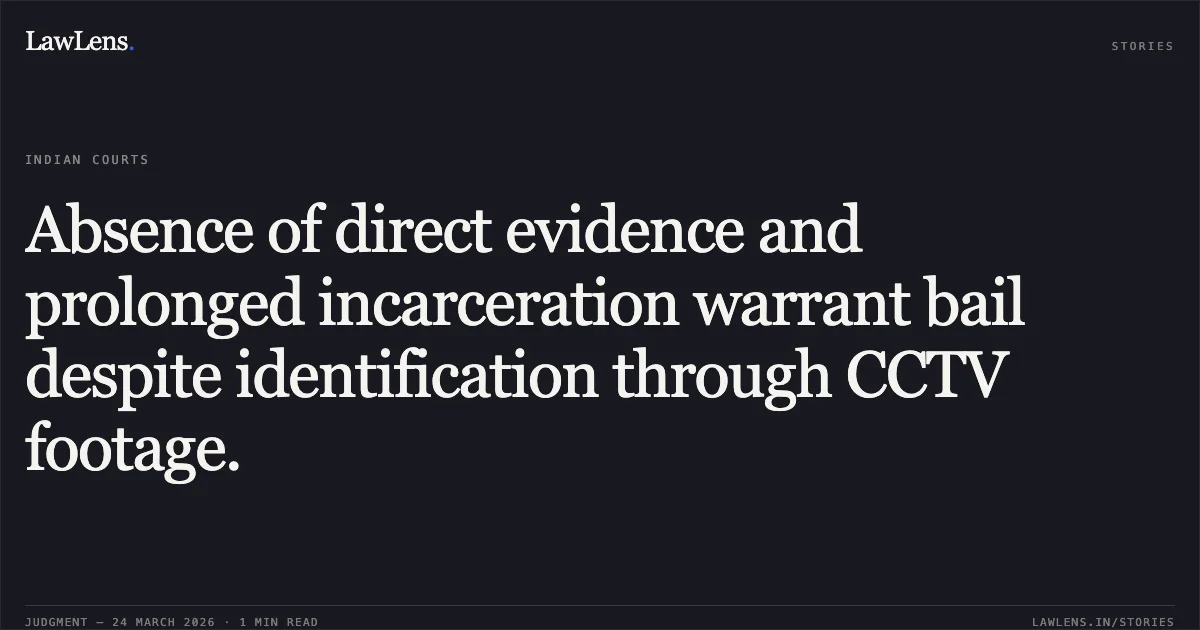
The Court observed that while the State alleged the appellant's involvement based on CCTV footage and Section 161 Cr.P.C. statements, there was a significant lack of direct evidence linking him to specific violent acts.
Source reference: p. 4The prosecution failed to demonstrate who exactly had identified the appellant from the footage.
Source reference: p. 4The Court noted that the role assigned to the appellant was general—inciting people and "pushing and shoving" within a crowd—rather than specific acts of arson or assault.
Source reference: p. 3-4Most importantly, the Court balanced the gravity of the UAPA charges against the fact that the appellant had already spent two years in custody.
Source reference: p. 4Under these circumstances, the Court found that the continued detention of the appellant was not justified, especially since no concrete evidence was presented to "nail" his specific involvement beyond his mere presence in his residential area.
Source reference: p. 3-4Holding
The High Court allowed the criminal appeal and set aside the order dated 10.11.2025.
The Court held that the appellant was entitled to regular bail due to the lack of direct evidence and his two-year period of incarceration.
Source reference: p. 4The appellant was directed to be released on executing a personal bond and furnishing two reliable sureties to the satisfaction of the trial court.
Source reference: p. 5All pending applications were disposed of accordingly.
Source reference: p. 5Acts & Sections Cited
13 provisions across 3 statutes referred to in this judgment. Each provision opens on LawLens.
Indian Penal Code, 1860
Unlawful Activities (Prevention) Act, 19672
Original Court PDF
ABU TASLEEMvsSTATE OF UTTARAKHAND
Click to open original judgment
Original judgment, available to read, download and summarize on LawLens.in