Facts
The petitioner, formerly a Nazir at Chakai Block, Jamui, was accused in Chakai P.S. Case No. 114 of 2016 of financial irregularities amounting to ₹11,00,000/- in the cash register
Source reference: para. 3The A.C.J.M-III, Jamui, took cognizance of the offences under Sections 409 and 420 of the Indian Penal Code (IPC) on 27.03.2018
Source reference: para. 2A subsequent revision petition against the cognizance order was dismissed by the Additional Sessions Judge-IV, Jamui, on 27.08.2021
Source reference: para. 2Parallel departmental proceedings revealed the case was one of "division of fund" rather than misappropriation; ₹10,00,000/- was adjusted, and the petitioner deposited the remaining ₹1,00,000/- as directed
Source reference: paras. 4, 5, 10The petitioner sought quashing of the criminal proceedings, noting that only two witnesses had been examined in nearly a decade
Source reference: paras. 3, 11Issues
1. Whether the essential ingredients of Section 409 (Criminal breach of trust by public servant) and Section 420 (Cheating) of the IPC are prima facie made out where the departmental audit negates dishonest intent
Source reference: paras. 7, 8, 92. Whether the continuation of criminal proceedings constitutes an abuse of the process of the Court after the accused has been fully absolved of financial liability by the state's own departmental authority
Source reference: paras. 10, 11Law Applied
The court applied Section 409 of the IPC, which requires "dishonest misappropriation or conversion" as an essential ingredient
Source reference: para. 8It also applied Section 420 of the IPC, requiring "fraudulent or dishonest inducement" causing delivery of property
Source reference: para. 9Additionally, the court invoked its inherent power to prevent the "abuse of the process of the Court," particularly where the substratum of the charge is negated by the State's own findings and the trial progress is unreasonably slow
Source reference: para. 11Reasoning
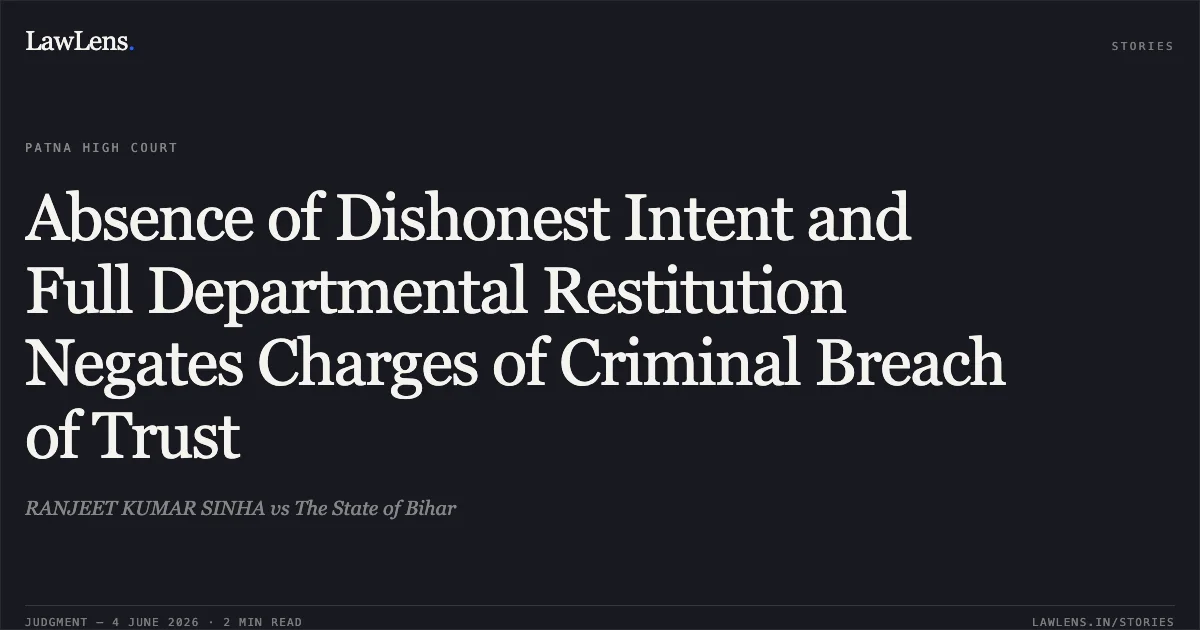
The court found that the departmental audit report—the foundation of the prosecution—expressly classified the matter as a "division of fund" rather than misappropriation, thereby nullifying the sine qua non of "dishonest intent" required under Section 409 IPC
Source reference: para. 8Regarding Section 420 IPC, the court noted a total absence of evidence showing any "false or fraudulent representation" by the petitioner
Source reference: para. 9The court heavily weighed the fact that the Disciplinary Authority found ₹10,00,000/- adjusted and the petitioner had settled the remaining balance, meaning the "substratum of the charge" of causing loss to the State no longer existed
Source reference: para. 10Given the petitioner’s retirement in 2020 and the "snail’s pace" of the trial (two witnesses in ten years), the court determined that forcing the petitioner to continue facing trial would be unjust
Source reference: para. 11Holding
The court answered the issues in the negative and allowed the petition
It held that the essential ingredients of the charged offences were not discernible and the departmental findings negated the foundational allegations
Source reference: para. 11The High Court quashed the order of cognizance dated 27.03.2018, the revisional order dated 27.08.2021, and all consequential proceedings against the petitioner
Source reference: paras. 11, 12Acts & Sections Cited
2 provisions across 1 statute referred to in this judgment. Each provision opens on LawLens.
Indian Penal Code, 18602
Original Court PDF
RANJEET KUMAR SINHAvsThe State of Bihar
Click to open original judgment
Original judgment, available to read, download and summarize on LawLens.in