Facts
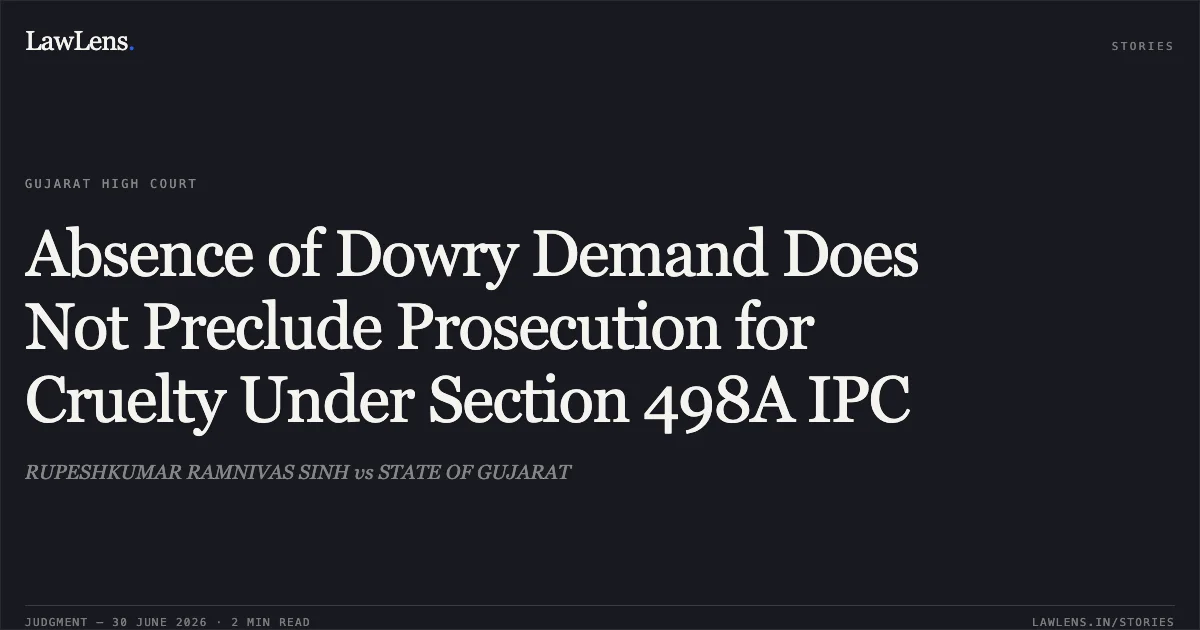
The applicant (husband) sought to quash FIR No. A-Part-11214001260001/2026 registered at Mahila Police Station, Surat Rural, for offences under Sections 85 and 352 of the Bharatiya Nyaya Sanhita (BNS), 2023.
Source reference: para. 1The complainant-wife alleged a history of matrimonial discord since 2011, including being abandoned at her in-laws' home and physical assault with a pipe in 2020.
Source reference: para. 4-4.1Previous complaints under Section 125 CrPC and Section 498A IPC had been withdrawn following settlements and assurances by the husband which were allegedly breached.
Source reference: para. 2, 4.1The applicant contended that the FIR was a result of his inability to find employment in Surat and that proceedings under Section 151 BNSS (erroneously cited as CrPC in arguments) had already been initiated for the same incident.
Source reference: para. 2-2.1Chargesheet had already been filed by the time of the hearing.
Source reference: para. 3Issues
1. Whether the allegations in the FIR, specifically regarding physical abuse without a dowry demand, constitute "cruelty" sufficient to maintain a criminal prosecution under the law.
Source reference: para. 5, 72. Whether the High Court should exercise its inherent powers under Section 528 of the BNSS (equivalent to Section 482 CrPC) to quash the FIR to prevent an abuse of the process of law.
Source reference: para. 1, 6Law Applied
The court primarily applied Section 85 of the Bharatiya Nyaya Sanhita, 2023 (corresponding to Section 498A of the IPC) regarding cruelty to a woman by her husband.
Source reference: para. 1, 7It relied on the precedent Aluri Venkata Ramana v. Aluri Thirupathi Rao and Others (2024), which established that "cruelty" is a disjunctive concept; physical or mental harm under clause (a) is sufficient to attract the law even in the absence of a dowry demand under clause (b).
Source reference: para. 5The court applied the seven guidelines from State of Haryana v. Bhajan Lal (1992) to determine the limits of inherent powers for quashing criminal proceedings.
Source reference: para. 6Reasoning
The Court examined the specific allegations in the FIR, noting detailed instances where the applicant allegedly assaulted the complainant and reneged on undertakings to improve his behavior.
Source reference: para. 4.1Applying the Aluri Venkata Ramana doctrine, the Court reasoned that the husband's alleged physical abuse and harassment squarely fall within the scope of "cruelty" as defined under the law, regardless of whether a dowry was demanded.
Source reference: para. 5, 7The Court then tested the facts against the Bhajan Lal criteria and found that the allegations were neither "absurd" nor "inherently improbable," and they prima facie disclosed the commission of a cognizable offence.
Source reference: para. 7Consequently, because a chargesheet had already been filed and the allegations required trial, the Court found no justification to exercise its extraordinary power to quash the proceedings at this stage.
Source reference: para. 3, 7Holding
The Court held that the FIR against the husband did not warrant interference as the allegations of physical abuse sufficiently constitute "cruelty" under the law.
The application for quashing the FIR and staying the proceedings was dismissed.
Source reference: para. 8Acts & Sections Cited
12 provisions across 5 statutes referred to in this judgment. Each provision opens on LawLens.
Bharatiya Nagarik Suraksha Sanhita, 20231
Bharatiya Nyaya Sanhita, 20232
Code of Criminal Procedure, 19735
Indian Penal Code, 18602
Original Court PDF
RUPESHKUMAR RAMNIVAS SINHvsSTATE OF GUJARAT
Click to open original judgment
Original judgment, available to read, download and summarize on LawLens.in