Facts
The informant alleged that on 16.10.2013, his 17-year-old son, Shivam Kumar (P.W. 6), was enticed and kidnapped by the appellant and others
Source reference: p. 2The victim was recovered on 01.12.2013 after allegedly being held for 1.5 months and forced to work as a laborer
Source reference: p. 3P.W. 1 (victim's brother) had previously filed a 'Sanha' (police report) stating the victim had forcefully taken his motorcycle and left
Source reference: p. 3The Trial Court acquitted the appellant under Section 364 IPC but convicted him under Section 365 IPC, sentencing him to three years of rigorous imprisonment
Source reference: p. 1-2, 5The appellant challenged this conviction on the grounds of material contradictions and lack of evidence of forcible confinement
Source reference: p. 5Issues
1. Whether the prosecution proved the ingredients of kidnapping or abduction with the intent to cause secret and wrongful confinement under Section 365 IPC beyond reasonable doubt
Source reference: p. 62. Whether the testimony of the victim (P.W. 6) was reliable given substantial contradictions between his statements under Sections 161 and 164 Cr.P.C. and his deposition in court
Source reference: p. 4, 7Law Applied
The court primarily applied Section 365 of the Indian Penal Code (IPC), which requires proof of kidnapping or abduction with the specific intent to cause the person to be secretly and wrongfully confined
Source reference: p. 6It also considered Section 222(2) of the Code of Criminal Procedure (Cr.P.C.), which allows a court to convict a person for a minor offense even if they were charged with a major offense, provided the facts support it
Source reference: p. 5, 7the court relied on the fundamental principle of criminal jurisprudence that suspicion, no matter how strong, cannot substitute for proof beyond reasonable doubt
Source reference: p. 7Reasoning
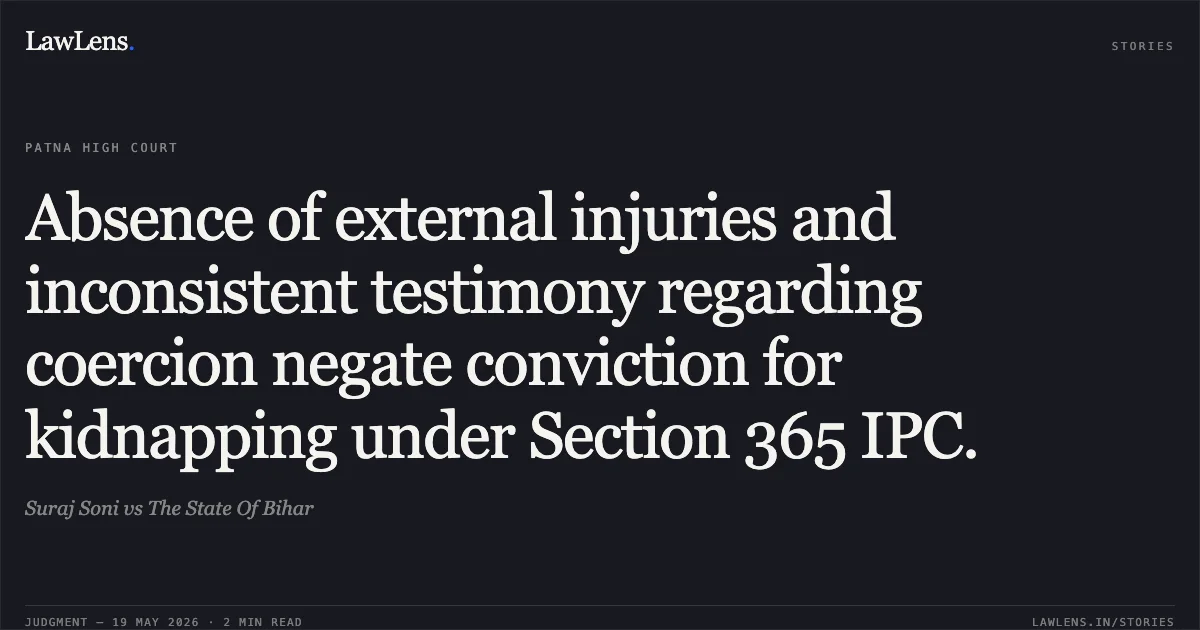
The High Court found the prosecution's foundation, primarily the testimony of P.W. 6, to be fundamentally flawed due to "substantial contradictions" regarding the manner of movement and confinement
Source reference: p. 6-7The victim admitted to traveling alone by bus to Ranchi and attending marriage parties, which negated the element of "wrongful confinement"
Source reference: p. 4, 7Medical evidence from P.W. 7 corroborated this by showing no signs of physical restraint or injury
Source reference: p. 4the court noted that the defense's version—that the victim left voluntarily after a dispute involving a motorcycle—was probabilized by the 'Sanha' filed by P.W. 1
Source reference: p. 5, 7The court concluded that the Trial Court erred in applying Section 222 Cr.P.C. to convict the appellant under Section 365 IPC, as the essential ingredients of abduction and intent to confine were not established
Source reference: p. 5, 7Holding
The Court answered the issues in the negative, holding that the charges against the appellant were not proved beyond a shadow of doubt
The appellant was granted the benefit of doubt
Source reference: p. 7The High Court set aside the judgment of conviction dated 16.03.2016 and the order of sentence dated 17.03.2016
Source reference: p. 7-8The appellant was acquitted of all charges and discharged from the liability of his bail bond. The appeal was allowed
Source reference: p. 8Acts & Sections Cited
7 provisions across 2 statutes referred to in this judgment. Each provision opens on LawLens.
Indian Penal Code, 18603
Code of Criminal Procedure, 19734
Original Court PDF
Suraj SonivsThe State Of Bihar
Click to open original judgment
Original judgment, available to read, download and summarize on LawLens.in