Facts
The deceased, Ramanbhai Rohit, died on September 26, 2004, after accidentally falling between platform Nos. 1 and 2 at Bharuch Railway Station while traveling from Surat.
Source reference: p. 1The appellants (widow and minor daughter) filed a claim for Rs. 4 lakhs under Section 23 of the Railway Claims Tribunal Act.
Source reference: p. 1The Railway Administration contested the claim, alleging the incident was not a "bona fide untoward incident" under Section 123(c)(2) and resulted from the deceased's own negligence.
Source reference: p. 2The Railway Claims Tribunal dismissed the petition, finding the deceased was not a bona fide passenger.
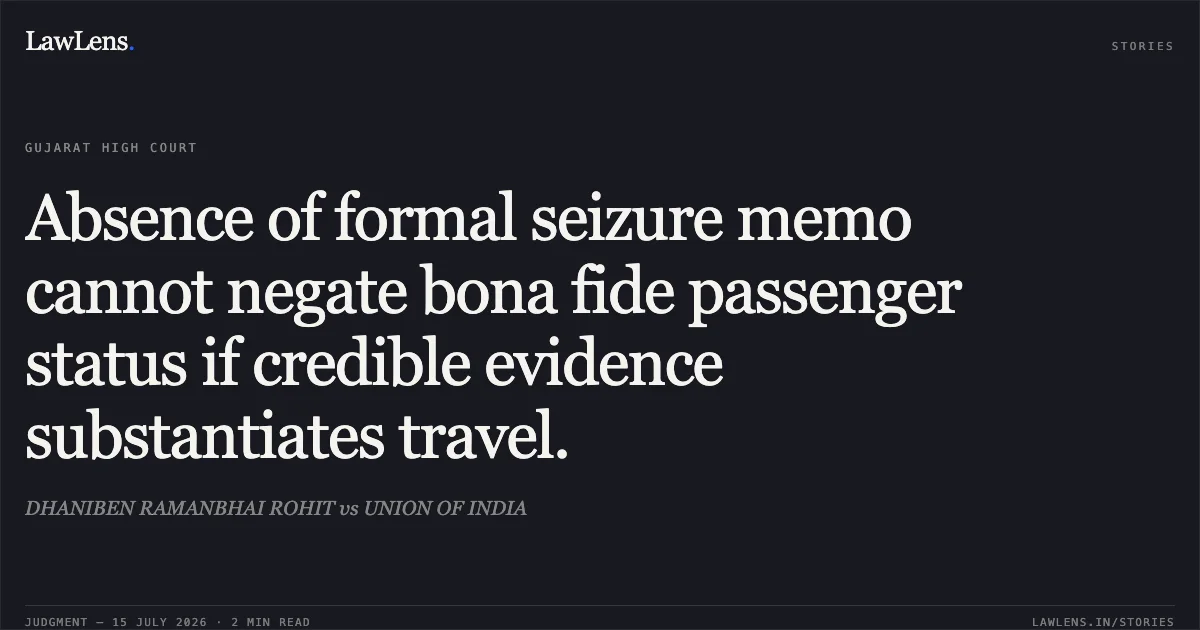
Source reference: p. 2Evidence in the police panchnama, however, recorded a railway ticket from Surat to Bharuch and Rs. 25/- found in the deceased’s pocket.
Source reference: p. 3Issues
1. Whether the deceased was traveling as a bona fide passenger by the train on September 26, 2004.
Source reference: p. 3, para 72. Whether the Railway Claims Tribunal erred in its hyper-technical approach regarding the burden of proof for a valid ticket.
Source reference: p. 8, para 10Law Applied
The Court applied Section 124-A of the Railways Act, 1989, which establishes the principle of strict liability for the railway administration regardless of fault.
Source reference: pp. 4-5The Court relied on Rajni v. Union of India [2025 Live Law (SC) 986], which held that once a claimant states on oath they had a ticket, the burden shifts to the Railway to disprove it, and that a "hyper-technical approach" regarding seizure memos should be avoided.
Source reference: pp. 3-4The Court further cited Union of India v. Prabhakaran Vijaya Kumar [2008 9 SCC 527], reaffirming that Section 124-A is a social welfare provision based on the doctrine of strict liability, exempt from the standard exceptions of negligence found in common law.
Source reference: pp. 4-8Reasoning
The High Court found that the Tribunal committed a "manifest error" by ignoring the Bharuch Railway Police panchnama, which explicitly recorded the recovery of a ticket from the deceased's person.
Source reference: p. 3The Court reasoned that the proceedings are governed by the principle of preponderance of probabilities rather than the criminal standard of proof beyond reasonable doubt.
Source reference: p. 4By relying on Rajni (supra), the Court determined that the claimants' foundational facts—possession of a ticket and an accidental fall—were established, thus activating the statutory presumption of being a bona fide passenger.
Source reference: p. 4The Court criticized the Tribunal for adopting an adversarial, hyper-technical stance that frustrated the beneficial object of the Railways Act, noting that the Railways, as a state instrumentality, cannot defeat claims through procedural imperfections in investigation.
Source reference: pp. 8-9Holding
The Court allowed the appeal, quashing the Tribunal's judgment and held that the deceased was a bona fide passenger and his death constituted an untoward incident.
The Court awarded compensation of Rs. 4 lakhs with 9% interest from the date of the incident (26.09.2004) until realization, or Rs. 8 lakhs (as per updated schedules), whichever is higher. The Railway Administration was directed to deposit the amount within eight weeks for disbursement to the claimants.
Source reference: p. 9Acts & Sections Cited
2 provisions across 2 statutes referred to in this judgment. Each provision opens on LawLens.
Railway Claims Tribunal Act, 19871
Railways Act, 19891
Original Court PDF
DHANIBEN RAMANBHAI ROHITvsUNION OF INDIA
Click to open original judgment
Original judgment, available to read, download and summarize on LawLens.in


