Facts
The appellant was convicted under Section 376 of the Indian Penal Code (IPC) by the Additional Sessions Judge, Bankura, on 12.02.1996 and sentenced to 7 years rigorous imprisonment
Source reference: para. 1The prosecution alleged that on 13.09.1991, the victim (PW-6) alighted a bus at Kotulpur and inquired at a tea stall for an escort to her village
Source reference: para. 2The appellant accompanied her, but along the way, he allegedly assaulted her, robbed her of ornaments and a watch, and committed rape
Source reference: para. 2The victim reported the incident to her brother (PW-1) and a neighbor (PW-3) before filing a complaint
Source reference: para. 2, 9, 11The appellant pleaded not guilty, suggesting the case was fabricated due to a prior land dispute
Source reference: para. 4, 21Issues
1. Whether the uncorroborated testimony of the prosecutrix inspired sufficient confidence to sustain a conviction under Section 376 of the IPC given material inconsistencies
Source reference: para. 51-532. Whether the absence of genital injuries and the delayed medical examination by a specialist undermined the prosecution's narrative of a violent sexual assault
Source reference: para. 54-553. Whether the defense's evidence of prior hostility and a compromise deed created reasonable doubt regarding the motive for the accusation
Source reference: para. 59-60Law Applied
The court primarily applied Section 376 of the IPC regarding rape and the evidentiary standards under the Indian Evidence Act.
Source reference: no citationThe established principle that while a conviction for rape can rest upon the solitary, uncorroborated testimony of the victim, such testimony must possess "intrinsic reliability" and be of "sterling quality"
Source reference: para. 35, 51, 57The court also applied the doctrine of "benefit of doubt," where the prosecution must prove its case beyond a reasonable doubt, whereas the defense need only establish a "reasonable possibility" of innocence
Source reference: para. 59, 65Reasoning
The Court found that the victim's testimony was not of the "sterling quality" required because she could not recollect material details during cross-examination, such as whether the appellant used a bicycle or the specifics of the alleged physical beating
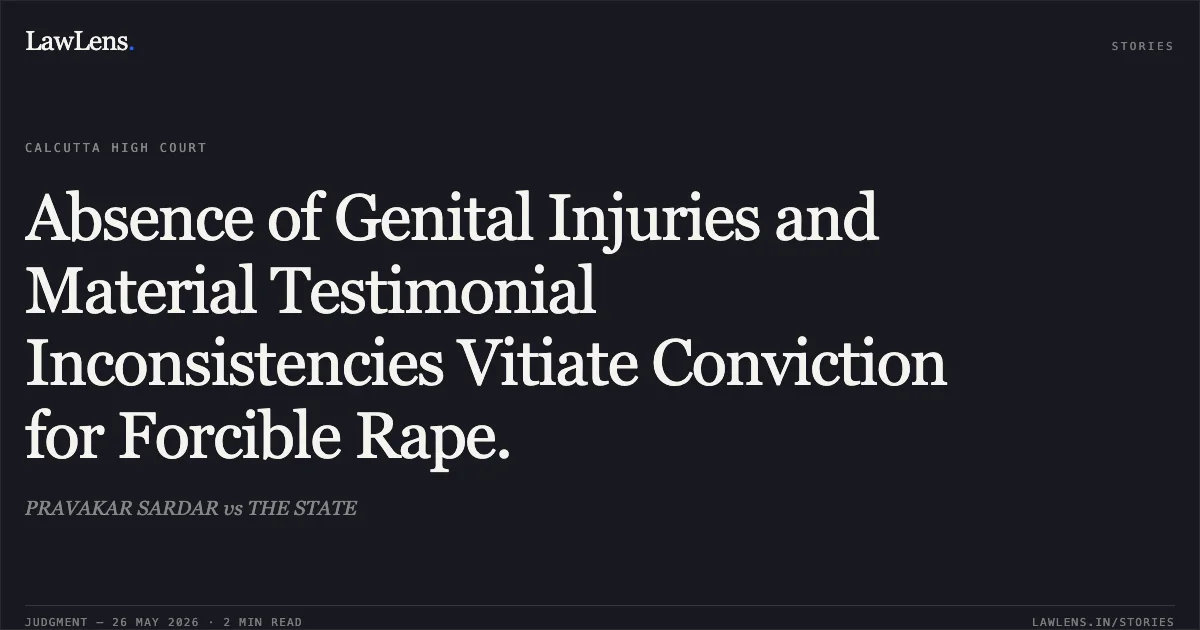
Source reference: para. 56-57Crucially, the medical evidence contradicted the narrative of a violent struggle; PW-7 (Gynecologist) found no genital injuries, and PW-8 (Initial Medical Officer) noted only superficial abrasions, with no mention of rape in the earliest medical history provided by the brother
Source reference: para. 54-55Furthermore, the court observed that the "last seen" evidence and post-occurrence disclosures were merely derivative and did not prove the act itself
Source reference: para. 58The defense’s evidence regarding a prior land dispute and a compromise deed (Exhibit-A), while not conclusive, established a plausible motive for false implication, which the prosecution failed to decisively rebut
Source reference: para. 59, 61The absence of forensic evidence or recovery of the allegedly stolen articles further weakened the chain of circumstances
Source reference: para. 61Holding
The High Court held that the prosecution failed to establish the appellant's guilt beyond a reasonable doubt as the evidence hovered between probability and certainty
The Court set aside the judgment and order dated 12.02.1996 passed by the Trial Court. The appellant was granted the benefit of doubt and acquitted of all charges under Sections 376 and 394 of the IPC. The appeal was allowed without costs
Source reference: para. 66, 68, 67, 69Acts & Sections Cited
5 provisions across 2 statutes referred to in this judgment. Each provision opens on LawLens.
Indian Penal Code, 18602
Code of Criminal Procedure, 19733
Original Court PDF
PRAVAKAR SARDARvsTHE STATE
Click to open original judgment
Original judgment, available to read, download and summarize on LawLens.in