Facts
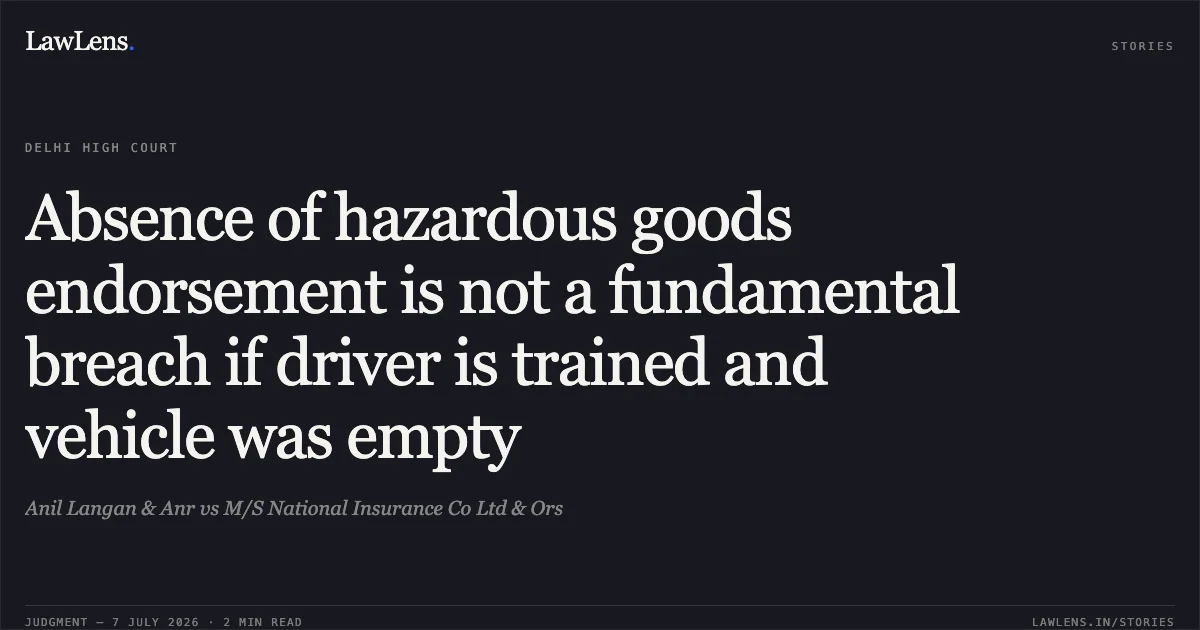
The Appellants (owner and driver) challenged a Motor Accident Claims Tribunal (MACT) award dated August 4, 2018, which granted recovery rights to the Insurance Company (Respondent No. 1).
Source reference: p. 1The MACT held that the driver, although possessing a valid Heavy Motor Vehicle (HMV) license, lacked a specific endorsement under Rule 9(3) of the Central Motor Vehicles Rules, 1989, for carrying hazardous goods (LPG cylinders).
Source reference: p. 2The Appellants contended that neither the FIR, charge-sheet, nor seizure memo proved the vehicle was carrying hazardous goods at the time of the accident.
Source reference: p. 2At the appellate stage, the Appellants moved an application under Order XLI Rule 27 of the CPC to bring on record certificates proving the driver had undergone specialized training for transporting hazardous goods.
Source reference: p. 2, 4Issues
1. Whether the specialized training certificates of the driver could be admitted as additional evidence at the appellate stage under Order XLI Rule 27 of the CPC?
Source reference: p. 4 / para. 122. Whether the lack of a ministerial endorsement on a driving license under Rule 9(3) of the Central Motor Vehicles Rules, 1989, entitles the insurer to recovery rights when the driver possesses specialized training and the carriage of hazardous goods is unproven?
Source reference: p. 9 / para. 15Law Applied
Admissibility of additional evidence under Order XLI Rule 27 of the CPC is allowed if it is relevant for adjudicating the main issue or removes a "cloud of doubt".
Source reference: p. 4-6The "rule of main purpose" and "fundamental breach" doctrines from National Insurance Co. Ltd. v. Swaran Singh (2004) establish that an insurer can only avoid liability if the breach is fundamental and contributed to the accident.
Source reference: p. 14In National Insurance Co. Ltd. v. Sonia Mittal (2017) and Manish Garg v. United India Insurance Co. Ltd. (2025), it was held that endorsement for hazardous goods is a ministerial act if the driver has training, and Rule 9(3) applies only when hazardous goods are actually being transported.
Source reference: p. 10, 12Reasoning
The Court first allowed the additional evidence, noting that the training certificates from Bharat Petroleum proved the driver was competent and that the insurer failed to file a reply disputing their authenticity.
Source reference: p. 8Analyzing the factual record (FIR, DAR, and seizure memo), the Court found no evidence that the truck was carrying LPG cylinders at the time of the accident; the vehicle was merely an "open body" truck with "Bharat Gas" branding.
Source reference: p. 19-20The Court reasoned that since the carriage of hazardous goods was not established, the requirement for an endorsement was irrelevant. Even if the vehicle were carrying such goods, the driver’s certified training satisfied the "main purpose" of the law, rendering the lack of a formal endorsement a mere ministerial lapse that did not constitute a fundamental breach of the insurance policy.
Source reference: p. 9, 12, 14, 21Holding
In the absence of evidence confirming the transport of hazardous goods, and given the driver’s valid HMV license and specialized training, the insurer could not abdicate its liability.
The Court allowed the appeal and set aside the MACT award to the extent that it granted recovery rights to the Insurance Company, and directed the refund of any statutory deposit to the Appellants.
Source reference: p. 21Acts & Sections Cited
3 provisions across 1 statute referred to in this judgment. Each provision opens on LawLens.
Motor Vehicles Act, 19883
Original Court PDF
Anil Langan & AnrvsM/S National Insurance Co Ltd & Ors
Click to open original judgment
Original judgment, available to read, download and summarize on LawLens.in