Facts
The appellant was convicted by the Special Judge (POCSO), Barpeta, for aggravated penetrative sexual assault under Section 6 of the POCSO Act and Section 376(AB) of the IPC involving a 9-year-old victim
Source reference: p. 2The victim alleged that the appellant pulled her into a tent, tied her hands, removed her clothes, and committed a "bad act," during which she lost consciousness
Source reference: p. 5The appellant challenged the conviction on two primary grounds: first, that the victim's statement under Section 164 Cr.P.C. used the term "bad act" rather than specifying sexual intercourse; and second, that medical evidence (PW-6) showed an intact hymen and no evidence of sexual intercourse, despite noted redness and tenderness
Source reference: p. 2-3Issues
1. Whether the use of the term "bad act" in a Section 164 Cr.P.C. statement satisfies the requirement for corroboration of a victim’s testimony regarding penetrative sexual assault in the Trial Court
Source reference: p. 4-52. Whether the absence of a ruptured hymen or external injuries in the medical report precludes a conviction for penetrative sexual assault under the POCSO Act
Source reference: p. 8-9Law Applied
The court applied Section 3 and Section 6 of the POCSO Act along with Section 376(AB) of the IPC regarding penetrative sexual assault
Source reference: p. 2, 10It relied on several Supreme Court precedents establishing that an intact hymen does not disprove rape, including State of Himachal Pradesh v. Manga Singh, State of Punjab v. Gurmit Singh, and Wahid Khan v. State of Madhya Pradesh
Source reference: p. 8, 9The court further emphasized the principle from Latesh @ Dadu Baburao Karlekar v. State of Maharashtra that oral testimony of a trustworthy witness takes precedence over medical evidence unless the latter completely refutes the possibility of the occurrence
Source reference: p. 10Reasoning
The court reasoned that while the term "bad act" is broad, its meaning must be derived from the surrounding facts and circumstances. In this case, the victim's statement that the appellant removed her clothes and panties before the "bad act" sufficiently corroborated her trial testimony where she explicitly detailed the penetration
Source reference: p. 5-7Regarding the medical evidence, the court held that under Section 3 of the POCSO Act, even the "slightest degree of penetration" of the vulva or labia majora constitutes penetrative sexual assault.
Source reference: p. 10The court noted that the redness and tenderness observed by the doctor were consistent with slight penetration, and an intact hymen is not a medical or legal bar to a conviction for rape
Source reference: p. 8-10The court distinguished this case from Shah Alam (MD) v. State of Assam, where the victim had remained silent when asked to define "bad act"; here, the victim provided a clear and consistent narrative of the assault
Source reference: p. 7Holding
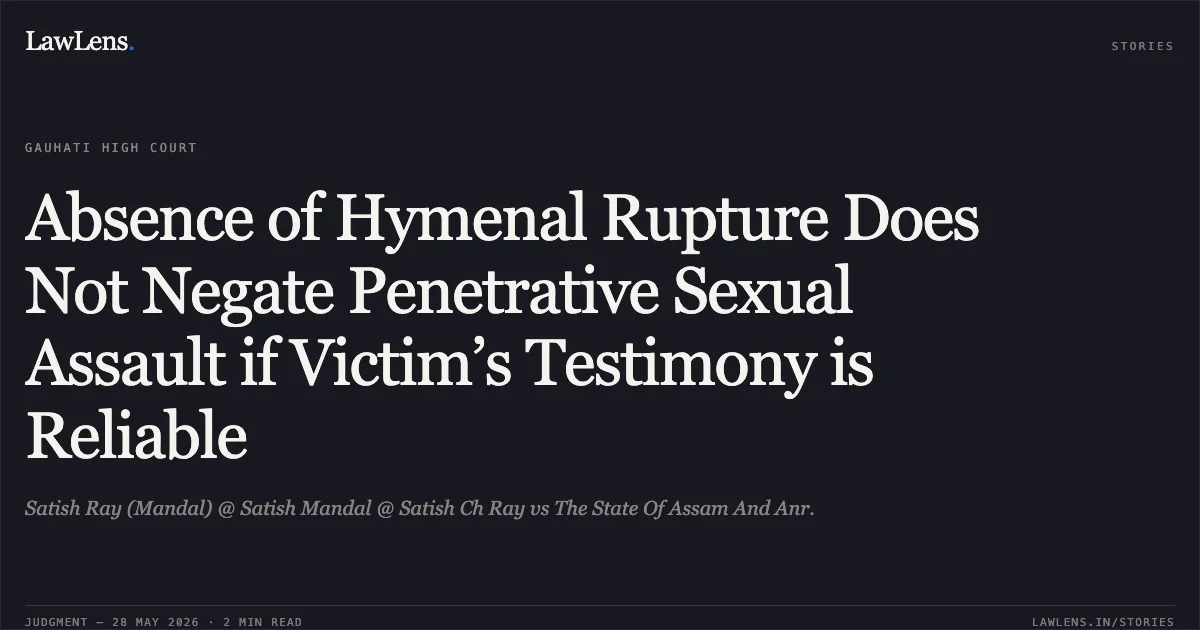
The Gauhati High Court answered both issues in the negative, finding that the victim's testimony was credible and sufficiently corroborated by her prior statements and the circumstantial medical findings of redness
The Court upheld the conviction and the sentence of 20 years of rigorous imprisonment, dismissing the appeal
Source reference: p. 10The holding affirms that penetrative sexual assault is a legal conclusion, not a purely medical diagnosis, and does not require complete penetration or injury to the genitals
Source reference: p. 9-10Acts & Sections Cited
4 provisions across 2 statutes referred to in this judgment. Each provision opens on LawLens.
Protection of Children from Sexual Offences Act, 20123
Code of Criminal Procedure, 19731
Original Court PDF
Satish Ray (Mandal) @ Satish Mandal @ Satish Ch RayvsThe State Of Assam And Anr.
Click to open original judgment
Original judgment, available to read, download and summarize on LawLens.in