Facts
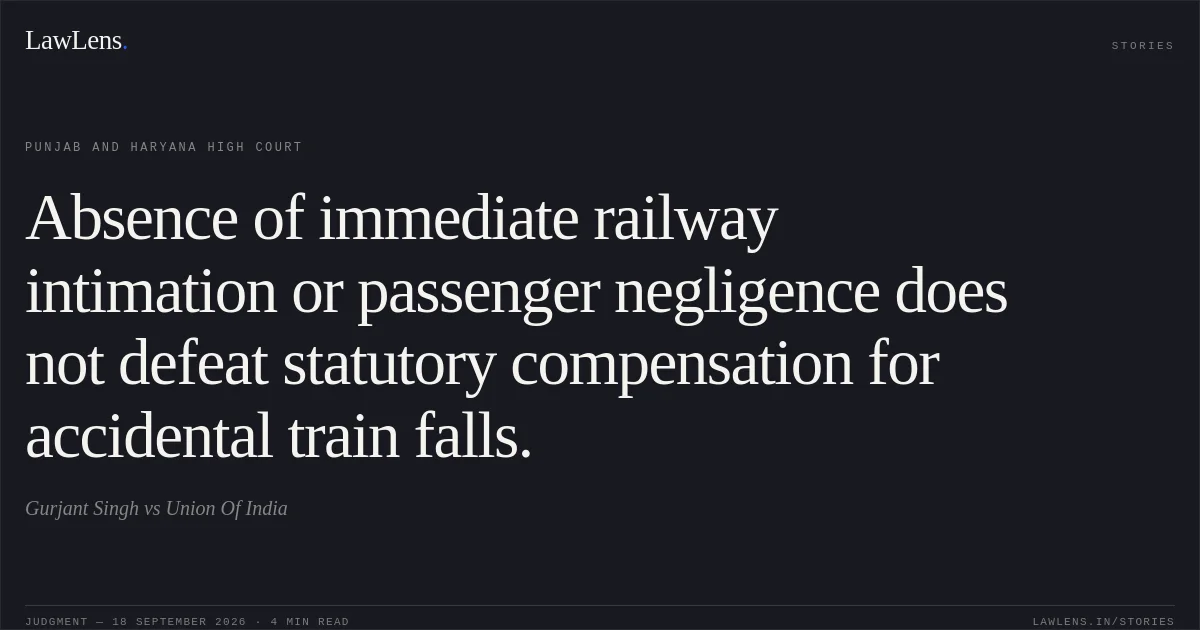
The appellant purchased a computerised railway ticket from Lehragaga to Ahmedgarh on 14 September 2024 and boarded the train. While the train was moving between Ahmedgarh and Kup railway stations, near kilometre 27, he allegedly fell from the train following a sudden jerk while waiting outside the occupied toilets. He sustained a right shoulder fracture/dislocation, facial fractures, chest trauma and head injuries, and was treated at various hospitals.
Source reference: paras. 1–4; pp. 1–2The railway ticket was seized by the Investigating Officer on 23 September 2024, after the appellant’s medical condition permitted his statement to be recorded. The Railway Claims Tribunal dismissed his claim for ₹8,00,000, holding that he had not established that he was a bona fide passenger or that he had suffered injuries in an “untoward incident” under the Railways Act, 1989. The appellant challenged that decision under Section 23 of the Railway Claims Tribunal Act, 1987.
Source reference: paras. 1–4; pp. 1–2Issues
Whether the appellant was a bona fide passenger travelling on the relevant train on the strength of a valid railway ticket?
Source reference: para. 8; pp. 3–5Whether the appellant’s fall from the moving train constituted an “untoward incident” under Sections 123(c)(2) and 124-A of the Railways Act, 1989?
Source reference: para. 9; pp. 5–7Whether the Railways established any statutory exception under the proviso to Section 124-A, including self-inflicted injury, suicide, criminal act, intoxication or insanity?
Source reference: para. 9.2; pp. 7–8What compensation was payable for the injuries proved on the record?
Source reference: para. 11; pp. 8–9Law Applied
The Court applied Sections 123(c)(2) and 124-A of the Railways Act, 1989, under which an accidental fall from a running train may constitute an “untoward incident” attracting the Railways’ no-fault statutory liability, subject to the exceptions in the proviso to Section 124-A.
Source reference: para. 8Relying on Union of India v. Rina Devi, (2019) 3 SCC 572, the Court held that once a claimant makes an initial showing of bona fide passenger status and the occurrence, the burden shifts to the Railways to disprove that status or establish a statutory exception.
Source reference: para. 8Mere negligence or contributory negligence does not defeat a claim under Section 124-A.
Source reference: para. 9.2The Court further applied Section 129 of the Railways Act and the Railway Accidents and Untoward Incidents (Compensation) Rules, 1990: Part III, Item 34 provides ₹64,000 for fracture of a major bone of one upper limb, while Rule 3(3) permits compensation for injuries not specifically scheduled, subject to a ceiling of ₹1,60,000 for such injuries taken together.
Source reference: para. 11Reasoning
The Court found that the appellant had produced computerised ticket No. UPG 6943 0875 dated 14 September 2024, which corresponded with the pleaded journey, and that the ticket’s delayed production was satisfactorily explained by his serious injuries and hospitalisation.
Source reference: para. 8.1; pp. 3–4The Railways’ own DRM report verified the ticket and recorded that the appellant was a bona fide passenger; the contrary internal note merely raised doubts based on the delay and the Loco Pilot’s denial of having felt a jerk, without independently disproving the ticket’s genuineness.
Source reference: para. 8.2; pp. 4–5The Court treated inconsistencies in the appellant’s testimony as understandable in light of his head injury and unconsciousness, and relied on the medical records, the police investigation and the statement of Mohammad Yusuf, who found the appellant injured near kilometre 27 and arranged ambulance assistance.
Source reference: paras. 8.3, 9 and 9.1; pp. 5–7The absence of immediate information to the Loco Pilot, Train Manager or Station Master was not considered fatal because the incident occurred at night between two stations while the train was moving.
Source reference: para. 9; pp. 5–6The Railways produced no positive evidence establishing any exception under Section 124-A. Even assuming that the appellant’s conduct involved negligence, such negligence could not be treated as a statutory defence or as a criminal act on the material available.
Source reference: para. 9.2; pp. 7–8For compensation, the Court treated the right shoulder injury requiring rod fixation as a fracture of a major bone of one upper limb and awarded ₹64,000 under Item 34. It awarded the maximum ₹1,60,000 under Rule 3(3) for the facial fractures, chest trauma, head injury, prolonged hospitalisation and associated pain and suffering.
Source reference: para. 11; pp. 8–9Holding
The appeal was allowed. The Court set aside the Tribunal’s findings on bona fide passenger status and the occurrence of an untoward incident, holding that the appellant was a bona fide passenger who suffered injuries in an accidental fall from a running train within the meaning of Sections 123(c)(2) and 124-A of the Railways Act, 1989.
The appellant was awarded ₹2,24,000, comprising ₹64,000 under Part III, Item 34 of the 1990 Rules and ₹1,60,000 under Rule 3(3), with simple interest at 9% per annum from the date of filing of the claim application until realisation.
Source reference: para. 11.1; p. 9The Union of India was directed to deposit the amount with the Railway Claims Tribunal, Chandigarh, within two months of receiving the certified judgment, for disbursement to the appellant.
Source reference: para. 11.1; p. 9Acts & Sections Cited
5 provisions across 2 statutes referred to in this judgment. Each provision opens on LawLens.
Railway Claims Tribunal Act, 19871
Railways Act, 19894
Original Court PDF
Gurjant SinghvsUnion Of India
Click to open original judgment
Original judgment, available to read, download and summarize on LawLens.in