Facts
The appellant (original complainant) filed a criminal appeal against the judgment dated 04.01.2014, whereby the 2nd Additional District & Sessions Judge, Vadodara, acquitted eight accused persons.
Source reference: p. 1-2The prosecution alleged that on 20.03.2011, the respondents, armed with sticks and Dharia, threatened the appellant’s family and used caste-based slurs in public view.
Source reference: p. 2The FIR was registered on 27.04.2011 after a delay of approximately 45 days.
Source reference: p. 6-7The accused were charged under Sections 143, 147, 148, 504, 506(2) of the IPC and Section 3(1)(10) of the Atrocity Act.
Source reference: p. 2Issues
1. Whether the trial court erred in acquitting the accused despite the oral and documentary evidence produced by the prosecution.
Source reference: p. 4-52. Whether the ingredients of Section 3(1)(10) of the Atrocity Act were satisfied regarding the alleged public insult.
Source reference: p. 5, 83. Whether the delay in filing the FIR and the lack of medical evidence were fatal to the prosecution's case.
Source reference: p. 6-7Law Applied
Section 3(1)(10) of the Scheduled Castes and Scheduled Tribes (Prevention of Atrocities) Act, 1989, which requires that abusive words be uttered in a public place within "public view" with the intent to insult.
Source reference: p. 9Principles from Shajan Skaria v. State of Kerala (AIR 2024 SC 4557) and Gunjan @ Girija Kumari v. State (NCT of Delhi) (2026 INSC 468) clarifying requirements of "public view".
Source reference: p. 9Principles from Chandrappa v. State of Karnataka ((2007) 4 SCC 415), emphasizing the "double presumption of innocence" and the limited grounds for interference unless the trial court’s finding is "perverse".
Source reference: p. 9-11Reasoning
The High Court observed that while the prosecution alleged a violent assault with deadly weapons, no medical evidence was produced, and no doctor was examined to prove any injuries.
Source reference: p. 7The court found the 45-day delay in filing the FIR remained inadequately explained, despite the appellant’s claim of police inaction.
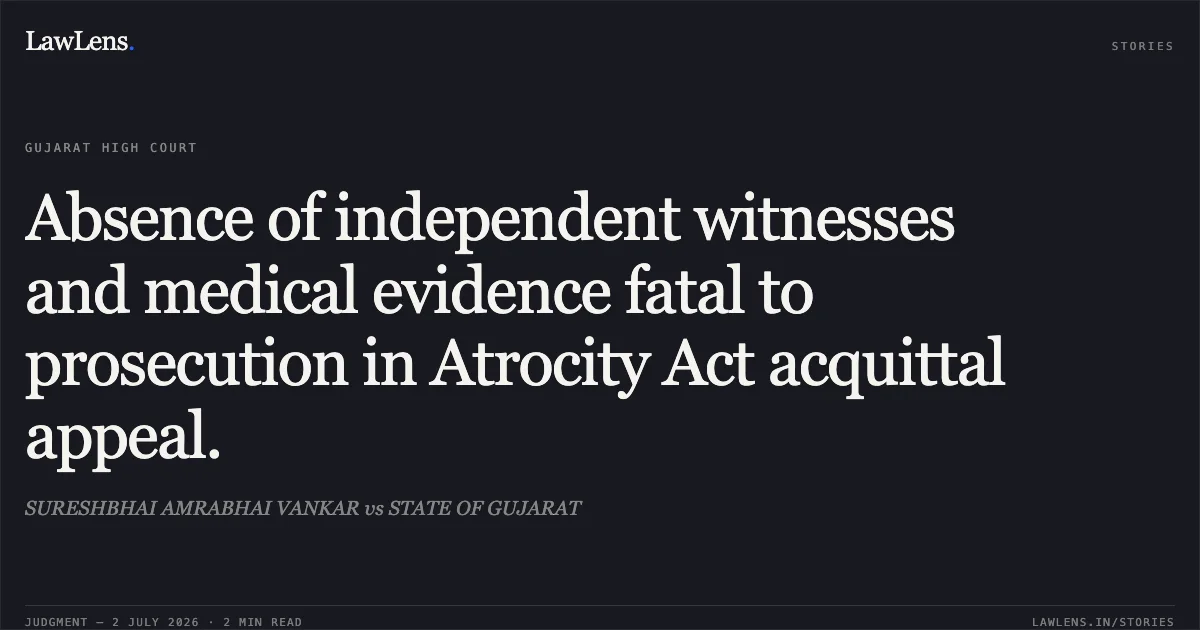
Source reference: p. 7The court noted that no independent witnesses from the locality were examined to corroborate the occurrence of the incident in "public view," a mandatory requirement for conviction under the Atrocity Act.
Source reference: p. 8Applying the standard from Chandrappa, the court reasoned that if two reasonable conclusions are possible, the appellate court must not disturb an acquittal unless the trial court's view is "vitiated by manifest illegality."
Source reference: p. 10-11The lack of corroborating independent testimony and medical proof made the trial court’s decision to grant the benefit of doubt a plausible and reasonable conclusion.
Source reference: p. 12-13Holding
The High Court dismissed the appeal and upheld the acquittal of the respondents.
The court held that the prosecution miserably failed to prove the charges beyond a reasonable doubt due to the absence of independent witnesses, lack of medical evidence, and the significant unexplained delay in registration of the FIR.
Source reference: p. 12-13The bail bonds were cancelled, and the trial court’s judgment was confirmed.
Source reference: p. 13Acts & Sections Cited
8 provisions across 3 statutes referred to in this judgment. Each provision opens on LawLens.
Code of Criminal Procedure, 19732
Indian Penal Code, 18605
Scheduled Castes and the Scheduled Tribes (Prevention of Atrocities) Act, 19891
Original Court PDF
SURESHBHAI AMRABHAI VANKARvsSTATE OF GUJARAT
Click to open original judgment
Original judgment, available to read, download and summarize on LawLens.in