Facts
On 21.05.2023, the appellant allegedly entered the informant’s house on the pretext of charging his mobile phone and sexually assaulted the informant’s 12-year-old granddaughter while she was alone with her younger brother.
Source reference: pp. 2–3, paras. 2–3The victim raised an alarm, following which the appellant fled.
Source reference: pp. 2–3, paras. 2–3An FIR was registered under Sections 448 and 376(3) IPC read with Section 4 of the POCSO Act, and the victim’s statement was recorded under Section 164 CrPC.
Source reference: pp. 2–3, paras. 2–3The prosecution examined eight witnesses, including the victim, the informant, supporting witnesses, the Medical Officer and the Investigating Officer; the defence examined three witnesses.
Source reference: pp. 3–4, para. 4The Trial Court convicted the appellant under Section 448 IPC and Section 8 of the POCSO Act, sentencing him to six months’ rigorous imprisonment under Section 448 IPC and three years’ rigorous imprisonment with a fine of ₹10,000 under Section 8 POCSO.
Source reference: p. 2, para. 1The appellant challenged the conviction, principally relying on contradictions in the evidence, the absence of injuries in the medical report, and the non-examination of the victim’s younger brother.
Source reference: pp. 6–7, paras. 11–12Issues
1. Whether the appellant committed house-trespass under Section 448 IPC by entering the informant’s dwelling house with the requisite intent.
Source reference: p. 5, para. 6, Issue I2. Whether the appellant committed penetrative sexual assault or rape upon the minor victim, thereby attracting Section 4 of the POCSO Act and the relevant IPC provision.
Source reference: p. 5, para. 6, Issue II3. Whether, notwithstanding the failure to establish penetrative sexual assault, the appellant committed sexual assault punishable under Section 8 of the POCSO Act.
Source reference: p. 5, para. 6, Issue III4. Whether the inconsistencies in the prosecution evidence, absence of injuries or spermatozoa, and the defence evidence created a reasonable doubt warranting acquittal.
Source reference: pp. 6–8, paras. 11–15Law Applied
The Court applied Section 448 IPC, which criminalises house-trespass when a person enters or remains in a dwelling house with the requisite criminal intent.
Source reference: p. 18, para. 43Section 8 of the POCSO Act punishes sexual assault upon a child, while Section 4 concerns penetrative sexual assault; the Court distinguished the two offences and held that penetrative assault must be specifically established before conviction under Section 4.
Source reference: pp. 16–17, paras. 39–42Under Sections 29 and 30 of the POCSO Act, once the foundational facts of the alleged offence are proved, statutory presumptions operate against the accused, subject to rebuttal.
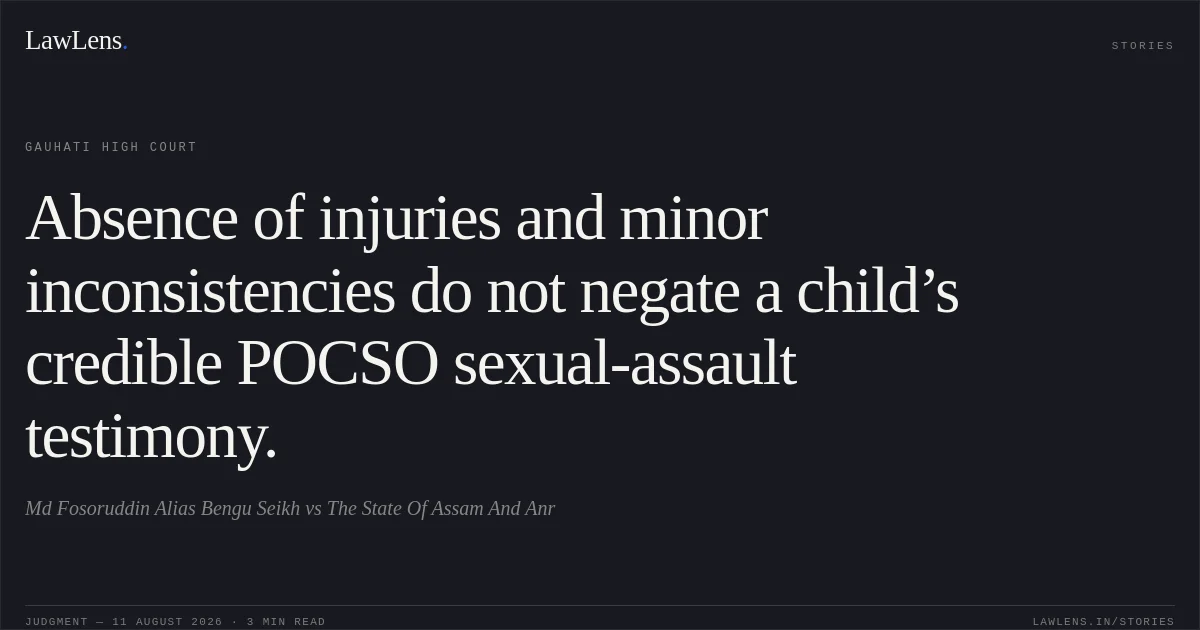
Source reference: p. 18, para. 43The Court further applied the principle that the testimony of a prosecutrix or child victim may by itself sustain a conviction if it is reliable and inspires confidence; minor inconsistencies do not discredit otherwise consistent evidence.
Source reference: pp. 9–11, paras. 20–23It also held that the absence of bodily injuries or spermatozoa in a medical examination is not conclusive proof that sexual assault did not occur.
Source reference: pp. 16–17, paras. 39–42The Court referred to Section 8 of the Evidence Act concerning the relevance of conduct, including the accused’s subsequent disappearance.
Source reference: pp. 14–16, paras. 35–38Reasoning
The High Court found the victim’s testimony substantially consistent with her statement under Section 164 CrPC and corroborated by the informant’s evidence and the immediate post-occurrence evidence of neighbouring witnesses who saw her crying.
Source reference: pp. 8–11, paras. 17–25The discrepancies regarding whether she had attended school, her relationship with the informant, and the identity of her school were treated as minor contradictions that did not affect the core allegation of sexual assault.
Source reference: pp. 6–7, 9–10, paras. 11, 20The non-examination of the victim’s younger brother was not considered fatal because the victim’s own evidence was reliable and the incident occurred in the privacy of the house.
Source reference: pp. 6–8, paras. 12–14Although the medical examination disclosed no external injuries and no spermatozoa, the Court held that such findings did not negate sexual assault.
Source reference: p. 16, para. 41However, because the victim did not specifically describe penetration, and the supporting witnesses spoke only of touching or holding her hand, the Court upheld the benefit of doubt regarding penetrative sexual assault and affirmed conviction only under Section 8 POCSO.
Source reference: pp. 16–17, paras. 39–42The appellant’s disappearance for three days and the inconsistent defence account concerning the alleged money or land dispute were treated as relevant conduct that failed to rebut the prosecution case or the statutory presumptions.
Source reference: pp. 14–16, paras. 33–38Holding
The appeal was dismissed.
The High Court affirmed the appellant’s conviction under Section 448 IPC and Section 8 of the POCSO Act, holding that the prosecution proved house-trespass and sexual assault beyond reasonable doubt, but not penetrative sexual assault under Section 4 POCSO.
Source reference: p. 18, paras. 42–44The period of detention already undergone during investigation or trial was directed to be set off against the custodial sentence, and the Trial Court Records were ordered to be returned.
Source reference: p. 18, paras. 44–45Acts & Sections Cited
8 provisions across 3 statutes referred to in this judgment. Each provision opens on LawLens.
Indian Penal Code, 18602
Protection of Children from Sexual Offences Act, 20124
Code of Criminal Procedure, 19732
Original Court PDF
Md Fosoruddin Alias Bengu SeikhvsThe State Of Assam And Anr
Click to open original judgment
Original judgment, available to read, download and summarize on LawLens.in