Facts
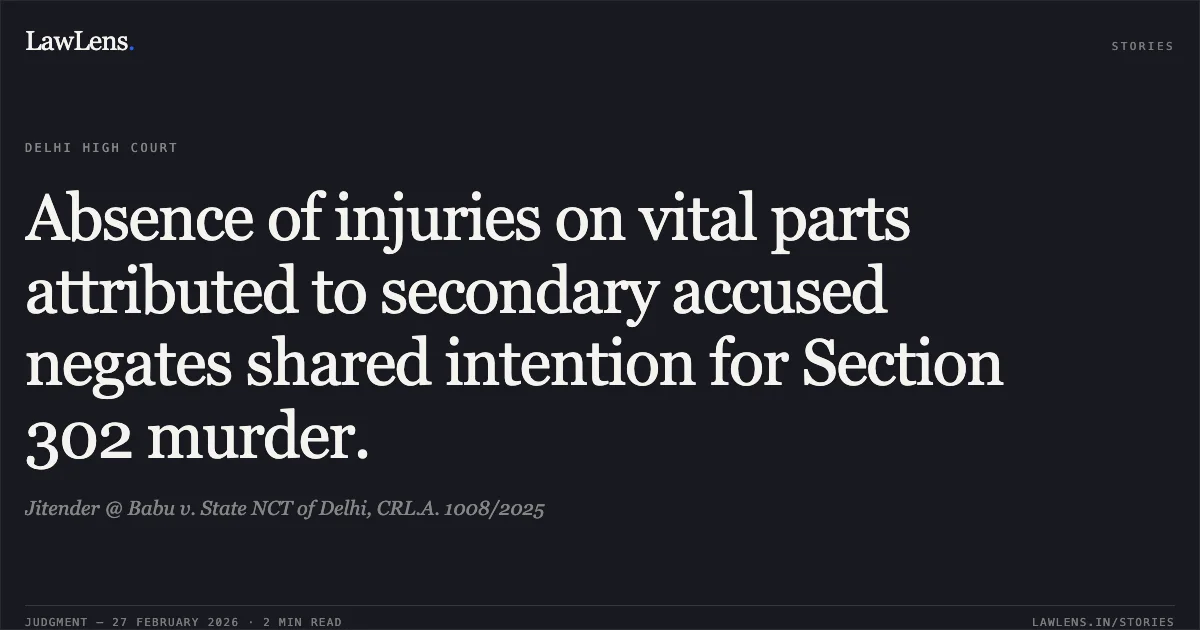
The Appellant, Jitender @ Babu, along with co-accused Sunny @ Babe, was convicted by the Trial Court under Section 302/34 IPC for the murder of Biju Varghese
Source reference: p. 2On May 19, 2015, eyewitnesses (PW-3 and PW-6) observed Sunny assaulting the deceased with a motorcycle helmet while the Appellant allegedly restrained the deceased by holding his neck from behind
Source reference: p. 3, 12The Post-Mortem Report (Ex.PW2/A) recorded 13 injuries to the head, face, and chest, but notably no injuries or marks of strangulation/compression on the neck
Source reference: p. 6, 25The Trial Court initially framed charges under Section 304 IPC but later altered them to Section 302 IPC at the end of the trial
Source reference: p. 8-9The Appellant challenged the conviction, arguing a lack of common intention or medical evidence linking his specific act to the cause of death
Source reference: p. 16-17Issues
Whether the act of restraining the deceased by the neck, in the absence of medical evidence of neck injury, is sufficient to establish a shared common intention for murder under Section 302/34 IPC
Source reference: p. 23, 26Whether the offence committed by the Appellant amounts to murder or culpable homicide not amounting to murder based on the degree of knowledge and intention
Source reference: p. 24, 28Law Applied
The Court applied Section 300 (Murder), Section 304 (Culpable Homicide), and Section 34 (Common Intention) of the Indian Penal Code, 1860
Source reference: p. 28, 30It relied on *Virsa Singh v. State of Punjab*, which mandates that for murder, the prosecution must prove the intention to inflict the specific injury that is sufficient to cause death
Source reference: p. 28It further cited *Sudam Prabhakar Achat v. State of Maharashtra*, holding that sudden fights without premeditation where weapons are not cruelly used fall under Section 304 IPC
Source reference: p. 28-29and *Chellappa v. State*, emphasizing that Section 34 liability requires clear proof of a shared mental design and not just simultaneous presence
Source reference: p. 30-31Reasoning
The Court observed that while the death was homicidal due to blunt force impact to the head and chest, the specific role attributed to the Appellant was one of "restraint" rather than "assault"
Source reference: p. 23, 26Crucially, the medical testimony of PW-24 highlighted that there were no injuries on the neck, contradicting the foundational allegation that the Appellant's grip was a lethal factor
Source reference: p. 25The Court reasoned that because the incident occurred suddenly without prior planning, and the Appellant did not wield a weapon or exhort the killer to commit murder (exhortations were limited to co-accused Sunny), a shared "intention" to kill could not be inferred
Source reference: p. 26However, the court found that the Appellant possessed the "knowledge" that his actions facilitated a violent assault likely to cause death, thereby satisfying the criteria for Section 304 Part I rather than Section 302 IPC
Source reference: p. 28, 32Holding
The High Court modified the conviction from Section 302/34 IPC to Section 304 Part I IPC
The Court held that the prosecution failed to establish a meeting of minds for murder, but proved the Appellant’s knowledge of the potential fatal outcome
Source reference: p. 32Consequently, the Appellant was sentenced to the period already undergone (approx. 4 years and 7 months), the fine was set aside, and his immediate release was ordered
Source reference: p. 33Acts & Sections Cited
5 provisions across 2 statutes referred to in this judgment. Each provision opens on LawLens.
Indian Penal Code, 18604
Bharatiya Nagarik Suraksha Sanhita, 20231
Original Court PDF
Jitender @ Babu v. State NCT of Delhi, CRL.A. 1008/2025
Click to open original judgment
Original judgment, available to read, download and summarize on LawLens.in