Facts
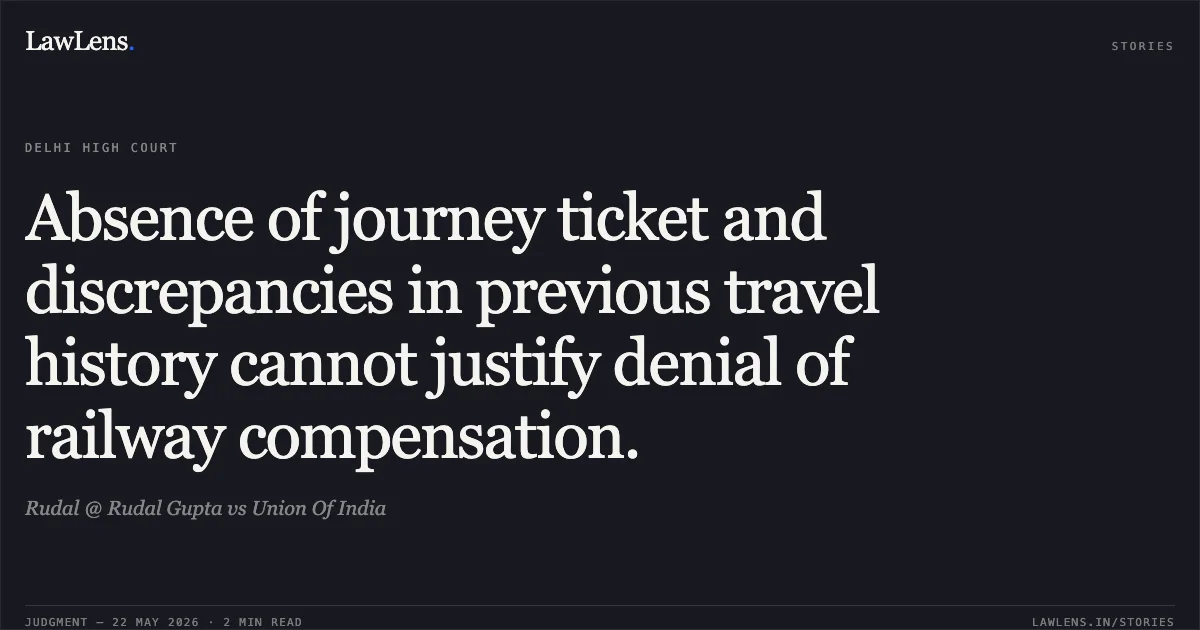
The appellant filed a claim for injury compensation after an alleged "untoward incident" on 08.05.2016. He claimed to have boarded an EMU train from Delhi to Badli at 1:30 AM, following two previous connecting journeys. Near Azadpur Station, he suffered an accidental fall due to a sudden jerk, resulting in the amputation of his right arm and right leg
Source reference: p. 1-2He asserted his journey ticket was lost during the accident
Source reference: p. 2The Railway Claims Tribunal dismissed the claim on 30.06.2017, doubting the appellant's version because one of the trains in the sequence (Sealdah Express) did not run on the day of the accident and because the appellant lacked a ticket
Source reference: p. 2Issues
1. Whether the Tribunal erred in dismissing the claim by focusing on discrepancies in previously completed journeys rather than the subject journey
Source reference: p. 3, para. 72. Whether the appellant discharged the initial burden of proving he was a bona fide passenger despite the loss of his ticket
Source reference: p. 3, para. 93. Whether the incident constitutes an "untoward incident" under the Railways Act, 1989
Source reference: p. 5, para. 12Law Applied
The Court applied Section 123(c) and Section 124-A of the Railways Act, 1989, which define and provide compensation for "untoward incidents"
Source reference: p. 2It relied on the Supreme Court precedent in Union of India v. Rina Devi, establishing that a claimant’s affidavit stating a ticket was purchased shifts the burden of proof to the Railways to rebut bona fide travel with cogent evidence
Source reference: p. 3It further cited Union of India v. Prabhakaran Vijaya Kumar and Jameela v. Union of India, which mandate that compensation provisions in the Act, being beneficial legislation, must be interpreted liberally
Source reference: p. 4Reasoning
The High Court found that the Tribunal misdirected itself by focusing on the appellant's two prior journeys rather than the specific 3rd journey (Delhi to Badli) where the fall occurred
Source reference: p. 3, para. 7Regarding bona fide status, the Court held that the appellant's testimony, corroborated by contemporaneous GRP and hospital records (DD entry and MLC), discharged his initial burden. The Court noted that the Railways' own UTS ticket verification for that route and time lent further credibility to the appellant's claim
Source reference: p. 4, para. 9Since the respondent failed to file a DRM report or provide substantive evidence to rebut the appellant’s testimony, the version of the "untoward incident" remained un-rebutted
Source reference: p. 4, para. 10Holding
The Court allowed the appeal and set aside the judgment dated 30.06.2017. It held that the appellant successfully established he was a bona fide passenger and that the injuries resulted from an "untoward incident"
The matter was remanded to the Tribunal to assess the quantum of compensation and ensure disbursement within two weeks of the assessment, with a direction to list the matter before the Tribunal on 28.05.2026
Source reference: p. 4-5Acts & Sections Cited
2 provisions across 2 statutes referred to in this judgment. Each provision opens on LawLens.
Railway Claims Tribunal Act, 19871
Railways Act, 19891
Original Court PDF
Rudal @ Rudal GuptavsUnion Of India
Click to open original judgment
Original judgment, available to read, download and summarize on LawLens.in