Facts
The petitioner (informant) filed an FIR alleging that the opposite party nos. 2 and 3 forcibly entered her house, assaulted her, her mother-in-law (Urmila Devi), and her brother-in-law over a land dispute
Source reference: para. 03The petitioner claimed her mother-in-law sustained internal injuries during the scuffle and died a few days later
Source reference: para. 04However, the police charge-sheeted the accused only under Sections 447, 341, 323, 504, 506, and 34 of the IPC, omitting Section 304 (Culpable homicide not amounting to murder)
Source reference: para. 02, 06On 19.06.2026, the ACJM 1st, Purnea, took cognizance based on the charge sheet
Source reference: para. 02The petitioner moved the High Court in revision, seeking to include Section 304 IPC in the cognizance order
Source reference: para. 04Issues
Whether the learned trial court committed an illegality or impropriety by failing to take cognizance under Section 304 of the Indian Penal Code despite allegations of the victim's death following the assault.
Source reference: para. 04 / para. 07Law Applied
The court applied the principles governing the stage of taking cognizance under the Code of Criminal Procedure (CrPC), emphasizing that while a prima facie case is required, there must be "credible material" on record to support the specific charges
Source reference: para. 07The court examined the requirements of Section 304 of the Indian Penal Code, which necessitates a causal link between the act of the accused and the death of the person
Source reference: para. 06Reasoning
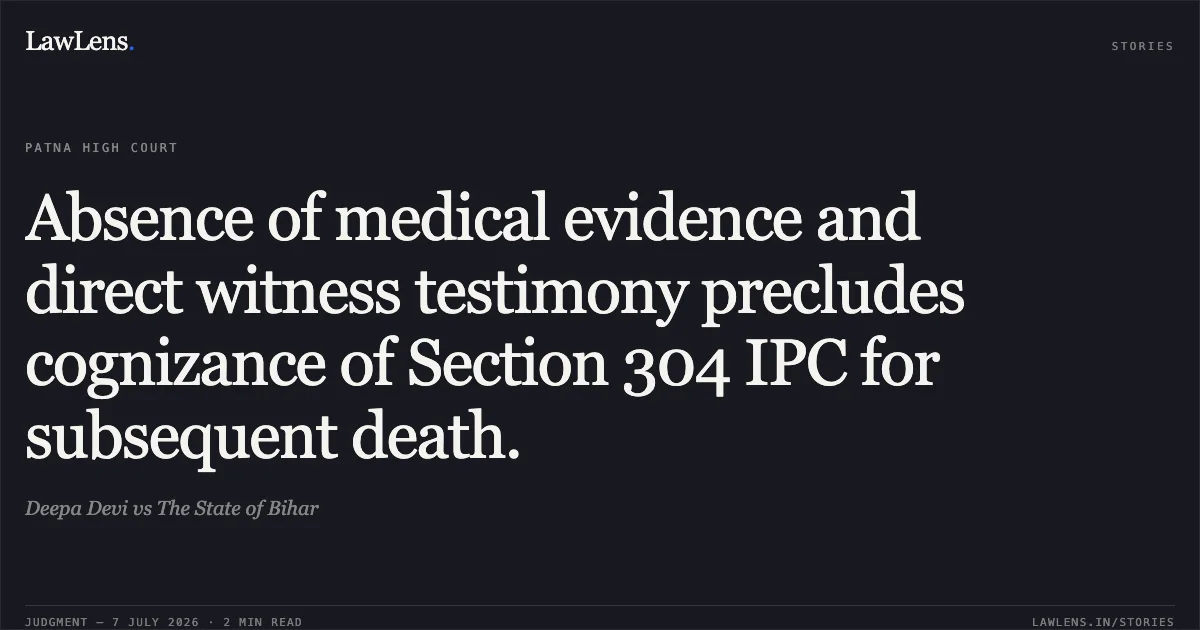
The Court observed that there was a complete lack of medical evidence to link the alleged assault to the death of the mother-in-law. The record indicated that the deceased was not medically examined on the date of the occurrence and showed no visible injuries
Source reference: para. 06Investigation revealed that she was hospitalized a week later in an unconscious state, where doctors diagnosed a "paralytic attack" rather than trauma-induced injuries
Source reference: para. 06Furthermore, witnesses cited in the case diary (paragraphs 48 and 49) admitted they did not actually see the accused assaulting the deceased and only "came to know" about it later
Source reference: para. 04, 06The Court reasoned that mere allegations in a written report or statements by interested family members do not suffice for cognizance under Section 304 IPC when contradicted by medical findings and lack of ocular evidence
Source reference: para. 07Holding
The Court answered the issue in the negative, holding that the trial court rightly desisted from taking cognizance under Section 304 IPC due to the absence of credible material
Finding no infirmity, illegality, or impropriety in the order dated 19.06.2026, the High Court affirmed the lower court's decision
Source reference: para. 07The revision petition was dismissed for lack of merit
Source reference: para. 08Acts & Sections Cited
12 provisions across 1 statute referred to in this judgment. Each provision opens on LawLens.
Original Court PDF
Deepa DevivsThe State of Bihar
Click to open original judgment
Original judgment, available to read, download and summarize on LawLens.in