Facts
The informant (PW 5) alleged that on 02.01.1997, the appellants took him to an orchard where Appellant No. 1 (Anuj Singh) demanded ₹200.
Source reference: para. 3Upon refusal, Appellant No. 2 (Ramesh Kumar) handed a pistol to Anuj Singh, who shot PW 5 in the chest
Source reference: para. 3PW 5 was treated at Jawaharlal Nehru Medical College and Hospital, and a fardbeyan was recorded on 04.01.1997, leading to an FIR
Source reference: paras. 3-4The Trial Court convicted both appellants under Sections 307/34 of the Indian Penal Code (IPC) and Section 27 of the Arms Act, sentencing them to ten years and three years of rigorous imprisonment, respectively.
Source reference: para. 1Issues
1. Whether the trial Court was right in convicting and sentencing the appellants for the offences punishable under Sections 307 r/w 34 of IPC and Section 27 of the Arms Act?
Source reference: para. 9(i)2. Whether the prosecution was able to prove the guilt of the appellants for the said offences beyond reasonable doubt?
Source reference: para. 9(ii)Law Applied
The Court applied Section 307 (Attempt to murder) and Section 34 (Common intention) of the IPC, alongside Section 27 of the Arms Act
Source reference: para. 1It relied on Kalika Tiwari v. State of Bihar regarding the recognition of accused persons by villagers in low light
Source reference: para. 19Satrughan Singh v. State of Bihar, which established that "intention" under Section 307 must be inferred from the nature of the weapon, seat of injury, severity of the assault, and medical evidence
Source reference: para. 26The court also emphasized the necessity of proving the injury through medical testimony to satisfy the ingredients of Section 307 IPC
Source reference: para. 27Reasoning
the incident occurred at 7:30 PM in January (winter darkness), and the informant failed to establish any source of light (e.g., flashlights or lamps) that would allow for the identification of specific acts, such as the passing of the weapon
Source reference: paras. 18, 22there was an unexplained two-day delay in lodging the FIR, which the prosecution failed to justify
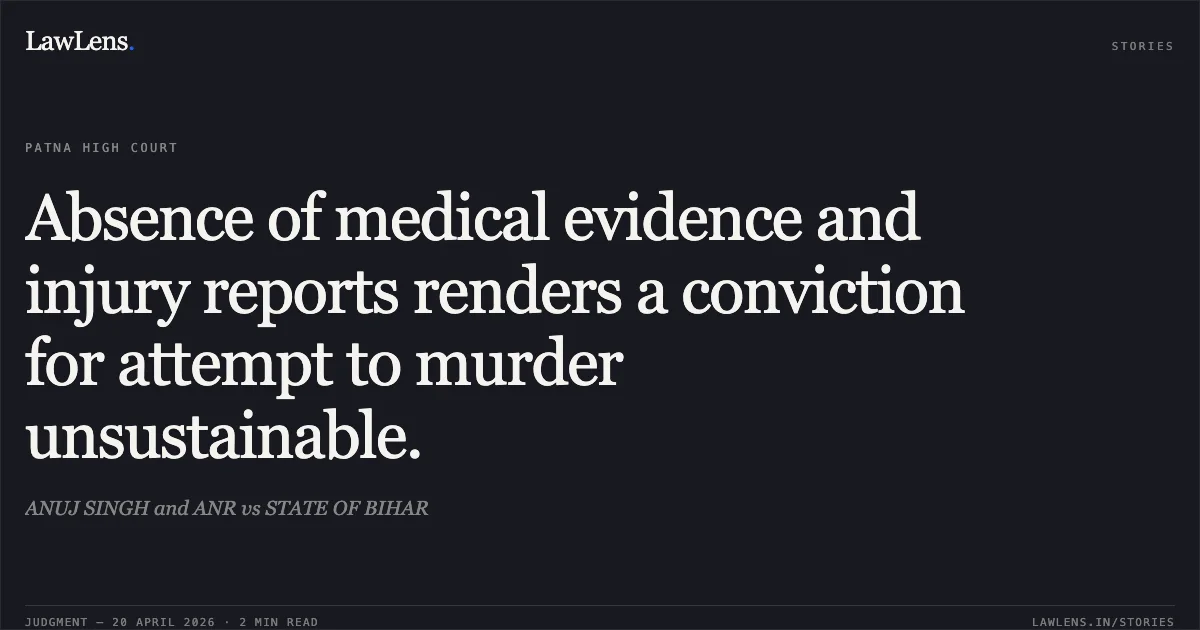
Source reference: paras. 23, 28the medical evidence was non-existent; the prosecution failed to examine the treating physician or exhibit the injury report, making it impossible to determine the nature or severity of the wound
Source reference: paras. 25, 27the Investigating Officer (PW 6) found no bloodstains or incriminating materials at the place of occurrence and failed to recover any weapon
Source reference: para. 28the Court found the testimony of the informant’s relatives (PWs 1, 2, and 4) to be hearsay, as they were not eye-witnesses to the shooting
Source reference: para. 16Holding
The Court held that the prosecution miserably failed to prove the charges beyond reasonable doubt
The Court answered both issues in the negative, finding that the absence of medical evidence, the unexplained delay in the FIR, and the lack of visibility at the scene vitiated the conviction.
Source reference: paras. 33-35The appeal was allowed, the judgment dated 21.07.2004 was set aside, and the appellants were acquitted of all charges
Source reference: paras. 33-35Acts & Sections Cited
5 provisions across 2 statutes referred to in this judgment. Each provision opens on LawLens.
Indian Penal Code, 18604
Arms Act, 19591
Original Court PDF
ANUJ SINGH and ANRvsSTATE OF BIHAR
Click to open original judgment
Original judgment, available to read, download and summarize on LawLens.in