Facts
The appellant, owner of a photography studio, was accused of confining a woman inside his premises on January 19, 2008.
Source reference: paras. 3, 15The prosecution alleged that after sending her father outside, the appellant locked the door, undressed himself, and attempted sexual assault.
Source reference: paras. 3, 15The trial court convicted the appellant under Sections 376/511 (attempted rape) and 342 (wrongful confinement) of the IPC, sentencing him to three years of rigorous imprisonment.
Source reference: para. 2The appellant challenged the conviction in the High Court, citing a lack of medical evidence and a delay in filing the First Information Report (FIR).
Source reference: para. 5Issues
1. Whether the uncorroborated testimony of the victim and her parents was sufficient to sustain a conviction for attempted rape in the absence of medical evidence or independent witnesses
Source reference: paras. 16, 262. Whether the acts attributed to the appellant met the legal threshold for an "attempt to commit rape" under Section 376/511 or if they constituted the lesser offense of outraging modesty under Section 354
Source reference: paras. 26, 28Law Applied
The court examined Section 375 (definition of rape), Section 376 (punishment), and Section 511 (punishment for attempting offenses) of the IPC.
Source reference: para. 13It relied on precedents regarding the "sterling witness" doctrine, specifically Krishan Kumar Malik v. State of Haryana and Rai Sandeep v. State (NCT of Delhi), which establish that while a victim's testimony can be sufficient for conviction, it must be of exceptional quality, consistent, and free from material lacunae.
Source reference: paras. 17-19The court also applied principles from Nand Lal v. State of Chhattisgarh regarding the cautious scrutiny required for "interested witnesses".
Source reference: para. 21Rajesh Patel v. State of Jharkhand concerning the impact of non-examination of medical officers.
Source reference: para. 23Reasoning
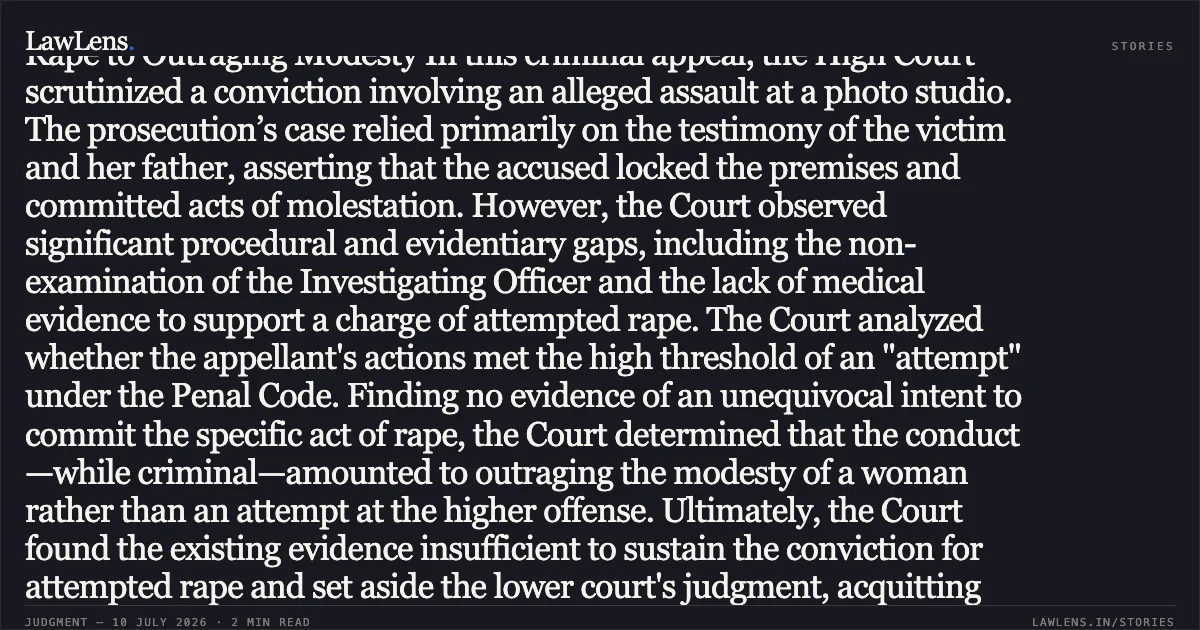
The Court found significant procedural and evidentiary gaps, notably the non-examination of the Investigating Officer and the Medical Officer.
Source reference: para. 16While acknowledging that a victim's testimony need not always be corroborated, the Court observed that the evidence in this case lacked the "sterling quality" required for a conviction of attempted rape, as there was no proof of penetration or an overt act unequivocally aimed at sexual intercourse.
Source reference: paras. 20, 26The Court reasoned that the witnesses (parents) were "interested witnesses" whose testimonies required careful weighing against the lack of physical evidence.
Source reference: paras. 21-22Although the Court excused the 24-hour delay in the FIR due to the police’s initial refusal to register it, it determined that the appellant's actions—confining the victim and physical molestation—aligned with the ingredients of outraging modesty under Section 354 IPC rather than an attempt to rape under Section 376/511.
Source reference: paras. 25, 27-28Holding
The High Court held that the prosecution failed to establish the charge of attempted rape beyond a reasonable doubt.
The Court set aside the judgment of conviction and order of sentence dated October 31, 2013, and November 1, 2013. The appellant was acquitted of all charges, his bail bonds were discharged, and the Court ordered the refund of any fines paid.
Source reference: paras. 30-31Acts & Sections Cited
10 provisions across 2 statutes referred to in this judgment. Each provision opens on LawLens.
Code of Criminal Procedure, 19735
Indian Penal Code, 18605
Original Court PDF
Himanshu Kr. Pathak @ Mithiya PathakvsThe State Of Bihar
Click to open original judgment
Original judgment, available to read, download and summarize on LawLens.in