01Facts
The applicant sought regular bail in Case No. VIII/36/DZU/2024 for alleged offences under Sections 8, 21, 23, 25, 27A and 29 of the Narcotic Drugs and Psychotropic Substances Act, 1985 (“NDPS Act”).
¶ 1The NCB alleged that 1.015 kg of cocaine was recovered from a courier parcel on 11 November 2024 and that, following the investigation, 81.515 kg of cocaine was recovered from co-accused Avadhesh Yadav’s residence on 14 November 2024.
¶ 2The applicant was arrested on 9 December 2024 and remained in custody, apart from 45 days of interim bail. His earlier regular-bail applications had been rejected, and his first application before the High Court had been withdrawn with liberty to approach the trial court.
¶ 6He contended that no contraband was recovered from him or at his instance, the alleged AirTag and mobile phone were not recovered, the electronic evidence was unreliable, there was no nexus between the March 2024 Gujarat visit and the November 2024 recovery, and he was entitled to parity with co-accused Rishi Sachdeva and Lokesh Chopra, who had been granted bail.
¶ 7–1102Issues
i.Whether the applicant satisfied the twin conditions under Section 37(1)(b) of the NDPS Act for grant of regular bail in a case involving commercial quantity of cocaine.
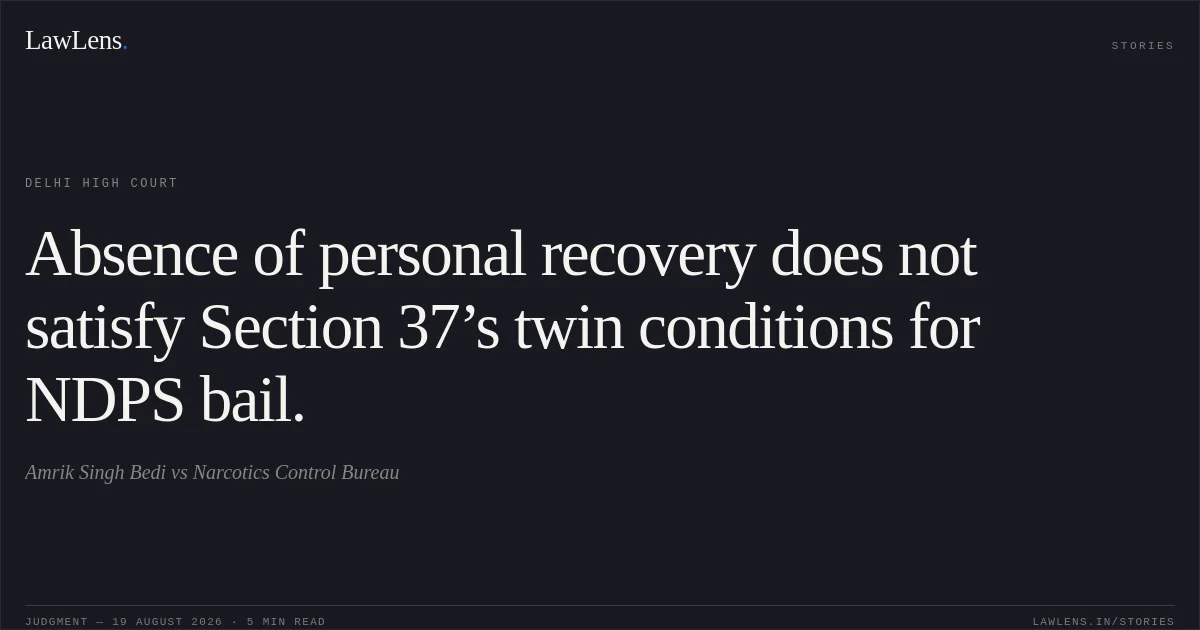
¶ 23–29, 45, 57ii.Whether the absence of personal recovery, possession or transportation of contraband from the applicant excluded the applicability of Section 37 or otherwise entitled him to bail.
¶ 19–22, 42iii.Whether the material relied upon by the prosecution—including co-accused statements, witness statements, CDR and travel records—provided reasonable grounds to believe that the applicant was not guilty of the alleged offences.
¶ 28–45iv.Whether the applicant was entitled to bail on the ground of parity with co-accused persons who had been granted bail.
¶ 46–47v.Whether the applicant’s prolonged custody, completion of investigation and filing of the complaint warranted bail notwithstanding Section 37 of the NDPS Act.
¶ 52–5603Law Applied
The Court applied Section 37(1)(b) of the NDPS Act, under which bail in a case involving commercial quantity may be granted only where the Court has reasonable grounds for believing that the accused is not guilty and is unlikely to commit an offence while on bail, in addition to the ordinary bail considerations.
¶ 23–26“Reasonable grounds” require credible and plausible material amounting to more than a mere prima facie case: State of M.P. v. Kajad, (2001) 7 SCC 673; State of Kerala v. Rajesh, (2020) 12 SCC 122; and Union of India v. Md. Nawaz Khan, (2021) 10 SCC 100.
¶ 24–26The absence of personal recovery does not by itself defeat the operation of Section 37 where the prosecution alleges conspiracy, abetment or facilitation under Section 29: State of Punjab v. Balraj Singh @ Billa, 2026 SCC OnLine SC 1058; Harpreet Singh Talwar alias Kabir Talwar v. State of Gujarat, 2025 SCC OnLine SC 1103; and Md. Nawaz Khan.
¶ 19–22A statement under Section 67 of the NDPS Act cannot be relied upon as a confessional statement against the accused, even at the bail stage, under Tofan Singh v. State of Tamil Nadu, (2021) 4 SCC 1; however, independent circumstantial and electronic material may still be considered.
¶ 35–38Parity requires a comparative assessment of the role and material against each accused and cannot be applied mechanically: Ramesh Bhavan Rathod v. Vishanbhai Hirabhai Makwana, (2021) 6 SCC 230.
¶ 47Custody period, filing of the complaint and completion of investigation do not, by themselves, override Section 37: Narcotics Control Bureau v. Mohit Aggarwal, (2022) 18 SCC 374.
¶ 53–56Provisions in the judgment · 7 · Linked ones open on LawLens
Narcotic Drugs and Psychotropic Substances Act, 1985 Section 8Section 21Section 23Section 25Section 29Section 37Section 67
04Reasoning
The Court held that the absence of recovery from the applicant did not exclude Section 37 because the prosecution attributed to him a conspiratorial and facilitating role under Section 29.
¶ 19–22, 42Disregarding the applicant’s alleged Section 67 statement as a confessional statement, the Court considered the remaining material cumulatively.
¶ 35–38The statement of co-accused Rishi Sachdeva was supported, at least at the bail stage, by the factory manager’s statement, Gurbani Talwar’s account of the Gujarat visit, CDR and tower-location data, flight records, and communications concerning the factory and co-accused persons.
¶ 28–34, 39–41The Court also found a prima facie continuity between the applicant’s alleged identification of the consignment at Mehsana, its subsequent collection and movement by co-accused persons, and the later recovery of cocaine, though it expressly refrained from conclusively determining identity of the consignment.
¶ 43–44The applicant’s challenge to the SIM activation date, witness credibility, non-recovery of the AirTag and absence of a direct recovery raised matters for trial but did not negate the cumulative prosecution material at the bail stage.
¶ 30–34, 39–41Parity was rejected because the material against the applicant included the factory-manager statement, the alleged factory visit, Gurbani Talwar’s statement and corroborative electronic and travel evidence, and therefore his role was not comparable on the available record to that of the co-accused.
¶ 46–47Finally, the Court held that the commercial quantity, alleged international and organised trafficking network, and absence of material showing that the applicant was unlikely to repeat such conduct meant that neither of the twin conditions under Section 37 was satisfied.
¶ 48–5605Holding
The High Court of Delhi dismissed the applicant’s second regular-bail application.
¶ 51, 57, 59It held that the applicant failed to establish reasonable grounds for believing that he was not guilty and also failed to satisfy the requirement that he was unlikely to commit an offence while on bail under Section 37(1)(b) of the NDPS Act.
¶ 51, 57, 59The Court further held that absence of personal recovery, prolonged custody, completion of investigation, filing of the complaint and claimed parity did not justify bail in the circumstances.
The observations were expressly confined to the bail determination and were not to influence the trial on merits.
¶ 58Original Court PDF
Amrik Singh BedivsNarcotics Control Bureau
Click to open original judgment
Original judgment, available to read, download and summarize on LawLens.in