Facts
On August 22, 2003, one Muddappa sustained three fractures (femur, tibia, and fibula) in a motor vehicle accident involving an autorickshaw and a Tata Sumo.
Source reference: p. 3, 11He died 387 days later, on September 14, 2004.
Source reference: p. 10His legal representatives (claimants) filed a petition under the Motor Vehicles Act claiming ₹15,00,000 in compensation, alleging the death was a direct result of the accidental injuries.
Source reference: p. 3The Motor Accident Claims Tribunal (MACT) dismissed the claim, finding no evidence of a nexus between the injuries and the death.
Source reference: p. 3, 7The appellants challenged this dismissal, relying on the testimony of PW3 (Doctor) who attributed death to septicemia and respiratory failure resulting from the accident.
Source reference: p. 6Issues
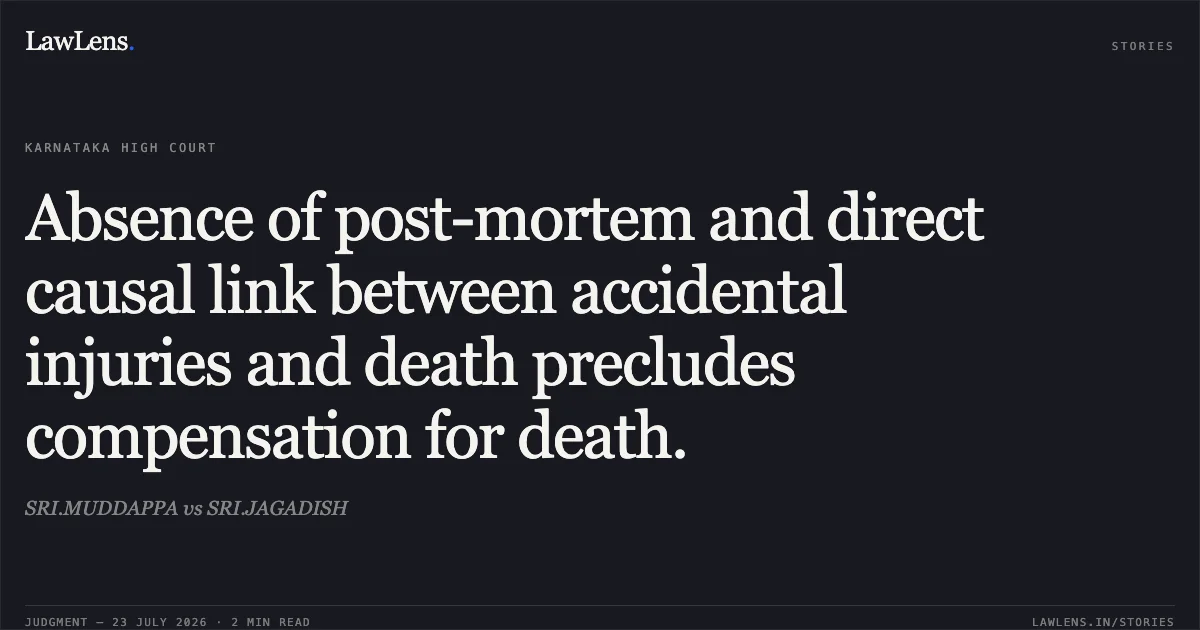
1. Whether there exists a direct causal link (nexus) between the accidental injuries sustained on 22.08.2003 and the death of the injured person on 14.09.2004.
Source reference: p. 102. Whether the claimants are entitled to compensation for death in the absence of a post-mortem report or a charge sheet under Section 304-A of the IPC.
Source reference: p. 10Law Applied
Section 173(1) of the Motor Vehicles Act, 1988, regarding appeals against awards.
Source reference: p. 3To claim compensation for death, a "clear causal link" or "nexus" between the accident and the demise must be established, as held in Haseena and Ors v. United India Insurance Co. Ltd. (AIR 2025 SCC 4071), where mere proximity of time is insufficient.
Source reference: p. 7Without continuous treatment records for a prolonged period, a nexus cannot be presumed, as established in Arun Kumar @ Kumar v. V.K. Kumar (MFA 6051/2014).
Source reference: p. 8Reasoning
The Court observed that the deceased died more than a year after the accident.
Source reference: p. 10It scrutinized the evidence of PW3 (Doctor) and found it "suspicious" because the medical certificate (Ex.P2) was not on a letterhead, and the doctor admitted to treating the deceased for general fever and respiratory distress as an outpatient rather than for trauma-related complications.
Source reference: p. 6-7, 10Significantly, no post-mortem was conducted to scientifically determine the cause of death, and the police did not file a charge sheet for causing death by negligence (Section 304-A IPC).
Source reference: p. 10The Court reasoned that while the injuries were severe—potentially leading to amputation—there was no medical or documentary proof that they led to septicemia or cardiac arrest a year later.
Source reference: p. 11Consequently, the "preponderance of probabilities" did not favor the claimants.
Source reference: p. 7Holding
The Court answered the issues in the negative, holding that the legal representatives failed to establish a nexus between the accidental injuries and the subsequent death.
The High Court upheld the Tribunal’s decision, stating there was no reason to interfere with the dismissal of the claim petition; the appeal was dismissed.
Source reference: p. 11Acts & Sections Cited
1 provisions across 1 statute referred to in this judgment. Each provision opens on LawLens.
Motor Vehicles Act, 19881
Original Court PDF
SRI.MUDDAPPAvsSRI.JAGADISH
Click to open original judgment
Original judgment, available to read, download and summarize on LawLens.in