Facts
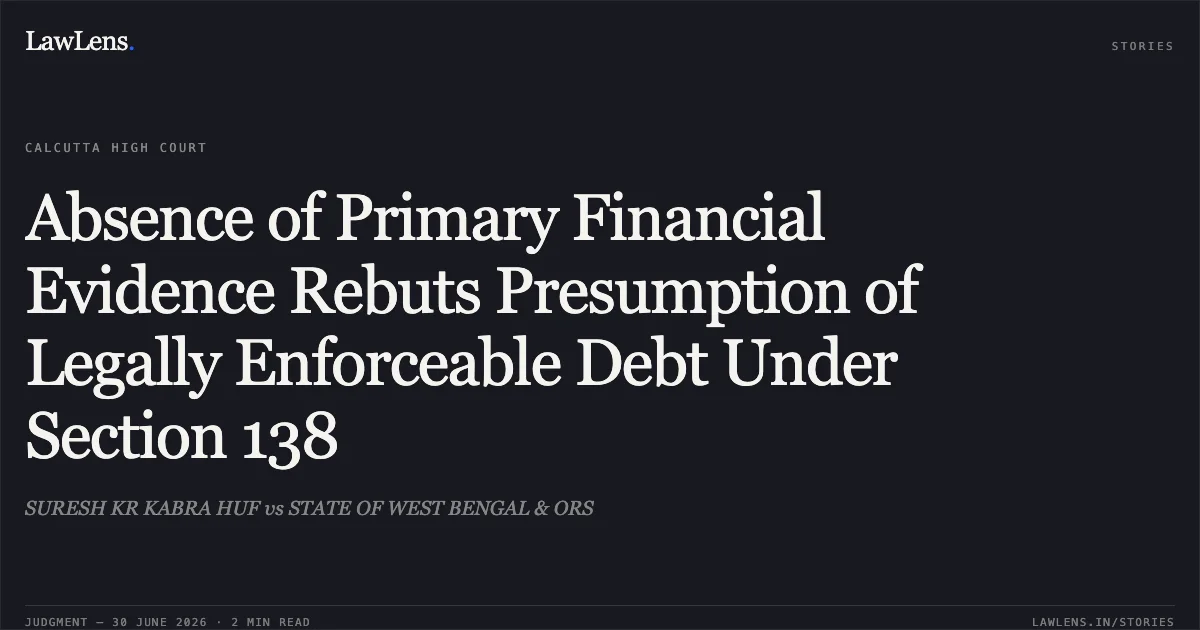
The appellant, a Chartered Accountant, alleged that he advanced a loan to respondent no. 2 on "absolute good faith," for which the respondent issued a cheque for Rs. 4,63,922.52 dated December 31, 2009.
Source reference: paras 2, 10The cheque was dishonored due to "insufficiency of funds" via a return memo dated May 3, 2010.
Source reference: para 2Despite a formal demand notice acknowledged on May 17, 2010, the respondent failed to pay, leading to a complaint under Section 138 of the Negotiable Instruments (N.I.) Act.
Source reference: para 3The Trial Court acquitted the respondent, primarily on the grounds that the appellant lacked a money-lending license under the Bengal Money Lenders Act, 1940.
Source reference: para 4The appellant challenged this acquittal, arguing the Trial Court ignored the statutory presumption under Section 139 of the N.I. Act.
Source reference: para 4Issues
1. Whether the absence of a money-lending license under the Bengal Money Lenders Act, 1940, renders a debt legally unenforceable for the purpose of a prosecution under Section 138 of the N.I. Act.
Source reference: paras 4, 82. Whether the respondent successfully rebutted the statutory presumption under Section 139 of the N.I. Act regarding the existence of a legally enforceable debt.
Source reference: paras 12, 14Law Applied
Section 138 of the N.I. Act regarding the dishonor of cheques for the discharge of a "legally enforceable debt".
Source reference: para 19Section 139, which mandates a rebuttable presumption in favor of the holder.
Source reference: para 20Bengal Money Lenders Act is irrelevant to the adjudication of Section 138 offenses as established in Jupiter Brokerage Services Limited v. Ektara Exports Pvt. Ltd. and Samarendra Nath Das v. Supriyo Moitra.
Source reference: paras 8, 16Principles from Bir Singh v. Mukesh Kumar and Hiten P. Dalal v. Bratindranath Banerjee regarding how signatures on blank cheques attract Section 139 and how prisms are displaced by a "preponderance of probabilities".
Source reference: paras 6, 17, 19Reasoning
The High Court agreed that the Trial Court's reliance on the Bengal Money Lenders Act was a "misconception of law," as a money-lending license is not a prerequisite for Section 138 proceedings.
Source reference: paras 4, 8The High Court observed that the appellant (a professional accountant) failed to provide basic details of the transaction, such as the loan date, interest rate, or any documentary proof/bank statements to corroborate the movement of capital.
Source reference: paras 10, 13The respondent established a "highly probable" defense: that he had a professional relationship with the appellant and had surrendered blank signed cheques for routine book-entry purposes.
Source reference: paras 11, 14The court reasoned that the appellant’s inability to prove the underlying transaction on the witness stand "shattered the baseline probability" of the debt, thereby shifting the onus back to the complainant and successfully rebutting the statutory presumption.
Source reference: paras 14, 17Holding
The court answered the first issue by holding that the lack of a money-lending license does not bar Section 138 proceedings.
On the second issue, it held that the respondent successfully rebutted the presumption of debt through the appellant's own lack of financial evidence.
Source reference: paras 14, 21The High Court affirmed the judgment of acquittal, ruling that the Trial Court's ultimate conclusion was a "plausible, well-reasoned" view and that there was no perversity warranting interference. The appeal was dismissed.
Source reference: paras 18, 21, 22Acts & Sections Cited
2 provisions across 1 statute referred to in this judgment. Each provision opens on LawLens.
Negotiable Instruments Act, 18812
Original Court PDF
SURESH KR KABRA HUFvsSTATE OF WEST BENGAL & ORS
Click to open original judgment
Original judgment, available to read, download and summarize on LawLens.in